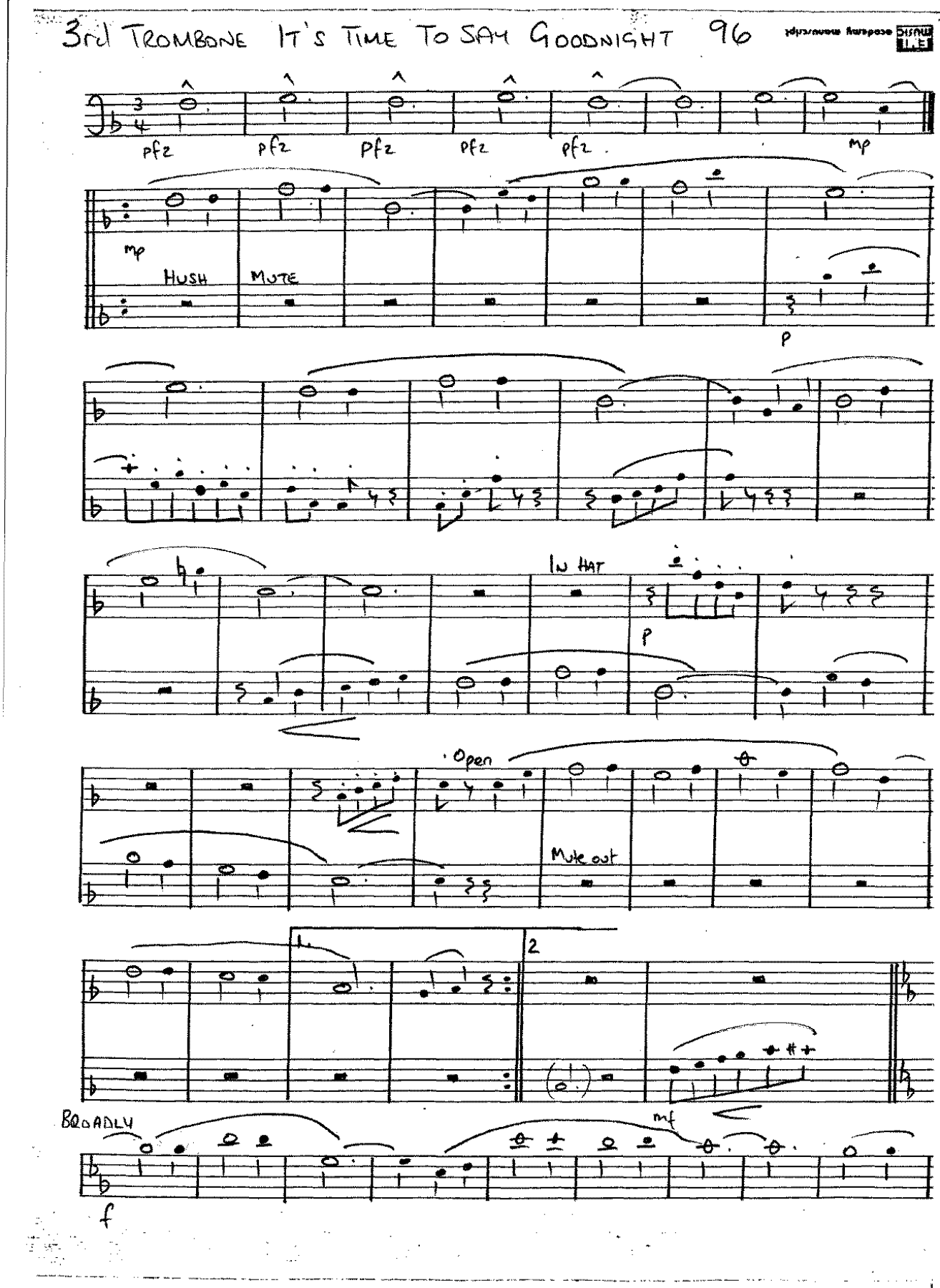
It's Time To Say Goodnight (J.Lally)
Composed by Jack Lally
Arranged by J. Lally
- Ensemble: Big Band Dance
- Style: Waltz
- Pages: 33
- Instruments (17): 1st Eb Alto Saxophone, 2nd Eb Alto Saxophone, Eb Baritone Saxophone, Bass, Drums, Piano Conductor, Guitar, 1st Bb Tenor Saxophone, 2nd Bb Tenor Saxophone, 1st Trombone, 2nd Trombone, 3rd Trombone, 4th Trombone, 1st Bb Trumpet, 2nd Bb Trumpet, 3rd Bb Trumpet, 4th Trumpet
- Difficulty: easy
- Content: Individual Parts
- Format: PDF Download (Instant)
- Price: $24.99
"It's Time To Say Goodnight," originally penned by Jack Lally, emerges from an era when popular song and dance music were intertwined, likely dating back to the mid-20th century, though the specific composition date by Jack Lally is not widely documented. The title itself evokes the sentimental ballads and closing themes common in the big band and dance orchestra repertoire of the 1930s and 40s, a period defined by its structured yet energetic arrangements designed for social dancing. While not a jazz standard in the improvisational sense, its thematic resonance aligns with the "sweet jazz" and dance band traditions that were foundational to the big band sound, where melody and mood often took precedence. This arrangement transforms the contemplative essence of the original into a sophisticated jazz waltz, maintaining a medium-slow tempo feel in 3/4 time. Unlike typical 4/4 swing, the jazz waltz presents a unique rhythmic landscape, emphasizing a flowing, often lilting pulse that can evoke both elegance and a gentle forward momentum. The mood is one of tender reflection, perhaps a nostalgic farewell or a quiet, intimate moment. The harmonic language is rich, employing extended chords and subtle voice leading that add depth and color without sacrificing the melody's inherent simplicity. The arrangement is crafted to elicit a warm, inviting energy, making it ideal for moments requiring musical grace and emotional resonance. J. Lally's arranging style for big band dance music is characterized by a meticulous attention to sectional voicing and dynamic contour. In this particular setting, the arrangement prominently features the 3rd and 4th trombones, weaving their lines with lyrical precision. Expect lush, close-voiced harmonies within the trombone section, creating a cohesive and expressive sound. While J. Lally's work often includes intricate soli sections, here the focus is on the blend and melodic interplay between these two brass voices, supported by the full ensemble. There are no extended improvisational solos, ensuring the piece remains a cohesive ensemble statement. The primary melody is carried alternately by the lead trombone and occasionally by a combined brass or reed section, allowing for varied textures throughout the piece. Performance of this arrangement is rewarding for its emphasis on musicality and blend. The main technical challenge lies in achieving a unified, legato sound within the trombone parts, particularly in maintaining intonation and balance through the richer harmonic passages. The medium-slow waltz tempo requires a steady, unhurried pulse, allowing the melodic phrases to breathe. This arrangement is well-suited for college-level jazz ensembles, community big bands, and professional dance orchestras seeking a refined, lyrical piece that highlights the expressive capabilities of the trombone section and the full ensemble's ability to create a beautiful, cohesive sound. Conductors should emphasize a consistent, yet flexible, medium-slow waltz feel, encouraging musicians to lean into the "one" of each measure while maintaining a fluid triplet subdivision in the rhythm section. The 3rd and 4th trombones, carrying significant melodic and harmonic weight, must focus on precise intonation and blend, particularly in sustained chords and lyrical lines. Encourage a warm, resonant tone quality throughout the brass. Dynamic contrasts are subtle but crucial; guide the ensemble to shape phrases with gentle crescendos and decrescendos to enhance the emotional arc. There are no special mute requirements, but a consistent approach to articulation—predominantly legato with occasional gentle accents—will define the piece's character. Rehearsal time should be dedicated to balancing the trombone section against the rest of the ensemble, ensuring their lines are present without overpowering the overall texture. Q: What instruments and parts are included in this arrangement? A: This arrangement is for a big band dance ensemble, specifically featuring detailed parts for Trombone 3 and Trombone 4, with 33 pages of score and parts for the full big band instrumentation. Q: What is the difficulty level of "It's Time To Say Goodnight (J.Lally)"? A: This arrangement is considered appropriate for intermediate to advanced ensembles, including college-level jazz bands, community big bands, and professional dance orchestras, due to its nuanced harmonic language and demands for precise ensemble blend and intonation. Q: What is the musical style and historical context of this piece? A: This is a jazz waltz arrangement of an original composition by Jack Lally, evoking the sentimental and elegant dance music traditions of the mid-20th century big band era. Q: What makes this arrangement unique compared to other big band pieces? A: J. Lally's arrangement stands out for its sophisticated jazz waltz treatment of a lyrical melody, with a particular focus on the expressive capabilities and intricate voicings of the 3rd and 4th trombones within the full big band setting. Q: What is the typical performance duration and tempo for this arrangement? A: The arrangement is designed for a medium-slow waltz tempo, which allows for a contemplative and lyrical performance, with a typical duration of approximately 3-4 minutes depending on interpretation.
Questions and answers
- What is included in the It's Time To Say Goodnight (J.Lally) PDF?
- The verified current file contains a conductor score and individual parts across 33 pages.
- How many instruments or parts are listed for It's Time To Say Goodnight (J.Lally)?
- The verified instrumentation list contains 17 entries for this Big Band Dance arrangement.
- Who is credited for It's Time To Say Goodnight (J.Lally)?
- Composer: Jack Lally. Arranger: J. Lally.
- What difficulty is listed for It's Time To Say Goodnight (J.Lally)?
- The verified difficulty level is easy.
- What style is listed for It's Time To Say Goodnight (J.Lally)?
- The catalog lists the style as Waltz.
- Can I preview It's Time To Say Goodnight (J.Lally) before buying?
- Yes. The product page provides a preview generated from the current PDF file.
- How is It's Time To Say Goodnight (J.Lally) delivered?
- After successful payment, the digital PDF is made available for download. The displayed price is $24.99.
Musicians Also Search For
It's Time To Say Goodnight J. Lally PDF • It's Time To Say Goodnight J. Lally sheet music • It's Time To Say Goodnight arranged by J. Lally • J. Lally big band dance charts • J. Lally jazz arrangements PDF • It's Time To Say Goodnight Jack Lally sheet music • It's Time To Say Goodnight Jack Lally big band dance arrangements • Jack Lally big band dance charts • It's Time To Say Goodnight big band dance arrangements • It's Time To Say Goodnight big band dance PDF download • It's Time To Say Goodnight jazz sheet music • big band dance sheet music download • It's Time To Say Goodnight conductor score PDF • It's Time To Say Goodnight individual parts download • It's Time To Say Goodnight sheet music PDF • It's Time To Say Goodnight Waltz charts • Waltz big band dance arrangements • buy It's Time To Say Goodnight sheet music • download It's Time To Say Goodnight PDF • It's Time To Say Goodnight jazz charts • best J. Lally big band dance arrangements • Jack Lally arranged by J. Lally • It's Time To Say Goodnight printable sheet music • big band dance repertoire PDF