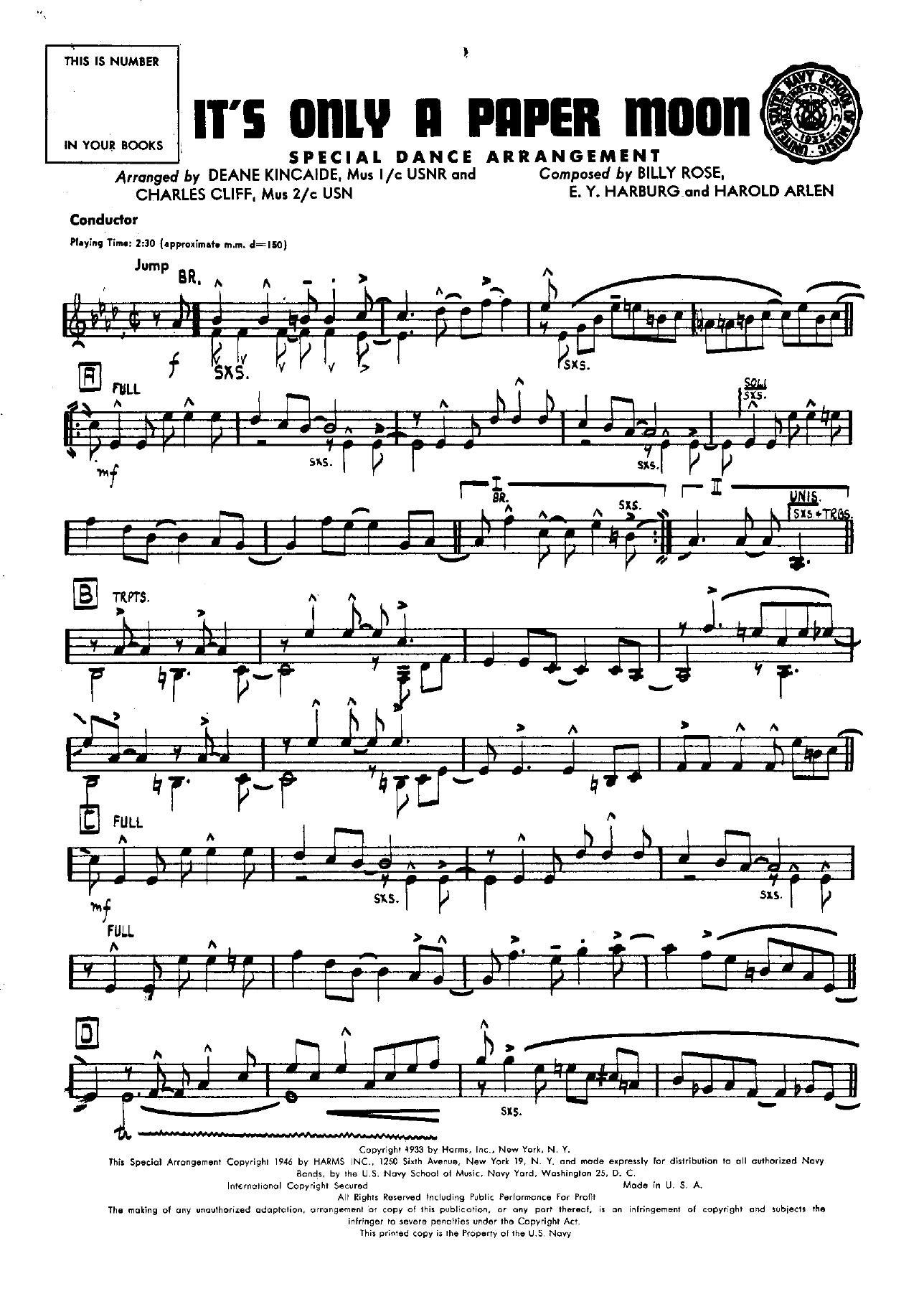
It's Only A Paper Moon (D.Kincaide) sheet music preview

It's Only A Paper Moon (D.Kincaide)

Composed by Harold Arlen

Arranged by D.Kincaide

  • Ensemble: Big Band
  • Style: Jazz Standard
  • Pages: 42
  • Instruments (20): Conductor, 1st Eb Alto Saxophone, 2nd Eb Alto Saxophone, 1st Bb Tenor Saxophone, 2nd Bb Tenor Saxophone, 5th Eb Baritone Saxophone, 1st Bb Trumpet, 2nd Bb Trumpet, 3rd Bb Trumpet, 4th Bb Trumpet, 1st Trombone, 2nd Trombone, 3rd Trombone, 4th Trombone, Guitar, Piano, Bass, Drums, Horn in F, 6th Eb Alto Saxophone
  • Difficulty: medium
  • Content: Individual Parts
  • Format: PDF Download (Instant)
  • Price: $24.99

"It's Only A Paper Moon," a timeless jazz standard, was originally composed by Harold Arlen with lyrics by Yip Harburg and Billy Rose. First introduced in the unsuccessful 1932 Broadway play *The Great Magoo* under the title "If You Believed in Me," it gained its enduring popularity and current title when featured in the 1933 film *Take a Chance*. This era, the early 1930s, marked a pivotal period in American popular music, bridging the Tin Pan Alley tradition with the burgeoning swing era. The song's simple yet poignant lyrics, combined with Arlen's memorable melody, resonated deeply, especially during the challenging times of the Great Depression and later, World War II. Its status as a jazz standard was cemented through iconic recordings by artists like Nat "King" Cole, Ella Fitzgerald, and Benny Goodman in the mid-1940s, each bringing their unique interpretation to its enduring charm. The tune's classic 32-bar AABA form and harmonic structure, often featuring an ascending bass line and ii-V-I progressions, make it a quintessential example of the Great American Songbook, providing a fertile ground for improvisation and sophisticated arranging. D.Kincaide's big band arrangement of "It's Only A Paper Moon" captures the essence of a medium swing feel, delivering a bright and engaging performance experience. While the original song has been recorded in various keys, including B♭ major and E♭ major, and tempos ranging from 114 to 135 BPM, Kincaide's treatment likely leans into a comfortable, danceable swing tempo, typically around 120-130 BPM, in a key that optimizes the ensemble's voicings. The mood is generally upbeat and optimistic, reflecting the song's underlying message of hope and belief in love's transformative power, even amidst illusion. The arrangement evokes a classic big band sound, reminiscent of the swing era's heyday, with a focus on clean lines and dynamic contrast. D.Kincaide, known for his significant contributions as an arranger for bands like Bob Crosby, Woody Herman, and Tommy Dorsey, brings a distinctive touch to this standard. His arrangements are often characterized by their idiomatic writing for each section, ensuring that the brass and reed sections are utilized effectively, both individually and in combination. Expect rich, full-bodied saxophone soli sections that highlight the ensemble's blend, punctuated by powerful brass figures. Kincaide's signature techniques often include carefully crafted shout choruses that build excitement and dynamic intensity, and his harmonic palette, while rooted in the swing tradition, might feature extended harmonies that add color without sacrificing accessibility. The arrangement likely features the melody passed between sections, perhaps starting with a lead trumpet or alto saxophone, then moving to a full saxophone section soli, and eventually culminating in a powerful tutti statement. There are opportunities for featured solos, typically for tenor saxophone or trumpet, allowing improvisers to explore the song's classic chord changes. Technical challenges would include precise articulation, dynamic control across the full dynamic range, and maintaining a consistent, driving swing feel. The rewarding aspect lies in achieving a cohesive, energetic performance that honors the song's legacy while showcasing the band's collective musicianship. This arrangement is ideally suited for college, community, and advanced high school jazz ensembles. Its well-crafted voicings and clear structure provide an excellent learning opportunity for developing musicians to master swing articulation, ensemble blend, and dynamic shaping within a classic big band context. Professional groups will appreciate its authentic swing feel and the solid foundation it provides for a vibrant performance. The arrangement's ability to sound full and engaging, even with slightly reduced instrumentation, makes it versatile for various ensemble settings. This D.Kincaide arrangement thrives on a consistent, medium-up swing feel, ideally around 128-132 BPM, emphasizing a relaxed yet driving rhythmic pulse. Conductors should encourage a clear, crisp articulation from all sections, particularly in the brass, ensuring short, detached eighth notes in swing passages. Special attention should be paid to dynamic contrasts; the arrangement likely features nuanced builds and releases, requiring the band to respond immediately to changes in intensity. Rehearsal tips include isolating soli sections for blend and intonation, especially in the saxophone section, and carefully balancing brass figures against the melodic lines. Trumpet players should focus on clean attacks and releases, while trombones should aim for a warm, blended sound. Soloists, typically a tenor saxophone or trumpet, should be encouraged to develop their improvisations over the provided chord changes, maintaining the song's cheerful character. No unusual special techniques (like plunger mutes or doits) are explicitly required, allowing the focus to remain on fundamental swing performance practices. **Q: What instruments/parts are included in this arrangement?** A: This big band arrangement includes a full conductor score and individual parts for standard big band instrumentation, typically encompassing five saxophones (2 alto, 2 tenor, 1 baritone), four trumpets, four trombones, and a rhythm section (piano, bass, drums, and guitar). **Q: What is the difficulty level of this arrangement?** A: This arrangement is rated as medium-advanced, making it appropriate for college, community, and advanced high school jazz ensembles. It requires solid musicianship, good ensemble playing, and the ability to navigate classic swing rhythms and harmonies. **Q: What musical style does "It's Only A Paper Moon" represent, and what is its historical context?** A: "It's Only A Paper Moon" is a quintessential jazz standard from the swing era, originally composed by Harold Arlen in 1932. It gained widespread popularity in the 1940s through recordings by jazz legends, embodying the optimistic and romantic spirit of the Great American Songbook. **Q: What makes D.Kincaide's arrangement of "It's Only A Paper Moon" unique?** A: D.Kincaide's arrangement is distinguished by its authentic swing-era voicings, dynamic soli sections for the saxophones, and powerful shout choruses that build excitement. His idiomatic writing ensures each section shines, providing a classic yet fresh interpretation of this beloved standard. **Q: What is the typical performance duration and tempo for this arrangement?** A: The typical performance duration for this arrangement is approximately 3-4 minutes, depending on the length of improvised solos. It is designed for a medium-up swing tempo, generally performed around 128-132 beats per minute, to capture its energetic and buoyant character.

Questions and answers

What is included in the It's Only A Paper Moon (D.Kincaide) PDF?
The verified current file contains a conductor score and individual parts across 42 pages.
How many instruments or parts are listed for It's Only A Paper Moon (D.Kincaide)?
The verified instrumentation list contains 20 entries for this Big Band arrangement.
Who is credited for It's Only A Paper Moon (D.Kincaide)?
Composer: Harold Arlen. Arranger: D.Kincaide.
What difficulty is listed for It's Only A Paper Moon (D.Kincaide)?
The verified difficulty level is medium.
What style is listed for It's Only A Paper Moon (D.Kincaide)?
The catalog lists the style as Jazz Standard.
Can I preview It's Only A Paper Moon (D.Kincaide) before buying?
Yes. The product page provides a preview generated from the current PDF file.
How is It's Only A Paper Moon (D.Kincaide) delivered?
After successful payment, the digital PDF is made available for download. The displayed price is $24.99.

Musicians Also Search For

It's Only A Paper Moon D.Kincaide PDFIt's Only A Paper Moon D.Kincaide sheet musicIt's Only A Paper Moon arranged by D.KincaideD.Kincaide big band chartsD.Kincaide jazz arrangements PDFIt's Only A Paper Moon Harold Arlen sheet musicIt's Only A Paper Moon Harold Arlen big band arrangementsHarold Arlen big band chartsIt's Only A Paper Moon big band arrangementsIt's Only A Paper Moon big band PDF downloadIt's Only A Paper Moon jazz sheet musicbig band sheet music downloadIt's Only A Paper Moon conductor score PDFIt's Only A Paper Moon individual parts downloadIt's Only A Paper Moon sheet music PDFIt's Only A Paper Moon Jazz Standard chartsJazz Standard big band arrangementsbuy It's Only A Paper Moon sheet musicdownload It's Only A Paper Moon PDFIt's Only A Paper Moon jazz chartsbest D.Kincaide big band arrangementsHarold Arlen arranged by D.KincaideIt's Only A Paper Moon printable sheet musicbig band repertoire PDF

All arrangements by D.Kincaide All Harold Arlen sheet music