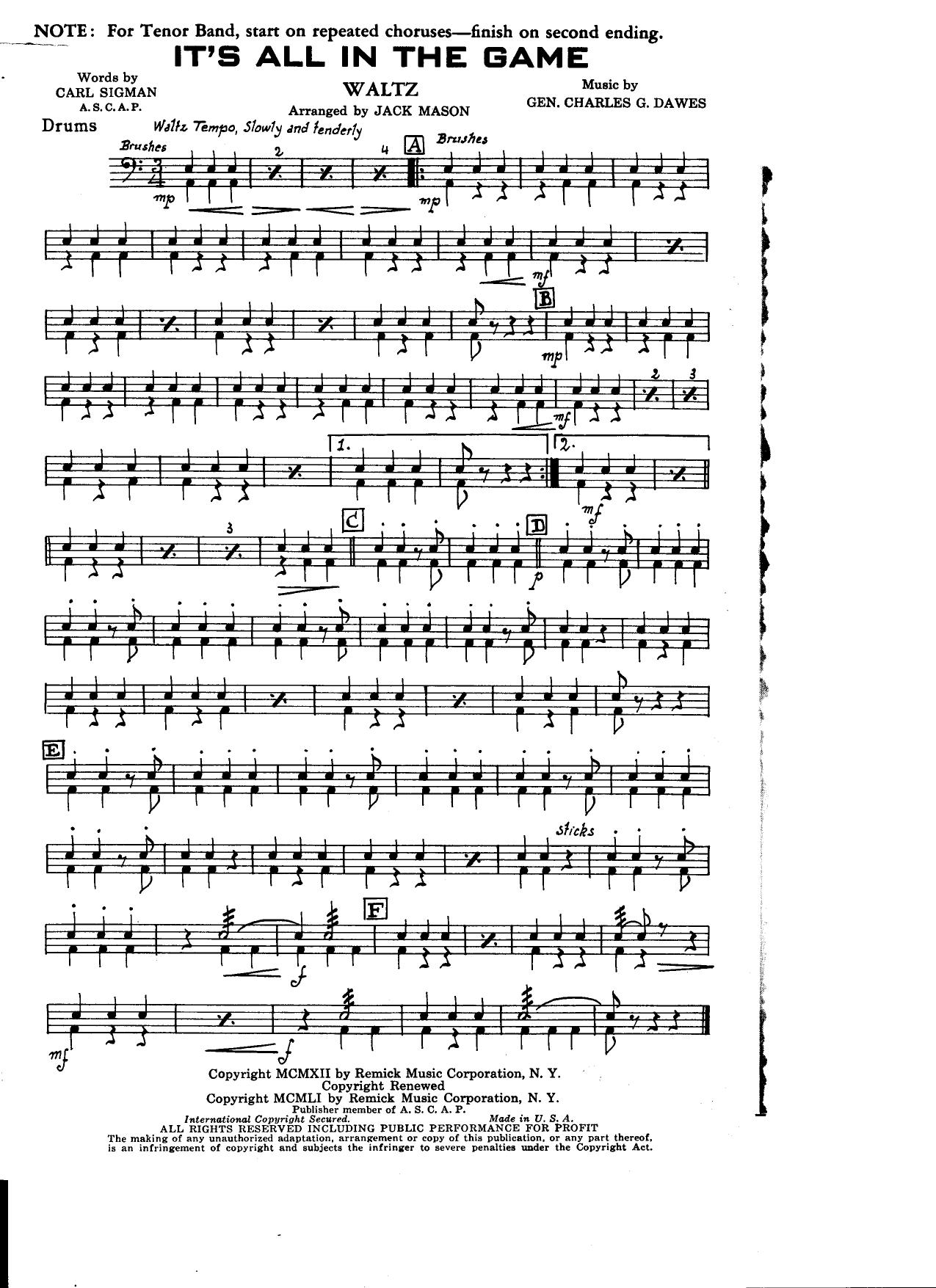
It's All In The Game (J.Mason)
Composed by Carl Sigman
Arranged by Jack Mason
- Ensemble: Big Band
- Pages: 27
- Instruments (18): Drums, Bass, Guitar, Piano, Violins, 1st Sax. Eb Alto, 2nd Sax. Bb Tenor, 3rd Sax. Eb Alto, 4th Sax. Bb Tenor, 5th Sax. Eb Baritone, 1st Sax. Bb Tenor (Tenor Band), 3rd Sax. Bb Tenor (Tenor Band), 1st Trombone, 2nd Trombone, 3rd Trombone, 1st Trumpet in Bb, 2nd Trumpet in Bb, 3rd Trumpet in Bb
- Difficulty: medium
- Content: Individual Parts
- Format: PDF Download (Instant)
- Price: $24.99
Carl Sigman and Charles Dawes’s timeless classic "It’s All In The Game"—built upon a 1912 melody originally titled "Melody in A Major" by Vice President Charles G. Dawes—found its definitive mid-century identity when Tommy Edwards took it to the top of the pop and R&B charts in 1958. This quintessential American popular song bridges the late-romantic parlor tradition with the sophisticated harmonic sensibilities of the post-war jazz and vocal era. Its languid, melancholic melody and bittersweet lyrical themes of romantic perseverance have made it a malleable vehicle for jazz interpreters ranging from Nat King Cole to Keith Jarrett, seamlessly adapting to both intimate ballad settings and lush orchestral jazz treatments. Jack Mason’s sophisticated big band interpretation transforms this vocal standard into a sweeping, textural masterpiece tailored for a standard 18-piece jazz orchestra, augmented by lush violin parts that evoke the cinematic string-laden recordings of the late 1950s. Setting a relaxed, expressive medium-ballad tempo with a subtle, flowing swing feel, the arrangement opens with a delicate chordal introduction in the piano and guitar before the ensemble enters with warm, harmonically rich voicings. The mood balances nostalgic introspection with soaring, cinematic grandeur, utilizing extended dominant sonorities and gorgeous suspension resolutions that evoke the classic West Coast cool jazz school while maintaining a deeply emotional, swinging pulse throughout its 27-page score. Mason expertly distributes melodic responsibility across the ensemble, ensuring vibrant color contrast between sections. The flugelhorns and muted trumpets frequently carry the initial thematic statements, answered by rich, block-voiced sax solis that showcase Mason’s signature penchant for lush, contrapuntal inner lines. A tastefully structured improvised solo section provides a featured soloist—ideally alto saxophone or guitar—space to stretch out over accessible, jazz-standard changes before building toward a dynamic, emotionally resonant shout chorus. This climax swells organically without sacrificing the inherent intimacy of the tune, driven by a subtle brushwork foundation from the drum set and a walking bassline that anchors the rich harmonic superstructure. Advanced high school ensembles with strong section players, as well as collegiate and professional community big bands, will find this arrangement an ideal vehicle for developing lyrical phrasing, dynamic control, and ensemble blend. Because the technical demands prioritize intonation, breath support, and stylistic cohesion over sheer velocity, bands can focus heavily on micro-dynamics and rubato-esque phrasing within the tempo. It serves as an exceptional change-of-pace ballad or feature chart for a mid-concert program, offering audiences a deeply moving, highly polished slice of mid-century jazz orchestration. Conductors should approach this chart with a primary focus on lyrical continuity and seamless dynamic contouring. The tempo must remain steady yet flexible, avoiding a rigid click-track feel; encourage the rhythm section to push and pull gently behind the beat to maintain a relaxed medium swing groove. Key technical challenges include maintaining pristine intonation during the dense, harmonically advanced sax soli sections and balancing the optional violin textures against the horns without masking the primary melodic voices. Trumpets should utilize harmon or bucket mutes where indicated to achieve that authentic retro-ballad warmth, completely eschewing harsh articulation in favor of soft, rounded front-ends on notes. Rehearsal should begin by isolating the rhythm section to lock in the underlying harmonic rhythm and subtle brush patterns. Next, rehearse the woodwinds and brass chorale sections independently to balance chords before integrating the string parts for unified blend and vibrato width. Pay meticulous attention to the crescendo leading into the shout chorus to ensure the band peaks musically right at the intended apex without overblowing. Q: What instruments and parts are included in this 18-instrument big band arrangement? A: The arrangement is scored for a standard 18-piece big band instrumentation, featuring standard jazz horns (5 saxophones with optional/supplemental woodwind doubling, 4 trumpets, 4 trombones), a full rhythm section (piano, guitar, acoustic bass, drum set), and dedicated violin parts to accommodate the lush, cinematic string textures characteristic of Jack Mason's scoring style. Q: What is the difficulty level of this arrangement, and is it suitable for high school bands? A: This chart is graded as medium-advanced, making it highly appropriate for top-tier high school ensembles, collegiate jazz orchestras, and professional community big bands. While the technical velocity demands are low, it requires high-level musicianship, sophisticated intonation, blend, and mature phrasing. Q: What is the historical style and musical context of this piece? A: Rooted in a 1912 melody by Charles G. Dawes with lyrics added by Carl Sigman, this arrangement channels the sophisticated post-war pop-jazz crossover era popularized by artists like Tommy Edwards in 1958. It blends traditional ballad phrasing with lush, West Coast-inspired jazz harmonies and a subtle swing feel. Q: What makes Jack Mason's arrangement unique compared to standard stock charts? A: Mason’s treatment stands out through its inclusion of rich violin scoring, intricate inner-voice counterpoint, and meticulously crafted sax solis that elevate a simple pop melody into a sophisticated, highly textured concert jazz work. Q: What is the recommended performance duration and tempo for this piece? A: The arrangement is set at a relaxed, flowing medium-ballad tempo with a subtle swing feel, and typically runs around 3.5 to 4.5 minutes depending on the length of the improvised solo choruses chosen by the conductor.
Questions and answers
- What is included in the It's All In The Game (J.Mason) PDF?
- The verified current file contains individual parts across 27 pages.
- How many instruments or parts are listed for It's All In The Game (J.Mason)?
- The verified instrumentation list contains 18 entries for this Big Band arrangement.
- Who is credited for It's All In The Game (J.Mason)?
- Composer: Carl Sigman. Arranger: Jack Mason.
- What difficulty is listed for It's All In The Game (J.Mason)?
- The verified difficulty level is medium.
- Can I preview It's All In The Game (J.Mason) before buying?
- Yes. The product page provides a preview generated from the current PDF file.
- How is It's All In The Game (J.Mason) delivered?
- After successful payment, the digital PDF is made available for download. The displayed price is $24.99.
Musicians Also Search For
It's All In The Game Jack Mason PDF • It's All In The Game Jack Mason sheet music • It's All In The Game arranged by Jack Mason • Jack Mason big band charts • Jack Mason jazz arrangements PDF • It's All In The Game Carl Sigman sheet music • It's All In The Game Carl Sigman big band arrangements • Carl Sigman big band charts • It's All In The Game big band arrangements • It's All In The Game big band PDF download • It's All In The Game jazz sheet music • big band sheet music download • It's All In The Game individual parts download • It's All In The Game sheet music PDF • buy It's All In The Game sheet music • download It's All In The Game PDF • It's All In The Game jazz charts • best Jack Mason big band arrangements • Carl Sigman arranged by Jack Mason • It's All In The Game printable sheet music • big band repertoire PDF