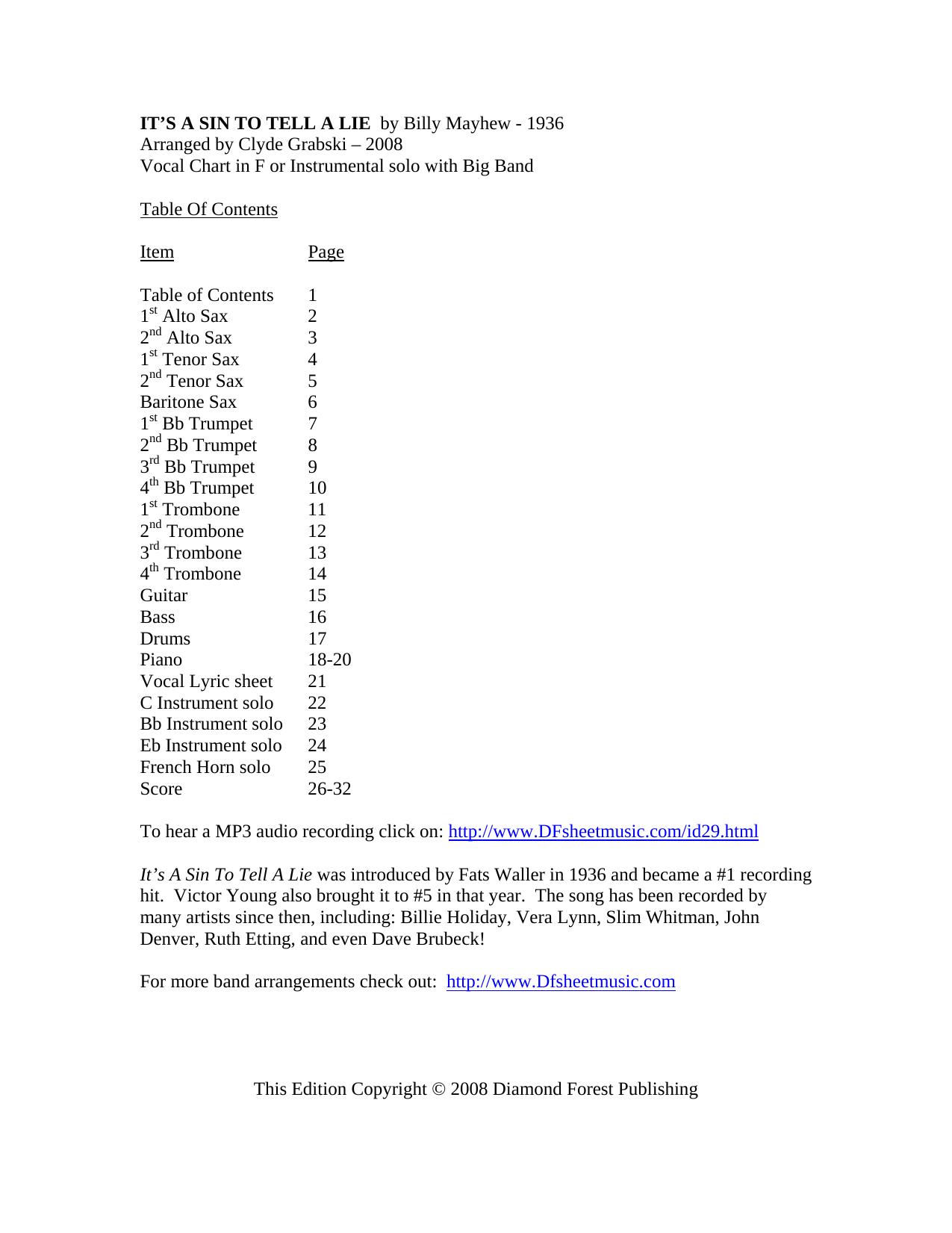
It's A Sin To Tell A Lie (C.Grabski) sheet music preview

It's A Sin To Tell A Lie (C.Grabski)

Composed by Frankie Laine

Arranged by C.Grabski

  • Ensemble: Big Band Vocal
  • Style: Jazz Standard
  • Pages: 32
  • Instruments (22): Vocal, Alto Sax 1, Alto Sax 2, Tenor Sax 1, Tenor Sax 2, Baritone Sax, Trumpet 1, Trumpet 2, Trumpet 3, Trumpet 4, Trombone 1, Trombone 2, Trombone 3, Trombone 4, Guitar, Bass, Drums, Piano, Solo C Instrument, Solo Bb Instrument, Solo Eb Instrument, Solo F Horn
  • Difficulty: medium
  • Content: Individual Parts
  • Format: PDF Download (Instant)
  • Price: $24.99

Originally composed by Billy May and famously recorded by Frankie Laine in 1946, "It's A Sin To Tell A Lie" emerges from the swing era, a period characterized by its infectious rhythms, sophisticated harmonies, and the rise of the big band sound. While not as frequently covered as some other standards, its enduring melodic charm and lyrical sentiment have ensured its place in the jazz repertoire, often appreciated for its straightforward yet heartfelt expression. The song embodies the classic big band ballad aesthetic, offering a canvas for lush arrangements and expressive vocal interpretation. Its timeless appeal lies in its simple, honest message, delivered through a melody that is both memorable and adaptable to various jazz treatments. C.Grabski's arrangement reimagines this beloved standard as a medium swing vocal feature, set in the inviting key of F Major. The overall mood is one of sophisticated warmth and gentle introspection, building to moments of classic big band exuberance. Grabski's signature approach is evident in the meticulous voicings, which provide a rich harmonic foundation without overpowering the vocalist. Expect carefully crafted saxophone soli sections that weave intricate counter-melodies, and brass figures that punctuate and support, rather than dominate. The arrangement maintains a consistent, relaxed medium swing feel throughout, allowing for a natural ebb and flow that highlights both the melody and the ensemble's dynamic control. The arrangement opens with a tender orchestral introduction, setting the stage for the vocalist's entrance with the iconic melody. The vocal lead is prominent, supported by subtle ensemble pads and rhythmic figures. Grabski skillfully employs call-and-response between the vocalist and various sections, particularly during the second A section and bridge, adding textural variety. A significant feature is an open solo section, typically for tenor saxophone or trumpet, providing an opportunity for improvisation over the standard chord changes. The arrangement culminates in a powerful yet controlled shout chorus, where the full ensemble comes together in a harmonically rich and dynamically exciting climax, before resolving into a soft, reflective coda that echoes the opening sentiment. Technical challenges include precise articulation in the swing figures, maintaining blend and balance in the soli sections, and achieving dynamic contrast, particularly in the build-up to the shout chorus. This arrangement is ideally suited for college, community, and advanced high school jazz ensembles. While the melodic lines are accessible, the harmonic depth and the need for nuanced dynamic control and stylistic authenticity require a band with solid fundamental skills and an understanding of big band performance practices. The rewarding aspect lies in the opportunity for the ensemble to perform a classic standard with a fresh, expertly crafted arrangement, allowing both the vocalist and the instrumentalists to shine in a piece that balances tradition with engaging musicality. This medium swing arrangement in F Major requires a relaxed, consistent groove from the rhythm section, emphasizing a light two-feel in quieter moments and a more driving four-feel during ensemble passages. Articulation is key: brass should aim for crisp, precise attacks on accented notes, while saxophones should articulate legato lines smoothly. Pay close attention to dynamic markings, particularly the crescendos leading into the shout chorus and the controlled decrescendo in the coda. The open solo section provides flexibility; encourage the soloist to embrace the melodic and harmonic contours of the original tune. Rehearsal time should focus on balancing the vocal lead with the ensemble, ensuring soli sections are tight and in tune, and achieving a cohesive, unified swing feel across all sections. No specific mutes beyond standard cup and straight mutes are required for brass. Q: What instruments and parts are included in this arrangement? A: This big band vocal arrangement includes parts for standard instrumentation: 5 saxophones (AATTB), 4 trumpets, 4 trombones, piano, bass, drums, guitar, and a dedicated vocal lead sheet. Q: What is the difficulty level of "It's A Sin To Tell A Lie (C.Grabski)"? A: This arrangement is rated as medium-advanced, suitable for college, community, and advanced high school jazz ensembles due to its harmonic sophistication, dynamic demands, and the need for stylistic precision. Q: What musical style and historical context does this arrangement represent? A: This arrangement is a jazz standard in a medium swing style, rooted in the classic big band era of the 1940s, famously associated with vocalists like Frankie Laine. Q: What makes C.Grabski's arrangement of "It's A Sin To Tell A Lie" unique? A: Grabski's treatment is characterized by lush, sophisticated voicings, carefully crafted saxophone soli sections, a dynamic build-up to a powerful shout chorus, and an overall balance that supports the vocalist while showcasing the ensemble. Q: What is the typical performance duration and tempo for this piece? A: At a medium swing tempo (approximately quarter note = 120-130 bpm), the typical performance duration for this arrangement is between 3:30 and 4:00 minutes, depending on the length of the improvised solo.

Questions and answers

What is included in the It's A Sin To Tell A Lie (C.Grabski) PDF?
The verified current file contains a conductor score and individual parts across 32 pages.
How many instruments or parts are listed for It's A Sin To Tell A Lie (C.Grabski)?
The verified instrumentation list contains 22 entries for this Big Band Vocal arrangement.
Who is credited for It's A Sin To Tell A Lie (C.Grabski)?
Composer: Frankie Laine. Arranger: C.Grabski.
What difficulty is listed for It's A Sin To Tell A Lie (C.Grabski)?
The verified difficulty level is medium.
What style is listed for It's A Sin To Tell A Lie (C.Grabski)?
The catalog lists the style as Jazz Standard.
Can I preview It's A Sin To Tell A Lie (C.Grabski) before buying?
Yes. The product page provides a preview generated from the current PDF file.
How is It's A Sin To Tell A Lie (C.Grabski) delivered?
After successful payment, the digital PDF is made available for download. The displayed price is $24.99.

Musicians Also Search For

It's A Sin To Tell A Lie C.Grabski PDFIt's A Sin To Tell A Lie C.Grabski sheet musicIt's A Sin To Tell A Lie arranged by C.GrabskiC.Grabski big band vocal chartsC.Grabski jazz arrangements PDFIt's A Sin To Tell A Lie Frankie Laine sheet musicIt's A Sin To Tell A Lie Frankie Laine big band vocal arrangementsFrankie Laine big band vocal chartsIt's A Sin To Tell A Lie big band vocal arrangementsIt's A Sin To Tell A Lie big band vocal PDF downloadIt's A Sin To Tell A Lie jazz sheet musicbig band vocal sheet music downloadIt's A Sin To Tell A Lie conductor score PDFIt's A Sin To Tell A Lie individual parts downloadIt's A Sin To Tell A Lie sheet music PDFIt's A Sin To Tell A Lie Jazz Standard chartsJazz Standard big band vocal arrangementsbuy It's A Sin To Tell A Lie sheet musicdownload It's A Sin To Tell A Lie PDFIt's A Sin To Tell A Lie jazz chartsbest C.Grabski big band vocal arrangementsFrankie Laine arranged by C.GrabskiIt's A Sin To Tell A Lie printable sheet musicbig band vocal repertoire PDF

All arrangements by C.Grabski All Frankie Laine sheet music