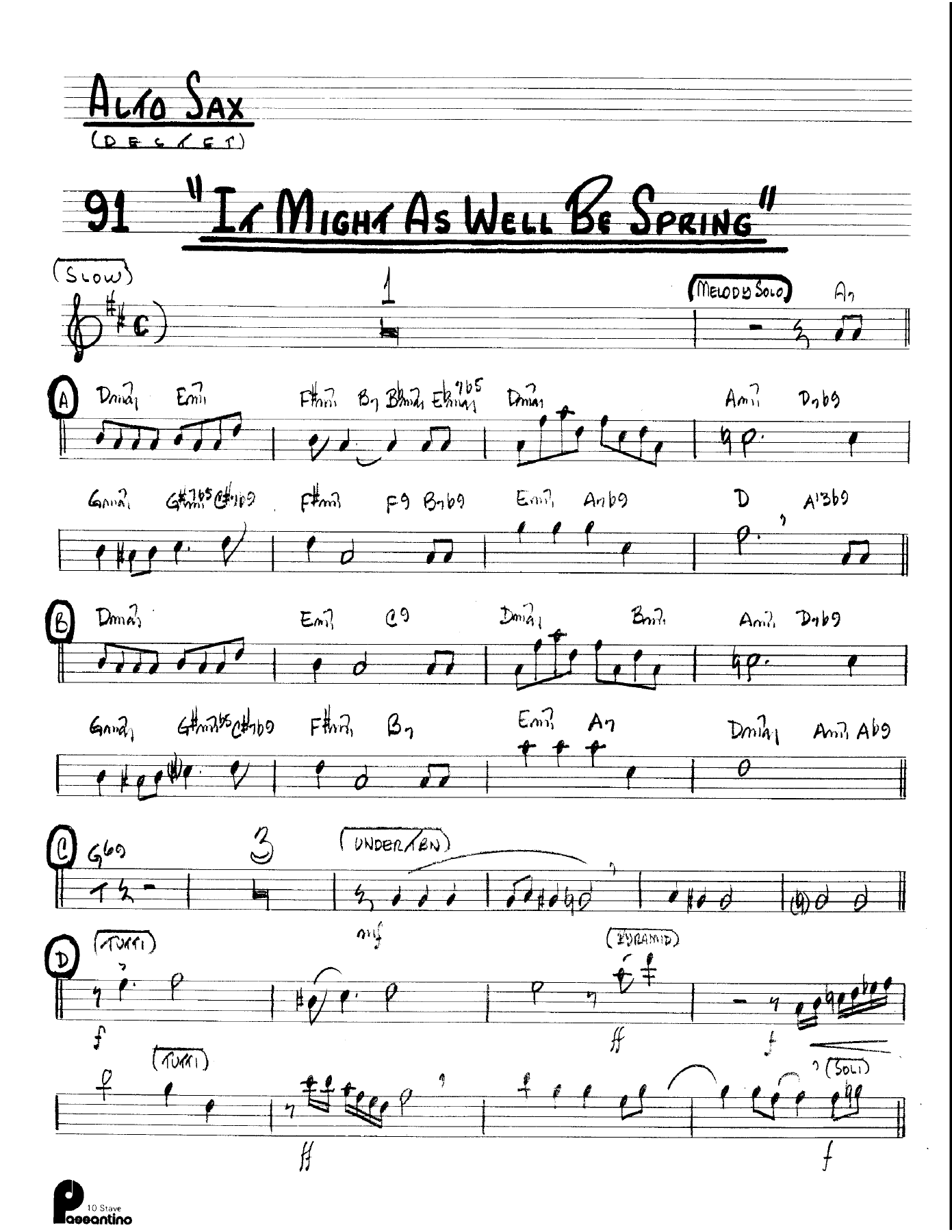
It Might As Well Be Spring (Kenton Dectet #91) sheet music preview

It Might As Well Be Spring (Kenton Dectet #91)

Composed by Richard Rodgers

Arranged by Stan Kenton Dected 176

  • Ensemble: Small Ensemble
  • Style: Jazz Standard
  • Pages: 24
  • Instruments (9): Alto Sax, Tenor Sax, Baritone Sax, Trumpet 1, Trumpet 2, Trombone, Piano, Bass, Drums
  • Difficulty: easy
  • Content: Individual Parts
  • Format: PDF Download (Instant)
  • Price: $12.99

"It Might As Well Be Spring," a timeless jazz standard, originated as a poignant ballad from the 1945 film *State Fair*, marking the only original film score penned by the legendary songwriting duo Richard Rodgers and Oscar Hammerstein II. This evocative piece quickly transcended its cinematic roots, earning an Academy Award for Best Original Song in 1946 and becoming a cornerstone of the Great American Songbook. Its enduring appeal lies in its lyrical portrayal of restless longing and emotional awakening, capturing the universal sentiment of "spring fever" even as the film's narrative unfolds in autumn. Though Rodgers initially conceived it as an upbeat tune, the film's musical director, Alfred Newman, insisted on a slow ballad tempo, a decision Rodgers later acknowledged as correct, lending the song its signature introspective and tender character. Celebrated vocalists like Sarah Vaughan, Ella Fitzgerald, and Frank Sinatra, alongside instrumentalists such as the Bill Evans Trio and Stan Getz, have cemented its status as a beloved standard, drawn to its lyrical melody and sophisticated harmonic possibilities. This particular arrangement, "It Might As Well Be Spring (Kenton Dectet #91)," is a masterful small ensemble treatment from the innovative mind of Stan Kenton Dectet 176. Kenton, a titan of progressive jazz, was renowned for pushing the boundaries of big band orchestration, incorporating complex harmonies, bold brass voicings, and a sophisticated, often orchestral, approach to jazz. While his larger ensembles were known for their power and dissonance, his dectet arrangements, often designed for smaller, more flexible groups, showcase a more refined and intricate side of his artistry. This arrangement is likely presented as a medium swing or a thoughtful ballad, allowing its rich harmonic landscape to unfold gradually, reflecting the song's inherent moodiness and soaring emotional arc. The Kenton Dectet's signature often includes lush, tightly voiced brass and saxophone sections, unexpected harmonic substitutions, and a dynamic interplay between ensemble passages and featured soloists. Musically, expect a rich tapestry of sound that evokes a sense of contemplative beauty and understated passion. The melody, initially carried by a lead instrument (perhaps trumpet or alto saxophone), will be supported by sophisticated counter-melodies and warm harmonic pads from the other horns. Kenton's arrangements frequently feature intricate soli sections where the ensemble acts as a unified voice, creating dense, shimmering textures. Solo opportunities are central to this piece, providing space for improvisation over its compelling chord changes, which are ripe for exploration by an advanced soloist. Technical challenges will likely include precise articulation, nuanced dynamic control, and navigating Kenton's characteristic extended harmonies and sometimes challenging rhythmic figures. The reward for performers lies in the sheer elegance and depth of the arrangement, offering a chance to engage with a jazz standard through the lens of one of its most influential figures, fostering a profound musical connection and delivering a truly artistic performance. This arrangement is ideally suited for advanced high school, college, community, or professional jazz ensembles capable of executing complex voicings and expressive musicality. Approaching this Stan Kenton Dectet arrangement requires meticulous attention to balance and blend, particularly within the tightly voiced horn sections. The primary technical challenge lies in achieving precise intonation and articulation across the ensemble, especially during the intricate soli passages and harmonic shifts. Conductors should emphasize a unified approach to phrasing, encouraging musicians to listen across sections to create a cohesive sound. Maintain a consistent medium swing feel, allowing the rhythm section to lay down a solid, yet flexible, foundation. While the overall mood is lyrical and contemplative, dynamic contrasts are crucial; build tension through carefully controlled crescendos and release it with expressive decrescendos. Soloists should be encouraged to embrace the ballad's emotional depth, utilizing melodic development and harmonic sophistication rather than purely technical display. Rehearsal tips include isolating challenging harmonic clusters to ensure clarity and practicing the interplay between the lead melody and accompanying lines to achieve Kenton's characteristic blend. Q: What instruments/parts are included in this arrangement? A: This Stan Kenton Dectet arrangement typically includes parts for a small ensemble, such as trumpet, trombone, alto saxophone, tenor saxophone, baritone saxophone, piano, bass, and drums, providing a full and rich sound. Q: What is the difficulty level of this arrangement? A: This arrangement is considered advanced, suitable for experienced high school, college, community, or professional jazz ensembles due to its complex harmonies, intricate voicings, and demands for expressive musicality. Q: What is the musical style and historical context of "It Might As Well Be Spring"? A: "It Might As Well Be Spring" is a jazz standard and a tender ballad from the 1945 film *State Fair*, composed by Richard Rodgers and Oscar Hammerstein II, known for its lyrical melody and introspective mood. Q: What makes this Stan Kenton Dectet arrangement unique? A: This arrangement showcases Stan Kenton's signature progressive jazz style within a small ensemble format, featuring sophisticated voicings, rich harmonic language, and dynamic interplay between instruments, offering a distinctive interpretation of the classic standard. Q: What is the typical performance duration and tempo for this piece? A: As a medium swing or ballad, the performance duration will vary based on solo lengths, but typically ranges from 4 to 6 minutes, maintaining a relaxed yet flowing tempo that allows the melodic and harmonic nuances to shine.

Questions and answers

What is included in the It Might As Well Be Spring (Kenton Dectet #91) PDF?
The verified current file contains individual parts across 24 pages.
How many instruments or parts are listed for It Might As Well Be Spring (Kenton Dectet #91)?
The verified instrumentation list contains 9 entries for this Small Ensemble arrangement.
Who is credited for It Might As Well Be Spring (Kenton Dectet #91)?
Composer: Richard Rodgers. Arranger: Stan Kenton Dected 176.
What difficulty is listed for It Might As Well Be Spring (Kenton Dectet #91)?
The verified difficulty level is easy.
What style is listed for It Might As Well Be Spring (Kenton Dectet #91)?
The catalog lists the style as Jazz Standard.
Can I preview It Might As Well Be Spring (Kenton Dectet #91) before buying?
Yes. The product page provides a preview generated from the current PDF file.
How is It Might As Well Be Spring (Kenton Dectet #91) delivered?
After successful payment, the digital PDF is made available for download. The displayed price is $12.99.

Musicians Also Search For

It Might As Well Be Spring Stan Kenton Dected 176 PDFIt Might As Well Be Spring Stan Kenton Dected 176 sheet musicIt Might As Well Be Spring arranged by Stan Kenton Dected 176Stan Kenton Dected 176 small ensemble chartsStan Kenton Dected 176 jazz arrangements PDFIt Might As Well Be Spring Richard Rodgers sheet musicIt Might As Well Be Spring Richard Rodgers small ensemble arrangementsRichard Rodgers small ensemble chartsIt Might As Well Be Spring small ensemble arrangementsIt Might As Well Be Spring small ensemble PDF downloadIt Might As Well Be Spring jazz sheet musicsmall ensemble sheet music downloadIt Might As Well Be Spring individual parts downloadIt Might As Well Be Spring sheet music PDFIt Might As Well Be Spring Jazz Standard chartsJazz Standard small ensemble arrangementsbuy It Might As Well Be Spring sheet musicdownload It Might As Well Be Spring PDFIt Might As Well Be Spring jazz chartsbest Stan Kenton Dected 176 small ensemble arrangementsRichard Rodgers arranged by Stan Kenton Dected 176It Might As Well Be Spring printable sheet musicsmall ensemble repertoire PDF

All arrangements by Stan Kenton Dected 176 All Richard Rodgers sheet music