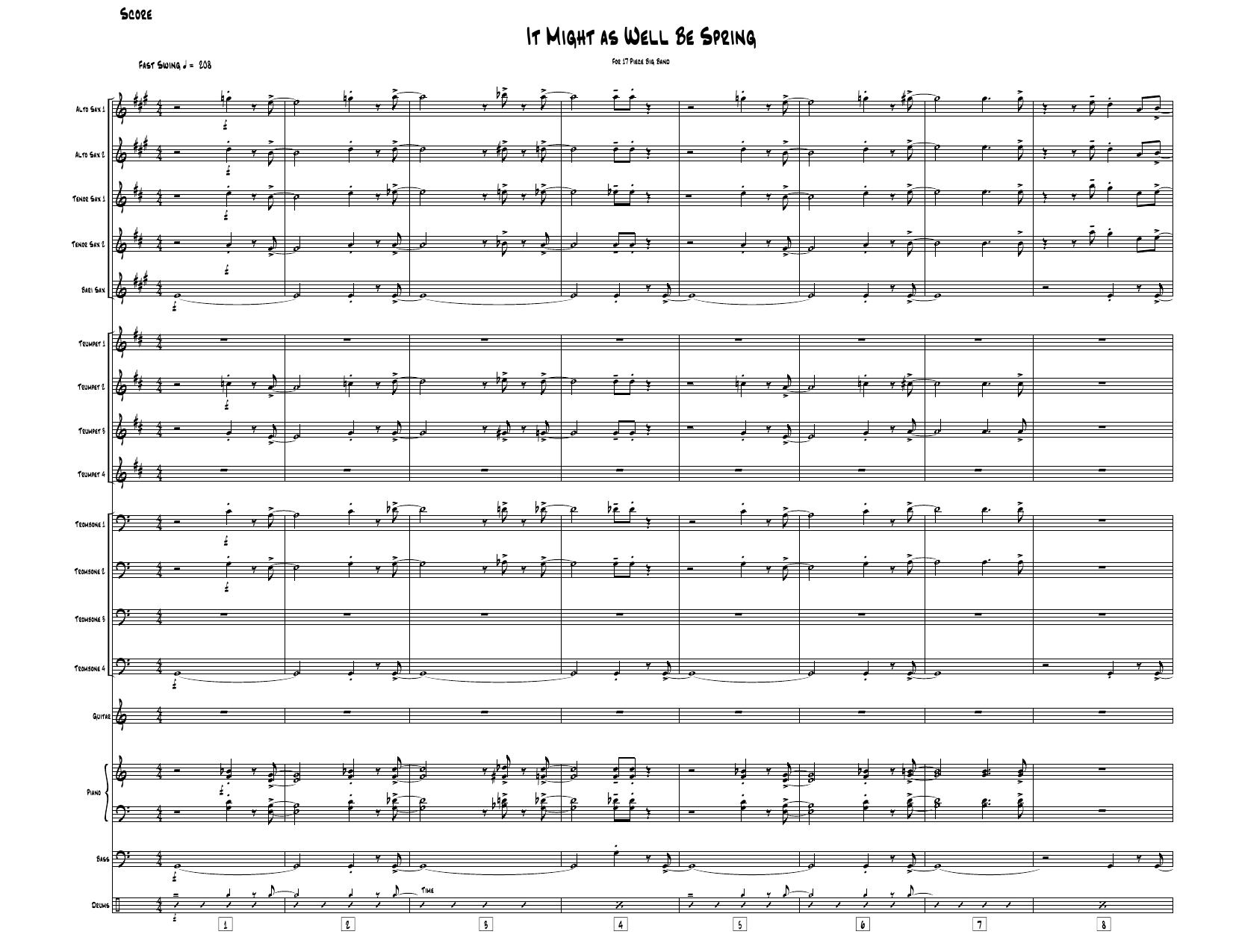
It Might As Well Be Spring (J.Martin) sheet music preview

It Might As Well Be Spring (J.Martin)

Composed by Richard Rodgers

Arranged by Jim Martin

  • Ensemble: Big Band
  • Pages: 100
  • Instruments (17): Alto Sax 1, Alto Sax 2, Tenor Sax 1, Tenor Sax 2, Bari Sax, Trumpet 1, Trumpet 2, Trumpet 3, Trumpet 4, Trombone 1, Trombone 2, Trombone 3, Trombone 4, Guitar, Piano, Bass, Drums
  • Difficulty: advanced
  • Content: Individual Parts
  • Format: PDF Download (Instant)
  • Price: $24.99

Richard Rodgers and Oscar Hammerstein II originally penned "It Might As Well Be Spring" for the 1945 musical film *State Fair*, where it won the Academy Award for Best Original Song. While birthed in the Broadway tradition, the tune was swiftly embraced by the modern jazz pantheon, becoming an essential vehicle for improvisers. Landmark interpretations by giants like Stan Getz, John Coltrane, and Sarah Vaughan transformed the wistful, pent-up yearning of the original melody into a sophisticated harmonic playground. The song captures a distinct duality: an outward, innocent optimism clashing with a restless, melancholic interiority, making it one of the most emotionally complex entries in the Great American Songbook. Jim Martin’s sophisticated big band interpretation frames this classic as a flowing, medium-tempo swing ballad that gradually builds from delicate introspection into lush, cinematic grandeur. Opening with a rubato, atmospheric introduction that highlights subtle woodwind colorations, the chart settles into an elegant, laid-back groove driven by a subtle ride cymbal pulse. The harmonic palette leans heavily into extended upper-structure extensions, modal shifts, and rich chord voicings that evoke the cool-school sophistication of the late 1950s West Coast scene, while retaining a warm, traditional big band glow. The melodic narrative unfolds primarily through a lush saxophone soli that showcases Martin’s gift for horizontal voice-leading and close-interval harmonization. Brass interplay is tasteful and restrained in the early choruses, utilizing warm cup and harmon mutes to establish an intimate atmosphere before opening up into a soaring, harmonically adventurous shout chorus. Solo opportunities are provided for tenor saxophone and piano, offering ample room for expressive, linear improvisation over the tune's sophisticated changes. The chart avoids dense technical pyrotechnics in favor of phrasing precision, balance, and dynamic control, rewarding ensembles that can maintain a consistent, unhurried pulse while floating delicate rubato phrases. Advanced high school, collegiate, and professional big bands will find this arrangement an ideal centerpiece for festival performances or formal concerts. Because the primary challenges lie in intonation, dynamic subtlety, and stylistic uniformity rather than sheer velocity, it serves as an exceptional vehicle for developing a section's listening skills and tonal blend. Ensembles looking to showcase maturity, sophisticated phrasing, and deep stylistic reverence will discover that Martin's chart offers a masterclass in modern big band ballad interpretation. Conductors should approach the tempo with a relaxed, breathing quarter-note feel around 104 BPM, ensuring the rhythm section maintains an unhurried, floating momentum rather than a rigid, mechanical swing. The primary technical hurdle rests in the dynamic control required during the muted brass passages; players must project rich core tones without sacrificing warmth or pushing the pitch sharp. In the saxophone soli, pay close attention to unison blend and articulation uniformity—notes marked with a sustained, vocal-like legato should swell and recede naturally with the harmonic tension. The rhythm section needs a deft touch; the pianist should voice chords sparingly using rootless voicings, while the drummer utilizes brushes or a light stick touch on the ride to keep the texture transparent. Rehearsal time is best spent isolating the rubato intro to lock in ensemble breath cues before locking down the subtle micro-dynamics of the shout chorus. Q: What instruments and parts are included in this arrangement? A: This 100-page publication is scored for a standard 17-instrument big band, consisting of 5 saxophones (2 altos, 2 tenors, 1 baritone), 4 trumpets, 4 trombones, guitar, piano, bass, and drums, alongside a comprehensive conductor score. Q: What is the difficulty level of this chart? A: It is graded as advanced-intermediate to advanced, making it best suited for accomplished high school, collegiate, and professional big bands where intonation, blend, and subtle dynamic control are prioritized over sheer technical speed. Q: What is the musical style and historical context of this piece? A: It is styled as a lush, sophisticated medium-tempo swing ballad based on Richard Rodgers and Oscar Hammerstein II's 1945 Academy Award-winning standard from *State Fair*. Q: What makes Jim Martin’s arrangement unique? A: Martin distinguishes his chart through his use of cool-school harmonic extensions, a richly voiced saxophone soli, and a seamless transition from an intimate, muted beginning to a soaring, cinematic shout chorus. Q: What is the recommended performance tempo and duration? A: The arrangement is designed to be played at a relaxed medium-swing tempo of approximately quarter note = 104 BPM, yielding a performance duration of roughly 4.5 to 5 minutes depending on solo choruses.

Questions and answers

What is included in the It Might As Well Be Spring (J.Martin) PDF?
The verified current file contains a conductor score and individual parts across 100 pages.
How many instruments or parts are listed for It Might As Well Be Spring (J.Martin)?
The verified instrumentation list contains 17 entries for this Big Band arrangement.
Who is credited for It Might As Well Be Spring (J.Martin)?
Composer: Richard Rodgers. Arranger: Jim Martin.
What difficulty is listed for It Might As Well Be Spring (J.Martin)?
The verified difficulty level is advanced.
Can I preview It Might As Well Be Spring (J.Martin) before buying?
Yes. The product page provides a preview generated from the current PDF file.
How is It Might As Well Be Spring (J.Martin) delivered?
After successful payment, the digital PDF is made available for download. The displayed price is $24.99.

Musicians Also Search For

It Might As Well Be Spring Jim Martin PDFIt Might As Well Be Spring Jim Martin sheet musicIt Might As Well Be Spring arranged by Jim MartinJim Martin big band chartsJim Martin jazz arrangements PDFIt Might As Well Be Spring Richard Rodgers sheet musicIt Might As Well Be Spring Richard Rodgers big band arrangementsRichard Rodgers big band chartsIt Might As Well Be Spring big band arrangementsIt Might As Well Be Spring big band PDF downloadIt Might As Well Be Spring jazz sheet musicbig band sheet music downloadIt Might As Well Be Spring conductor score PDFIt Might As Well Be Spring individual parts downloadIt Might As Well Be Spring sheet music PDFbuy It Might As Well Be Spring sheet musicdownload It Might As Well Be Spring PDFIt Might As Well Be Spring jazz chartsbest Jim Martin big band arrangementsRichard Rodgers arranged by Jim MartinIt Might As Well Be Spring printable sheet musicbig band repertoire PDF

All arrangements by Jim Martin All Richard Rodgers sheet music