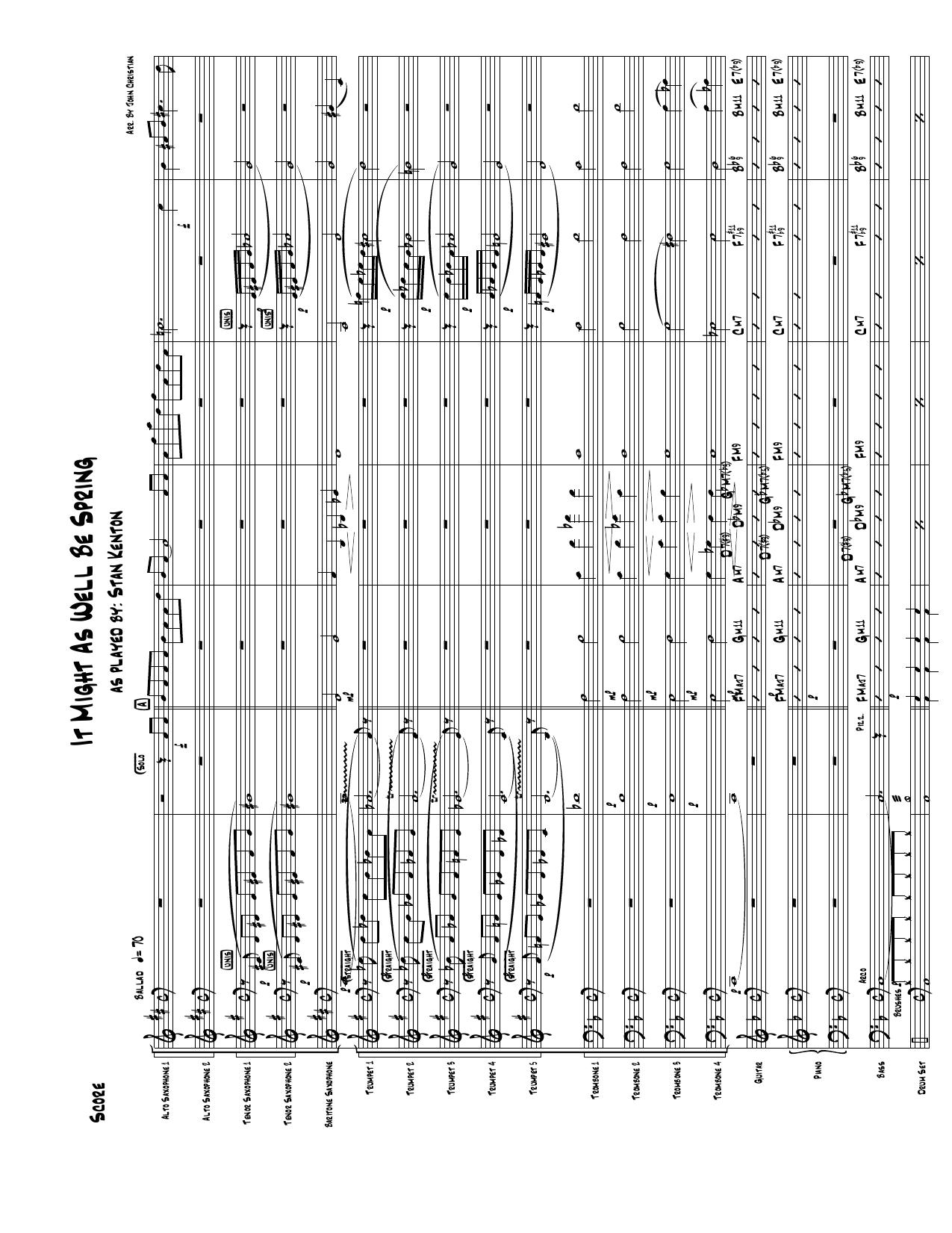
It Might As Well Be Spring (J.Christian) sheet music preview

It Might As Well Be Spring (J.Christian)

Composed by Richard Rodgers

Arranged by J.Christian

  • Ensemble: Big Band
  • Pages: 47
  • Instruments (17): Alto Saxophone 1, Alto Saxophone 2, Tenor Saxophone 1, Tenor Saxophone 2, Baritone Saxophone, Trumpet 1, Trumpet 2, Trumpet 3, Trumpet 4, Trumpet 5, Trombone 1, Trombone 2, Trombone 3, Trombone 4, Piano, Bass, Drums
  • Difficulty: medium
  • Content: Individual Parts
  • Format: PDF Download (Instant)
  • Price: $24.99

Composed by Richard Rodgers with lyrics by Oscar Hammerstein II for the 1945 musical film *State Fair*, "It Might As Well Be Spring" quickly transcended its cinematic origins to become one of the most enduring jewels of the American Songbook and a definitive jazz standard. Won over by its lush, wistful melody and sophisticated harmonic contour, countless jazz icons—from modal explorers like John Coltrane to vocal stylists like Sarah Vaughan and instrumentalists like Stan Getz—have reinterpreted its bittersweet charm. The song captures a uniquely complex emotional landscape: a mixture of restless yearning, daydreaming, and gentle optimism. Translating this delicate balance into a full big band canvas requires a deft touch, one that honors the intimacy of the original ballad while harnessing the rich, collective color palette of an 18-piece jazz orchestra. In this masterful treatment, arranger J.Christian reframes the classic standard as an expressive, luminous medium-tempo swing ballad that gradually builds in harmonic density and emotional resonance. Eschewing a static, predictable head-arrangement, the chart opens with a moody, harmonically rich rubato introduction in the woodwinds before settling into a relaxed, floating groove. Christian employs sophisticated extended voicings in the brass and lush sax solis that weave through the changes with chromatic elegance. The arrangement balances transparent, delicate scoring—where individual instrumental voices are laid bare—with full-ensemble swells that evoke the grand tradition of classic West Coast arranging, emphasizing linear counterpoint and warm, blended sonorities over sheer volume. Throughout the chart, melodic responsibilities are thoughtfully distributed across the ensemble. The lead alto saxophone and flugelhorn (or muted trumpet) share early thematic statements, establishing a tender, conversational tone before handing off to a robust, harmonically adventurous saxophone soli. A featured improvised solo section provides a canvas for a mature tenor saxophone or piano soloist to stretch out over standard changes made fresh by Christian's subtle reharmonizations. The rhythmic section acts as a vital structural anchor, requiring a subtle, driving ride cymbal pulse and a tasteful, supportive walking bass line that maintains forward momentum without ever rushing the relaxed pocket. Advanced high school ensembles, collegiate jazz orchestras, and professional big bands will find this chart an exceptional vehicle for developing stylistic maturity, blend, and dynamic control. Because the chart relies heavily on nuanced phrasing, subtle rubato pacing, and sophisticated inner-voice movement rather than high-note endurance, it serves as an ideal masterclass in ensemble listening. It rewards groups capable of nuanced dynamic shading, making it a standout centerpiece for a festival program, spring concert, or advanced jazz club performance. Success with J.Christian’s arrangement of "It Might As Well Be Spring" hinges on the ensemble's ability to maintain a relaxed, unhurried time feel while navigating dense, shifting harmonic textures. The tempo should sit comfortably in a medium swing pocket (approx. quarter note = 104–112 BPM), avoiding any tendency to drag during rubato transitions or rush the swing sections. Conductors should pay close attention to the dynamic balance between the rhythm section and horns; the inner-voice harmonies in the saxophones must project without forcing the tone. Trumpets should utilize cup or harmon mutes where indicated to achieve the requisite warmth, reserving open horn playing for the climactic ensemble choruses. Rehearsals should initially isolate the exposed sax soli, ensuring seamless blend and uniform articulation before integrating the rhythm section's counter-lines. Emphasize horizontal phrasing over vertical note-reading to capture the bittersweet, lyrical narrative inherent in Rodgers' timeless melody. Q: What instruments and parts are included in this arrangement? A: The chart is scored for a standard 18-piece big band instrumentation consisting of 5 saxophones (2 altos, 2 tenors, baritone), 4 trumpets, 4 trombones, piano, guitar, bass, and drums, plus a comprehensive conductor score. Q: What is the overall difficulty level of this chart? A: This arrangement is graded as advanced (appropriate for top-tier high school, collegiate, and professional big bands), primarily due to its sophisticated harmonic vocabulary, requirement for precise intonation, and demand for subtle stylistic control rather than extreme technical pyrotechnics. Q: What is the historical and stylistic context of this piece? A: Originally written by Richard Rodgers and Oscar Hammerstein II in 1945, this arrangement reinterprets the classic Tin Pan Alley standard through a sophisticated jazz lens, blending traditional swing-era ballad sensibilities with modern, rich harmonic reharmonizations. Q: What makes J.Christian's arrangement unique compared to other big band versions? A: It stands out for its cinematic, rubato-to-swing pacing, intricate inner-voice movement, and a gorgeous saxophone soli that recontextualizes the familiar melody within a lush, West Coast-inspired harmonic landscape. Q: What is the performance duration and recommended tempo for this arrangement? A: The piece runs approximately 4.5 to 5 minutes in duration when performed at the recommended medium swing tempo of around 108 BPM.

Questions and answers

What is included in the It Might As Well Be Spring (J.Christian) PDF?
The verified current file contains a conductor score and individual parts across 47 pages.
How many instruments or parts are listed for It Might As Well Be Spring (J.Christian)?
The verified instrumentation list contains 17 entries for this Big Band arrangement.
Who is credited for It Might As Well Be Spring (J.Christian)?
Composer: Richard Rodgers. Arranger: J.Christian.
What difficulty is listed for It Might As Well Be Spring (J.Christian)?
The verified difficulty level is medium.
Can I preview It Might As Well Be Spring (J.Christian) before buying?
Yes. The product page provides a preview generated from the current PDF file.
How is It Might As Well Be Spring (J.Christian) delivered?
After successful payment, the digital PDF is made available for download. The displayed price is $24.99.

Musicians Also Search For

It Might As Well Be Spring J.Christian PDFIt Might As Well Be Spring J.Christian sheet musicIt Might As Well Be Spring arranged by J.ChristianJ.Christian big band chartsJ.Christian jazz arrangements PDFIt Might As Well Be Spring Richard Rodgers sheet musicIt Might As Well Be Spring Richard Rodgers big band arrangementsRichard Rodgers big band chartsIt Might As Well Be Spring big band arrangementsIt Might As Well Be Spring big band PDF downloadIt Might As Well Be Spring jazz sheet musicbig band sheet music downloadIt Might As Well Be Spring conductor score PDFIt Might As Well Be Spring individual parts downloadIt Might As Well Be Spring sheet music PDFbuy It Might As Well Be Spring sheet musicdownload It Might As Well Be Spring PDFIt Might As Well Be Spring jazz chartsbest J.Christian big band arrangementsRichard Rodgers arranged by J.ChristianIt Might As Well Be Spring printable sheet musicbig band repertoire PDF

All arrangements by J.Christian All Richard Rodgers sheet music