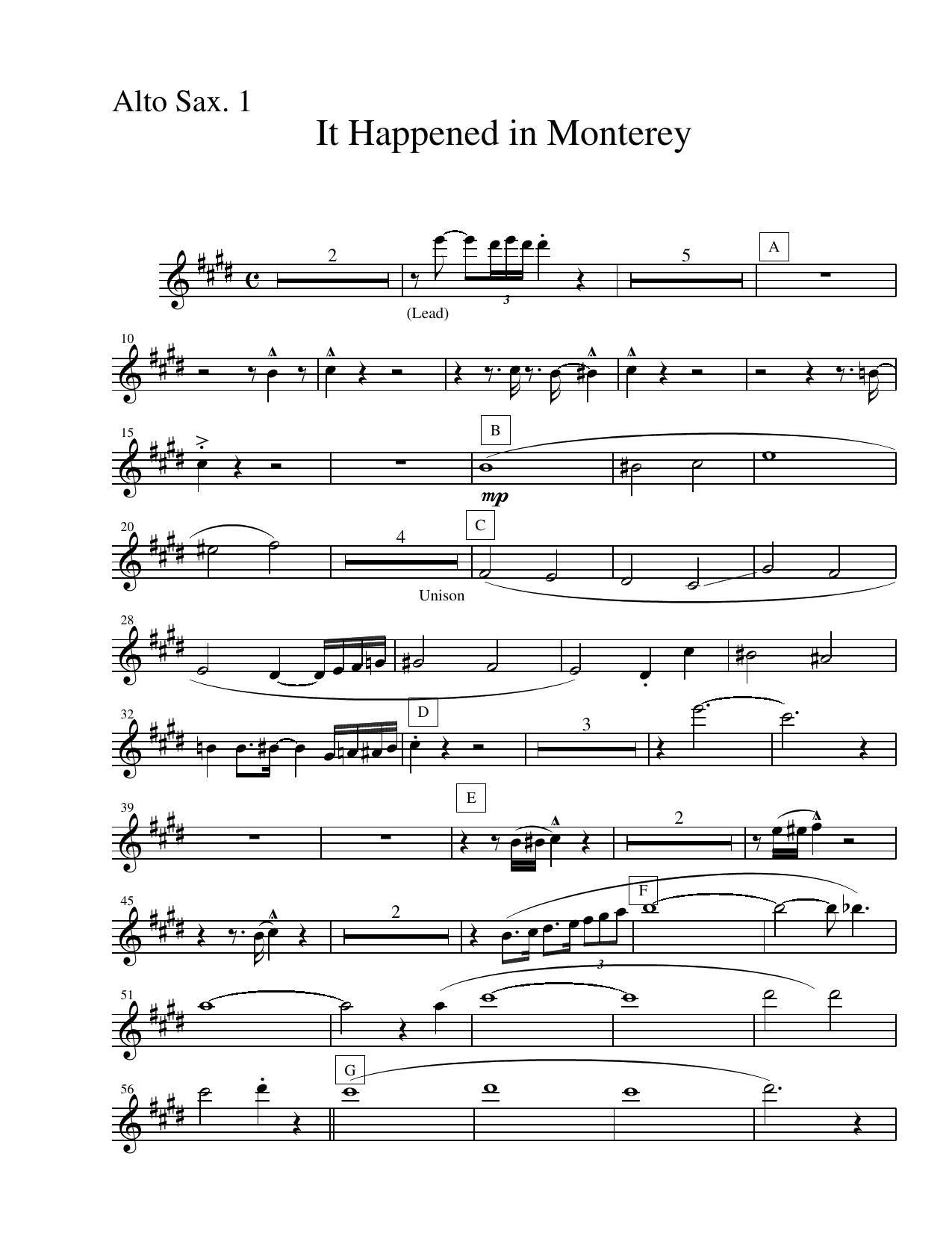
It Happened In Monterey (N.Riddle)
Composed by Mabel Wayne
Arranged by Frank Sinatra & Nelson Riddle
- Ensemble: Big Band
- Pages: 43
- Instruments (17): Alto Sax. 1, Alto Sax. 2, Tenor Sax. 1, Tenor Sax. 2, Baritone Sax., Trumpet 1, Trumpet 2, Trumpet 3, Trumpet 4, Trombone 1, Trombone 2, Trombone 3, Trombone 4, Drum Set, Piano/Guitar, Bass, Vocals
- Difficulty: medium
- Content: Individual Parts
- Format: PDF Download (Instant)
- Price: $24.99
Mabel Wayne’s timeless composition "It Happened In Monterey," introduced to the American popular songbook in 1930, reached its absolute definitive interpretation when vocal icon Frank Sinatra and master arranger Nelson Riddle collaborated to transform the Tin Pan Alley waltz into a blistering, high-octane Latin-swing hybrid. Originally written for the film *The King of Jazz*, the tune found its ultimate home in the Capitol Records era, serving as a cornerstone of the sophisticated, brass-heavy orchestration that defined the Sinatra-Riddle partnership. This big band arrangement encapsulates the peak of mid-century Hollywood and Vegas sophistication, capturing a sultry, adventurous Mediterranean atmosphere through aggressive, rhythmic drive and lush, cinematic harmonic coloring. Driven by an infectious, percussion-heavy medium-up Latin-swing groove in 4/4 time, the arrangement radiates an irresistible, swaggering energy. The mood oscillates between tense, dramatic cinematic build-ups and joyous, swinging release. Riddle’s signature compositional fingerprints are stamped across every measure: soaring upper-register brass stabs, intricate counter-melodies woven through the woodwinds, and a brilliantly executed harmonic palette that utilizes suspended chords and chromatic descents to heighten the underlying romantic tension. The arrangement wastes no time establishing its momentum, launching straight into a bold, rhythmically complex intro that immediately commands the listener's attention. The ten-instrument ensemble shares a brilliantly distributed workload where no single section is left resting. The saxophone section—featuring alto, tenor, and baritone voices—navigates tight, harmonically rich Soli passages that evoke the breezy, coastal imagery of Monterey, while the trumpets and trombones deliver sharp, punchy counter-punches that drive the groove forward. Featured solo space allows individual players to step into the spotlight with modal exploration, supported by crisp, driving rhythmic figures from the rhythm section. Technical challenges center around maintaining precise articulation through rapid syncopated figures and balancing the dynamic contrast between whispered, muted horn lines and roaring, full-ensemble shout choruses. Advanced high school, collegiate, and professional jazz ensembles will find this chart to be an exceptionally rewarding centerpiece for a concert program or festival performance. Because the arrangement relies heavily on precise ensemble intonation, stylistic unity between straight Latin feels and traditional swing syncopation, it offers directors a fantastic teaching tool for modern big band phrasing. Audiences respond instantly to its recognizable historic pedigree and cinematic grandeur, making it a guaranteed showstopper that bridges the gap between sophisticated jazz artistry and sheer entertainment value. Conductors should approach this chart with a primary focus on rhythmic precision and stylistic hybridity. The tempo must remain relentlessly steady; resist the urge to rush the transitional crescendos. The rhythm section is the engine here, requiring a clean, driving Latin groove that seamlessly transitions into crisp swing feels without losing forward momentum. Saxophones should focus on a seamless blend during the intricate soli passages, ensuring that the inner voice lead lines project clearly beneath the top voice. Brass players must exercise careful dynamic control—particularly when utilizing cup or straight mutes—to ensure that background figures complement rather than obscure the primary melody. Rehearsal time should be heavily invested in locking in the syncopated ensemble hits, ensuring that every 16th-note pickup speaks with absolute clarity and unified articulation across all sections. Q: What instrumentation and parts are included in this arrangement? A: This chart is scored for a 10-instrument big band lineup, specifically featuring Alto Saxophone, Tenor Saxophone, Baritone Saxophone, Trumpet, and Trombone parts, alongside a full rhythm section. Q: What is the difficulty level of this Nelson Riddle arrangement? A: This arrangement is graded as advanced, demanding strong technical facility, precise ensemble blend, and the ability to navigate sophisticated harmonic shifts and syncopated Latin-swing rhythms. Q: What is the historical style and context of this piece? A: Originating as a 1930 Tin Pan Alley waltz by Mabel Wayne, this specific arrangement reflects the iconic Capitol Records style developed by Frank Sinatra and arranger Nelson Riddle during the 1950s golden era of vocal jazz. Q: What makes this specific arrangement unique? A: It uniquely reimagines a traditional waltz as a high-energy Latin-swing hybrid, utilizing Nelson Riddle’s signature cinematic voicings, dramatic dynamic contrasts, and sophisticated brass counter-lines. Q: What is the performance duration and tempo feel of the piece? A: The arrangement runs approximately 3 to 4 minutes and is performed at a driving, medium-up tempo featuring a hybrid Latin-swing groove in 4/4 time.
Questions and answers
- What is included in the It Happened In Monterey (N.Riddle) PDF?
- The verified current file contains a conductor score and individual parts across 43 pages.
- How many instruments or parts are listed for It Happened In Monterey (N.Riddle)?
- The verified instrumentation list contains 17 entries for this Big Band arrangement.
- Who is credited for It Happened In Monterey (N.Riddle)?
- Composer: Mabel Wayne. Arranger: Frank Sinatra & Nelson Riddle.
- What difficulty is listed for It Happened In Monterey (N.Riddle)?
- The verified difficulty level is medium.
- Can I preview It Happened In Monterey (N.Riddle) before buying?
- Yes. The product page provides a preview generated from the current PDF file.
- How is It Happened In Monterey (N.Riddle) delivered?
- After successful payment, the digital PDF is made available for download. The displayed price is $24.99.
Musicians Also Search For
It Happened In Monterey Frank Sinatra & Nelson Riddle PDF • It Happened In Monterey Frank Sinatra & Nelson Riddle sheet music • It Happened In Monterey arranged by Frank Sinatra & Nelson Riddle • Frank Sinatra & Nelson Riddle big band charts • Frank Sinatra & Nelson Riddle jazz arrangements PDF • It Happened In Monterey Mabel Wayne sheet music • It Happened In Monterey Mabel Wayne big band arrangements • Mabel Wayne big band charts • It Happened In Monterey big band arrangements • It Happened In Monterey big band PDF download • It Happened In Monterey jazz sheet music • big band sheet music download • It Happened In Monterey conductor score PDF • It Happened In Monterey individual parts download • It Happened In Monterey sheet music PDF • buy It Happened In Monterey sheet music • download It Happened In Monterey PDF • It Happened In Monterey jazz charts • best Frank Sinatra & Nelson Riddle big band arrangements • Mabel Wayne arranged by Frank Sinatra & Nelson Riddle • It Happened In Monterey printable sheet music • big band repertoire PDF