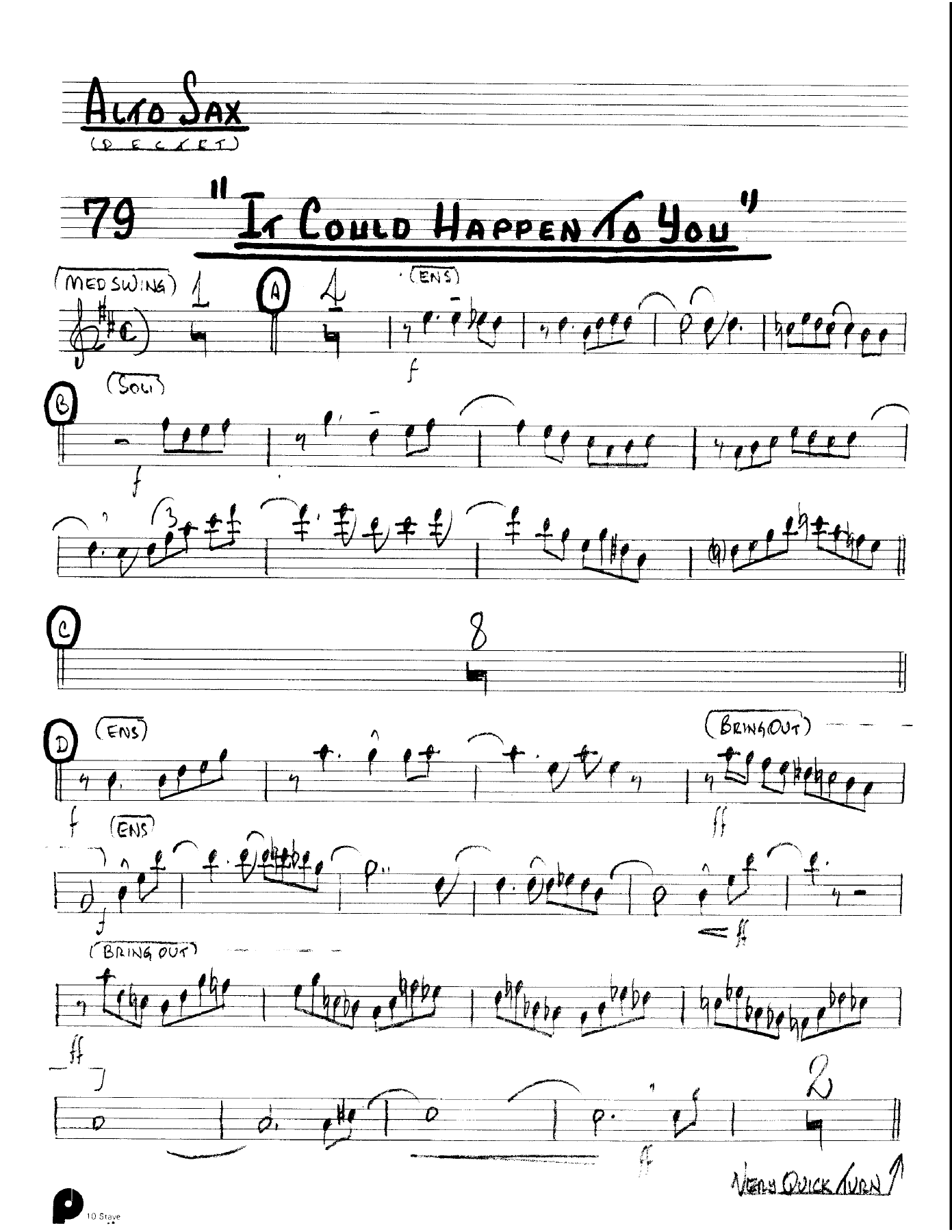
It Could Happen To You (Kenton Dectet #79)
Composed by Jimmy Van Heusen
Arranged by Stan Kenton Dected 176
- Ensemble: Small Ensemble
- Style: Jazz Standard
- Pages: 28
- Instruments (9): Alto Sax, Tenor Sax, Baritone Sax, Trumpet 1, Trumpet 2, Trombone, Piano, Bass, Drums
- Difficulty: easy
- Content: Individual Parts
- Format: PDF Download (Instant)
- Price: $12.99
"It Could Happen To You," a timeless jazz standard, was originally penned by Jimmy Van Heusen with lyrics by Johnny Burke in 1944. Emerging from the Golden Age of American popular song, this ballad quickly became a staple of the jazz repertoire, first gaining significant traction through recordings by Jo Stafford and Bing Crosby. Its enduring appeal lies in its sophisticated yet accessible melody and harmonic progression, making it a favorite for improvisers and vocalists alike. The tune's structure, typically an AABA form, provides a clear framework for melodic development and harmonic exploration, cementing its status as a cornerstone of the jazz canon that transcends generations and musical trends. This particular arrangement, "It Could Happen To You (Kenton Dectet #79)," reimagines the classic through the distinctive lens of the Stan Kenton Dectet, offering a medium swing feel that balances elegance with a subtle rhythmic drive. The key, often C or F major in various interpretations, is expertly chosen to highlight the Dectet's unique instrumentation and voicings, evoking a mood of sophisticated romance and introspection. The energy remains understated but compelling, allowing the inherent beauty of Van Heusen's melody to shine through while imbuing it with Kenton's signature harmonic richness. This isn't a high-energy shout chorus chart, but rather a masterclass in nuanced ensemble playing and harmonic color. Stan Kenton's approach, even in his smaller Dectet format, is characterized by his innovative voicings and a penchant for lush, often challenging, harmonic textures. In this arrangement, listeners and performers will encounter his distinctive use of close harmony and extended chords, which give the piece a rich, almost orchestral depth despite the limited instrumentation. The melody is artfully distributed, initially carried by a lead instrument (likely trumpet or alto saxophone) with subtle counter-melodies and fills from the other horns, creating a dialogue within the ensemble. A featured solo, typically for a melodic instrument like trumpet or tenor saxophone, provides an opportunity for expressive improvisation over the standard's well-loved changes. The arrangement culminates in a beautifully voiced ensemble passage, showcasing Kenton's ability to create a powerful yet refined statement. Performing this arrangement offers immense rewards, particularly in developing ensemble blend and harmonic sensitivity. Technical challenges primarily revolve around achieving precise intonation within Kenton's tight voicings and navigating the subtle dynamic shifts required to convey the piece's emotional depth. The rhythmic precision demanded by the medium swing feel, especially in the ensemble passages, is also a key focus. This chart is ideally suited for advanced high school, college, community, and professional jazz ensembles seeking to explore sophisticated small group writing. Its demands on musicianship make it an excellent vehicle for teaching advanced harmonic concepts and the art of collective interpretation within a classic jazz idiom. Conductors should emphasize a relaxed, yet precise, medium swing feel, ensuring the rhythmic pulse is consistent without being rigid. The tempo marking should hover around quarter note = 120-130 BPM, allowing for expressive phrasing. Key technical challenges include achieving accurate intonation and balance within Stan Kenton's characteristic close-voiced harmonies, particularly in the brass and saxophone sections. Encourage musicians to listen across sections to blend chords seamlessly. Dynamics are crucial; guide the ensemble to explore a wide range from soft, introspective moments to subtly building ensemble swells, avoiding harsh attacks. There are no special techniques like plungers or doits specifically notated, but expressive vibrato and nuanced articulation are essential. Rehearsal time should be dedicated to isolating challenging harmonic passages slowly, ensuring each voice is heard and understood before bringing it up to tempo. Focus on the melodic contour of inner voices to enhance the overall harmonic richness. Q: What instruments are included in the "It Could Happen To You (Kenton Dectet #79)" arrangement? A: This arrangement is scored for a small ensemble, specifically the Stan Kenton Dectet instrumentation, which typically includes three trumpets, two trombones, four saxophones (alto, two tenors, baritone), and a rhythm section (piano, bass, drums). Q: What is the difficulty level of this arrangement? A: This arrangement is considered advanced, suitable for college, community, and professional jazz ensembles. It requires strong sight-reading skills, advanced harmonic understanding, and a developed sense of ensemble blend and intonation. Q: What is the musical style and historical context of this arrangement? A: This is a jazz standard arranged in the distinctive style of Stan Kenton's Dectet, featuring a sophisticated medium swing feel. It draws from the Golden Age of American popular song but is reinterpreted with Kenton's signature modern jazz harmonies and voicings. Q: What makes this specific arrangement unique compared to other versions of "It Could Happen To You"? A: This arrangement is unique due to Stan Kenton's signature Dectet voicings, which provide a rich, complex harmonic texture within a small ensemble setting. It features a sophisticated interplay between horns and a nuanced approach to the melody, characteristic of Kenton's innovative style. Q: What is the approximate performance duration and recommended tempo for this piece? A: The approximate performance duration is typically 3-4 minutes, depending on the length of the improvised solo. The recommended tempo is a medium swing, around quarter note = 120-130 BPM, allowing for expressive melodic and harmonic interpretation.
Questions and answers
- What is included in the It Could Happen To You (Kenton Dectet #79) PDF?
- The verified current file contains individual parts across 28 pages.
- How many instruments or parts are listed for It Could Happen To You (Kenton Dectet #79)?
- The verified instrumentation list contains 9 entries for this Small Ensemble arrangement.
- Who is credited for It Could Happen To You (Kenton Dectet #79)?
- Composer: Jimmy Van Heusen. Arranger: Stan Kenton Dected 176.
- What difficulty is listed for It Could Happen To You (Kenton Dectet #79)?
- The verified difficulty level is easy.
- What style is listed for It Could Happen To You (Kenton Dectet #79)?
- The catalog lists the style as Jazz Standard.
- Can I preview It Could Happen To You (Kenton Dectet #79) before buying?
- Yes. The product page provides a preview generated from the current PDF file.
- How is It Could Happen To You (Kenton Dectet #79) delivered?
- After successful payment, the digital PDF is made available for download. The displayed price is $12.99.
Musicians Also Search For
It Could Happen To You Stan Kenton Dected 176 PDF • It Could Happen To You Stan Kenton Dected 176 sheet music • It Could Happen To You arranged by Stan Kenton Dected 176 • Stan Kenton Dected 176 small ensemble charts • Stan Kenton Dected 176 jazz arrangements PDF • It Could Happen To You Jimmy Van Heusen sheet music • It Could Happen To You Jimmy Van Heusen small ensemble arrangements • Jimmy Van Heusen small ensemble charts • It Could Happen To You small ensemble arrangements • It Could Happen To You small ensemble PDF download • It Could Happen To You jazz sheet music • small ensemble sheet music download • It Could Happen To You individual parts download • It Could Happen To You sheet music PDF • It Could Happen To You Jazz Standard charts • Jazz Standard small ensemble arrangements • buy It Could Happen To You sheet music • download It Could Happen To You PDF • It Could Happen To You jazz charts • best Stan Kenton Dected 176 small ensemble arrangements • Jimmy Van Heusen arranged by Stan Kenton Dected 176 • It Could Happen To You printable sheet music • small ensemble repertoire PDF