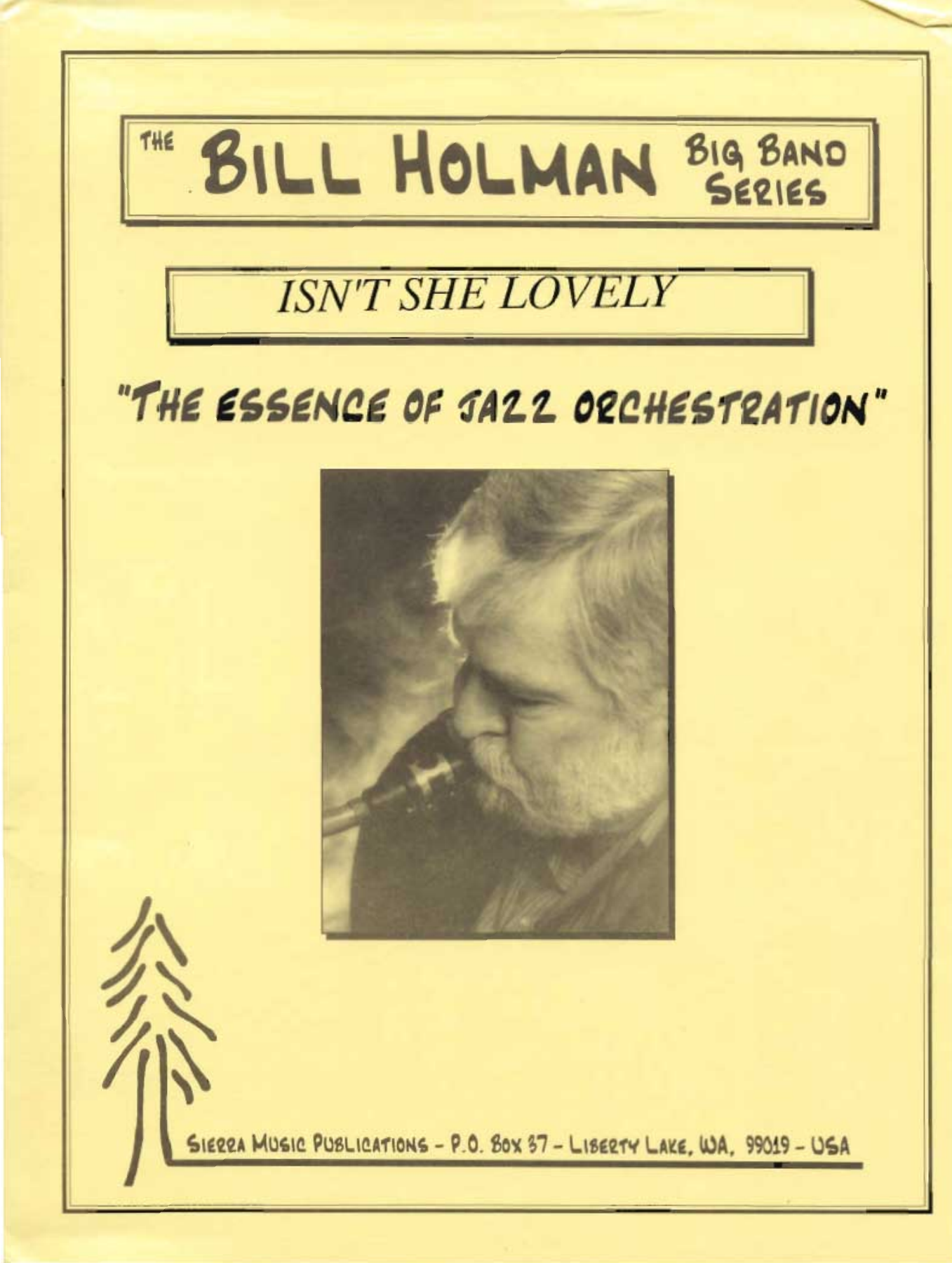
Isn't She Lovely (B.Holman)
Composed by Stevie Wonder
Arranged by Bill Holman
- Ensemble: Big Band
- Style: Jazz Standard
- Pages: 89
- Instruments (17): Alto Saxophone 1, Alto Saxophone 2, Tenor Saxophone 1 (Solo), Tenor Saxophone 2, Baritone Saxophone, Trumpet 1, Trumpet 2, Trumpet 3, Trumpet 4, Trombone 1, Trombone 2, Trombone 3, Bass Trombone 4, Guitar, Piano (Solo), Bass, Drums
- Difficulty: advanced
- Content: Individual Parts
- Format: PDF Download (Instant)
- Price: $24.99
Stevie Wonder's "Isn't She Lovely," a joyous celebration penned in 1976 for his newborn daughter, Aisha, stands as a monumental work from his seminal album *Songs in the Key of Life*. This iconic track, while not initially released as a single, quickly transcended its pop origins to become a beloved standard, frequently covered across genres and particularly embraced by the jazz community for its infectious melody, sophisticated harmonic progression, and inherent improvisational potential. Its enduring appeal lies in its blend of soulful R&B groove with a sophisticated harmonic language, making it a natural fit for jazz interpretation. The original composition, characterized by its distinctive harmonica melody and buoyant 4/4 meter, captures a universal sense of wonder and affection, resonating deeply with audiences worldwide and solidifying its place in the modern American songbook. Bill Holman's masterful big band arrangement of "Isn't She Lovely" transforms this contemporary classic into a sophisticated, medium-swing vehicle, imbued with his signature wit and harmonic ingenuity. Set primarily in the key of E-flat major, the arrangement maintains the original's bright, optimistic mood while elevating its musical complexity. Holman, renowned for his intricate voicings and contrapuntal lines, crafts an arrangement that is both familiar and fresh. The piece opens with a captivating ensemble statement of the melody, often featuring layered brass and saxophones in rich, close-knit harmonies that are unmistakably Holman. The energy throughout is consistently buoyant, driven by a solid, yet flexible, medium-swing rhythm section that underpins the intricate horn work. Holman's distinctive approach shines through in his treatment of the melody and the subsequent development. The initial melodic statements are often passed between sections, creating a dynamic call-and-response texture before coalescing into powerful soli passages. Expect trademark Holman shout choruses, where the full ensemble erupts in tightly voiced, harmonically adventurous figures that propel the piece forward with exhilarating force. There are ample opportunities for featured solos, typically over the original's well-known chord changes, allowing soloists to engage with the familiar harmonic landscape while navigating Holman's reharmonizations. The arrangement challenges performers with its rhythmic precision and demanding ensemble blend, particularly in the intricate counter-melodies and rapid-fire soli sections. The rewarding aspect lies in achieving the seamless interplay and vibrant energy that defines Holman's best work. This arrangement is ideally suited for advanced high school, collegiate, community, and professional big bands. Its demands on ensemble precision, individual musicianship, and rhythmic sophistication make it an excellent choice for groups looking to tackle a challenging yet incredibly rewarding chart. The intricate voicings require strong intonation and blend from all sections, while the rhythmic figures necessitate a tight, cohesive rhythm section. Performing this arrangement offers a valuable educational experience in navigating complex big band writing and interpreting the nuanced stylistic elements of a true jazz master. Conductors should emphasize a consistent, relaxed medium-swing feel from the outset, ensuring the rhythm section lays down a solid, yet agile, foundation. The primary technical challenge lies in achieving clarity and balance within Bill Holman’s characteristically dense voicings and intricate soli passages, particularly in the saxophone and brass sections. Encourage musicians to listen across the ensemble to ensure precise rhythmic alignment and blend. Articulation should be crisp and unified, especially in the brass. Solo sections, typically over the original changes, require improvisers to be both melodically inventive and harmonically aware of Holman’s reharmonizations. Rehearsal time should be dedicated to isolating and polishing the shout choruses and any rapid, contrapuntal lines to ensure maximum impact and precision. Q: What instruments and parts are included in this arrangement? A: This arrangement is scored for a standard 17-piece big band, including Alto Saxophone 1, Alto Saxophone 2, Tenor Saxophone 1, Tenor Saxophone 2, Baritone Saxophone, Trumpet 1, Trumpet 2, Trumpet 3, Trumpet 4, Trombone 1, Trombone 2, Trombone 3, Bass Trombone, Piano, Bass, Drums, and Guitar. It also includes an 89-page conductor score. Q: What is the difficulty level of this arrangement? A: This arrangement is considered advanced, suitable for collegiate, community, and professional big bands. It demands strong individual musicianship, precise ensemble playing, and a sophisticated understanding of jazz articulation and phrasing. Q: What is the musical style and historical context of this arrangement? A: This is a big band jazz arrangement of Stevie Wonder's "Isn't She Lovely," a pop/R&B classic from 1976. Bill Holman's treatment transforms it into a sophisticated medium-swing jazz standard, reflecting his distinctive West Coast jazz arranging style. Q: What makes Bill Holman's arrangement of "Isn't She Lovely" unique? A: Holman's arrangement is characterized by his intricate, often contrapuntal voicings, sophisticated reharmonizations, and dynamic use of soli and shout choruses. He maintains the original's joyous spirit while infusing it with his signature harmonic complexity and rhythmic drive. Q: What is the typical performance duration and tempo of this piece? A: The performance duration will vary slightly based on solo lengths, but typically ranges from 4 to 6 minutes. The arrangement is designed for a consistent medium-swing tempo, allowing for both melodic clarity and rhythmic buoyancy.
Questions and answers
- What is included in the Isn't She Lovely (B.Holman) PDF?
- The verified current file contains a conductor score and individual parts across 89 pages.
- How many instruments or parts are listed for Isn't She Lovely (B.Holman)?
- The verified instrumentation list contains 17 entries for this Big Band arrangement.
- Who is credited for Isn't She Lovely (B.Holman)?
- Composer: Stevie Wonder. Arranger: Bill Holman.
- What difficulty is listed for Isn't She Lovely (B.Holman)?
- The verified difficulty level is advanced.
- What style is listed for Isn't She Lovely (B.Holman)?
- The catalog lists the style as Jazz Standard.
- Can I preview Isn't She Lovely (B.Holman) before buying?
- Yes. The product page provides a preview generated from the current PDF file.
- How is Isn't She Lovely (B.Holman) delivered?
- After successful payment, the digital PDF is made available for download. The displayed price is $24.99.
Musicians Also Search For
Isn't She Lovely Bill Holman PDF • Isn't She Lovely Bill Holman sheet music • Isn't She Lovely arranged by Bill Holman • Bill Holman big band charts • Bill Holman jazz arrangements PDF • Isn't She Lovely Stevie Wonder sheet music • Isn't She Lovely Stevie Wonder big band arrangements • Stevie Wonder big band charts • Isn't She Lovely big band arrangements • Isn't She Lovely big band PDF download • Isn't She Lovely jazz sheet music • big band sheet music download • Isn't She Lovely conductor score PDF • Isn't She Lovely individual parts download • Isn't She Lovely sheet music PDF • Isn't She Lovely Jazz Standard charts • Jazz Standard big band arrangements • buy Isn't She Lovely sheet music • download Isn't She Lovely PDF • Isn't She Lovely jazz charts • best Bill Holman big band arrangements • Stevie Wonder arranged by Bill Holman • Isn't She Lovely printable sheet music • big band repertoire PDF