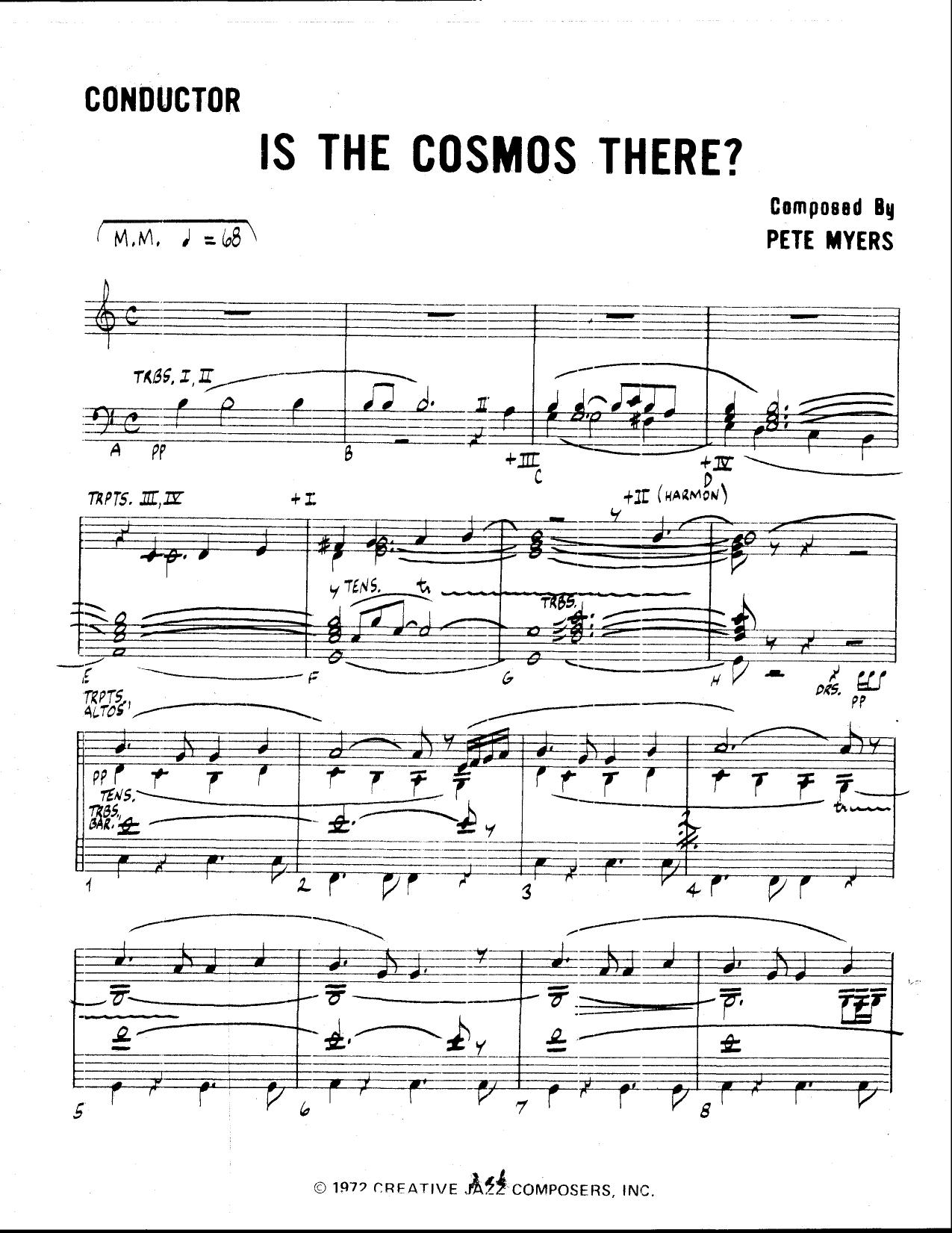
Is The Cosmos There (P.Myers) sheet music preview

Is The Cosmos There (P.Myers)

Composed by P. Myers

Arranged by P.Myers

  • Ensemble: Big Band
  • Style: Jazz Standard
  • Pages: 41
  • Instruments (18): 1st Alto Saxophone, 2nd Alto Saxophone, 3rd Tenor Saxophone, 4th Tenor Saxophone, 5th Baritone Saxophone, 1st Trumpet, 2nd Trumpet, 3rd Trumpet, 4th Trumpet, 1st Trombone, 2nd Trombone, 3rd Trombone, 4th Trombone, Bass, Drums, Percussion, Piano, Guitar
  • Difficulty: advanced
  • Content: Individual Parts
  • Format: PDF Download (Instant)
  • Price: $24.99

"Is The Cosmos There," composed and arranged by P. Myers, stands as a compelling entry into the modern big band repertoire, offering a sophisticated exploration of the jazz standard tradition. While the original composition date is not widely publicized, its musical language evokes the rich harmonic and melodic sensibilities of post-bop and contemporary jazz, aligning with the evolution of the jazz standard from its Tin Pan Alley roots through the innovative mid-20th century. The piece is not attributed to a single famous recording artist in the traditional sense of a "standard" popularized by a specific rendition, but rather establishes its own identity through its intricate compositional and arranging craft. This allows the work to be appreciated for its inherent musicality and its contribution to the ongoing development of big band literature, resonating with ensembles seeking challenging and rewarding material that pushes beyond conventional boundaries. The musical character of "Is The Cosmos There" is defined by a medium-up tempo swing feel, typically hovering around 160-180 BPM, though flexible to the ensemble's interpretation. The primary key signature is often modal, suggesting a sophisticated harmonic palette that moves beyond simple diatonicism, creating an expansive and introspective mood. The piece balances moments of driving energy with sections of lyrical introspection, evoking a sense of wonder and cosmic contemplation. Expect rich, extended harmonies, often featuring quartal voicings and subtle dissonances that resolve elegantly, contributing to a modern, yet accessible, sound. The overall energy is dynamic, building from nuanced textures to powerful, full-ensemble statements, creating an engaging narrative arc throughout the performance. P. Myers' arranging approach is characterized by a masterful command of big band orchestration, utilizing the full 19-instrument palette to create a tapestry of sound. Signature techniques include intricate counterpoint between sections, particularly within the saxophone and brass choirs, and strategically placed soli sections that highlight the ensemble's precision and blend. The arrangement features several impactful shout choruses that build intensity and excitement, often employing layered rhythmic figures and dense harmonic voicings. There are subtle modulations that broaden the harmonic landscape, preventing stagnation and maintaining listener engagement. Myers demonstrates a keen understanding of how to craft a big band chart that is both intellectually stimulating and viscerally thrilling, drawing on his extensive experience as a composer and arranger. The melody of "Is The Cosmos There" is initially carried by a combination of the lead alto saxophone and trumpet, often in unison or octaves, providing a clear and soaring line. Subsequent sections see the melody passed between various sections, including a lyrical trombone soli and a powerful saxophone soli, showcasing the versatility of the ensemble. Featured solo opportunities are prominently placed for tenor saxophone and trumpet, allowing improvisers to explore the rich harmonic framework. Technical challenges include demanding ensemble precision in fast-moving soli passages, intricate rhythmic interplay within the rhythm section, and the need for strong individual soloists capable of navigating complex harmonic changes with creativity and conviction. The rewarding aspect of performing this piece lies in its depth and the collective achievement of bringing its expansive musical vision to life, culminating in a powerful and memorable experience for both performers and audience. This arrangement is ideally suited for advanced high school, collegiate, community, and professional big bands. Its sophisticated harmonic language, intricate ensemble writing, and significant solo demands require a high level of musicianship, technical proficiency, and ensemble cohesion. Bands with strong lead players in all sections, particularly in the trumpet and saxophone chairs, and a rhythm section capable of maintaining a nuanced yet driving swing feel, will find this piece to be an exceptional vehicle for demonstrating their abilities and expanding their repertoire. Conductors should emphasize precision in rhythmic figures, particularly during the fast-paced soli sections and shout choruses where intricate syncopation demands tight ensemble playing. A consistent, medium-up swing feel is paramount, with the rhythm section driving the pulse while maintaining flexibility for dynamic shifts. Encourage the bass and drums to lock into a solid groove, providing a foundation for the horn lines. Special attention should be given to articulation markings; precise staccatos, tenutos, and accents are crucial for conveying the intended character and clarity of the melodic and rhythmic motifs. Brass players should be prepared for dynamic contrasts, from subtle whispers to full-bodied fortissimos, and be mindful of blend and balance within their sections and with the saxophones. Rehearsal time should be dedicated to isolating challenging harmonic passages and ensuring all voices within chords are balanced and in tune, particularly in the extended voicings. Soloists should be encouraged to explore the modal implications of the harmony, utilizing scales and arpeggios that complement the contemporary jazz aesthetic of the piece. Q: What instruments and parts are included in this arrangement? A: This arrangement includes a full 19-instrument big band score: Conductor Score, Alto Saxophone 1, Alto Saxophone 2, Tenor Saxophone 3, Tenor Saxophone 4, Baritone Saxophone, Trumpet 1, Trumpet 2, Trumpet 3, Trumpet 4, Trombone 1, Trombone 2, Trombone 3, Bass Trombone, Piano, Bass, Drums, and Guitar. Q: What is the difficulty level of "Is The Cosmos There (P.Myers)"? A: This arrangement is considered advanced, suitable for high school, collegiate, community, and professional big bands. It features complex harmonies, intricate ensemble passages, and demanding solo sections that require skilled musicianship. Q: What is the musical style and historical context of this piece? A: "Is The Cosmos There" is a contemporary jazz standard, reflecting the post-bop and modern jazz traditions. While it doesn't have a specific historical recording that made it famous, its compositional style aligns with sophisticated big band writing from the mid-20th century onwards. Q: What makes this arrangement unique or distinctive? A: P. Myers' arrangement is distinguished by its sophisticated harmonic language, intricate counterpoint between sections, impactful shout choruses, and strategic use of soli passages. It offers a fresh and expansive interpretation of the jazz standard format. Q: What is the approximate performance duration or tempo of this piece? A: The piece is typically performed at a medium-up swing tempo, generally ranging from 160-180 BPM. The exact duration will vary based on tempo choices and the length of improvised solos.

Questions and answers

What is included in the Is The Cosmos There (P.Myers) PDF?
The verified current file contains a conductor score and individual parts across 41 pages.
How many instruments or parts are listed for Is The Cosmos There (P.Myers)?
The verified instrumentation list contains 18 entries for this Big Band arrangement.
Who is credited for Is The Cosmos There (P.Myers)?
Composer: P. Myers. Arranger: P.Myers.
What difficulty is listed for Is The Cosmos There (P.Myers)?
The verified difficulty level is advanced.
What style is listed for Is The Cosmos There (P.Myers)?
The catalog lists the style as Jazz Standard.
Can I preview Is The Cosmos There (P.Myers) before buying?
Yes. The product page provides a preview generated from the current PDF file.
How is Is The Cosmos There (P.Myers) delivered?
After successful payment, the digital PDF is made available for download. The displayed price is $24.99.

Musicians Also Search For

Is The Cosmos There P.Myers PDFIs The Cosmos There P.Myers sheet musicIs The Cosmos There arranged by P.MyersP.Myers big band chartsP.Myers jazz arrangements PDFIs The Cosmos There P. Myers sheet musicIs The Cosmos There P. Myers big band arrangementsP. Myers big band chartsIs The Cosmos There big band arrangementsIs The Cosmos There big band PDF downloadIs The Cosmos There jazz sheet musicbig band sheet music downloadIs The Cosmos There conductor score PDFIs The Cosmos There individual parts downloadIs The Cosmos There sheet music PDFIs The Cosmos There Jazz Standard chartsJazz Standard big band arrangementsbuy Is The Cosmos There sheet musicdownload Is The Cosmos There PDFIs The Cosmos There jazz chartsbest P.Myers big band arrangementsP. Myers arranged by P.MyersIs The Cosmos There printable sheet musicbig band repertoire PDF

All arrangements by P.Myers All P. Myers sheet music