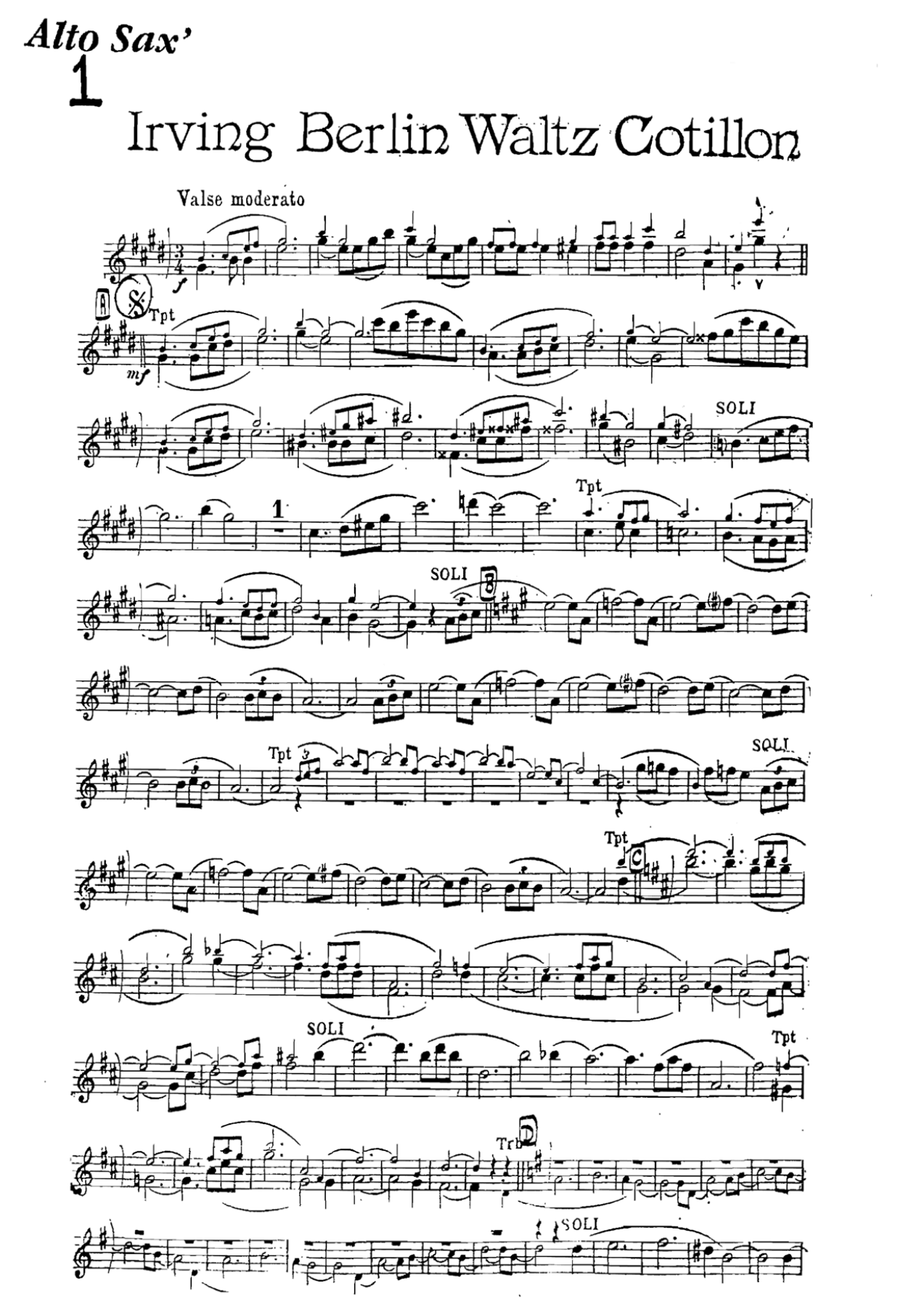
Irving Berlin Waltz Cotillion - Walts (I.Cotillion)
Composed by Irving Berlin
Arranged by Irving Berlin Waltz Cotillion
- Ensemble: Big Band
- Style: Waltz
- Pages: 21
- Instruments (10): Alto Sax' 1, Alto Sax' 3, Tenor Sax' 2, Trumpet 1, Trumpet 2, Trombone, Piano, Bass, Drums, Guitar
- Difficulty: medium
- Content: Individual Parts
- Format: PDF Download (Instant)
- Price: $24.99
Irving Berlin's "Waltz Cotillion," a charming and often overlooked gem from the early 20th century, emerges here in a sophisticated big band treatment by the arranger Irving Berlin Waltz Cotillion. While the original composition dates back to the nascent days of American popular music, predating the swing era, this arrangement reimagines the piece through a distinctly modern lens, transforming its inherent grace into a captivating jazz waltz. The original "Cotillion" was a popular dance form, and Berlin's composition captured the elegance and structured movement of the era, though it never achieved the widespread fame of his later standards like "Blue Skies" or "Cheek to Cheek." This arrangement, however, elevates the piece, showcasing its melodic beauty and harmonic potential within a contemporary big band framework, making it a delightful addition to any ensemble's repertoire and a fascinating study in musical evolution. The musical character of this arrangement is a nuanced blend of classic charm and rhythmic sophistication. Set in a comfortable 3/4 time signature, it eschews a traditional swing feel for a more lilting, graceful jazz waltz groove, reminiscent of later European jazz influences or even some of Bill Evans's trio work. The primary key is D major, lending a bright, optimistic, yet refined mood. The tempo is a medium-slow waltz (quarter note around 108-116 bpm), allowing for expressive phrasing and rich harmonic exploration. The overall energy is one of elegant dynamism, building from delicate ensemble passages to full-bodied, yet never overwhelming, climaxes. The arrangement evokes a sense of nostalgia blended with fresh interpretation, perfect for a concert opener or a featured moment in a set. The arranger, Irving Berlin Waltz Cotillion, approaches this piece with a keen ear for both historical reverence and contemporary big band voicing. Distinctive features include lush, often close-voiced saxophone soli sections that weave intricate counter-melodies, providing a rich harmonic texture. The brass writing is articulate and supportive, employing tasteful plunger mute work in the trombones during certain sections to add color without sacrificing clarity. There are no extended improvisational solos, maintaining the piece's ensemble-centric nature; instead, melodic lines are passed between sections, creating a dynamic conversational feel. The arrangement features several subtle modulations that keep the harmonic landscape fresh and engaging, ultimately returning to the home key with a satisfying resolution. This approach highlights the inherent beauty of Berlin's melody while showcasing the full expressive capabilities of the modern big band. Performance of "Waltz Cotillion" is both rewarding and challenging. The main melody is initially carried by the lead alto saxophone, then passed to the trumpet section, and later featured in a full ensemble soli. Technical challenges include precise articulation in the woodwind soli passages, maintaining a consistent and flowing jazz waltz feel in the rhythm section, and achieving balanced dynamics across the full ensemble, particularly in sections with layered voicings. The piece demands excellent blend and intonation, especially in the sustained brass chords. A standout musical moment is the development section where the harmonic progression becomes more adventurous, leading to a powerful, yet controlled, shout chorus that builds to a majestic final statement. This arrangement is ideally suited for college-level big bands seeking to expand their repertoire with a piece that offers both musical depth and a unique stylistic challenge, as well as advanced community bands or professional ensembles looking for a sophisticated and engaging concert selection. "Waltz Cotillion" requires a delicate balance of precision and expressive freedom within its jazz waltz framework. The primary technical challenge lies in maintaining a consistent, flowing 3/4 pulse, avoiding any tendency to rush or drag, particularly in the rhythm section. Drummers should focus on a light, driving cymbal pattern with subtle bass drum accents on beat one. The saxophone soli sections demand meticulous attention to blend, intonation, and uniform articulation; practicing these passages slowly and sectionally will yield the best results. Trumpets should execute the plunger mute sections with controlled, crisp articulation, ensuring the "wah" effect is musical and not overdone. Conductors should emphasize dynamic contrasts, allowing the softer, lyrical moments to breathe before building to the full ensemble climaxes. Rehearsal should focus on the interplay between sections, ensuring that melodic lines are clearly heard when passed between instruments, and that the harmonic richness is fully realized. Q: What instruments and parts are included in this arrangement? A: This arrangement is scored for a standard 17-piece big band, including Alto Saxophone 1 & 2, Tenor Saxophone 1 & 2, Baritone Saxophone, Trumpet 1-4, Trombone 1-4, Piano, Bass, and Drums. Q: What is the difficulty level of "Irving Berlin Waltz Cotillion - Walts (I.Cotillion)"? A: This arrangement is rated as medium-advanced (Grade 4-5), suitable for college-level big bands, advanced community ensembles, or professional groups due to its intricate voicings, dynamic demands, and precise ensemble playing requirements. Q: What is the musical style and historical context of this arrangement? A: This is a contemporary jazz waltz arrangement of Irving Berlin's early 20th-century composition "Waltz Cotillion," blending the elegance of the original with modern big band harmonic and rhythmic sophistication. Q: What makes this specific arrangement by Irving Berlin Waltz Cotillion unique? A: The arranger's distinctive approach lies in its lush, close-voiced saxophone solis, tasteful brass plunger mute work, and a focus on ensemble interplay rather than extended individual solos, transforming a classic waltz into a sophisticated jazz concert piece. Q: What is the approximate performance duration and tempo of this piece? A: The approximate performance duration is 4-5 minutes, performed at a medium-slow jazz waltz tempo (quarter note = 108-116 bpm).
Questions and answers
- What is included in the Irving Berlin Waltz Cotillion - Walts (I.Cotillion) PDF?
- The verified current file contains individual parts across 21 pages.
- How many instruments or parts are listed for Irving Berlin Waltz Cotillion - Walts (I.Cotillion)?
- The verified instrumentation list contains 10 entries for this Big Band arrangement.
- Who is credited for Irving Berlin Waltz Cotillion - Walts (I.Cotillion)?
- Composer: Irving Berlin. Arranger: Irving Berlin Waltz Cotillion.
- What difficulty is listed for Irving Berlin Waltz Cotillion - Walts (I.Cotillion)?
- The verified difficulty level is medium.
- What style is listed for Irving Berlin Waltz Cotillion - Walts (I.Cotillion)?
- The catalog lists the style as Waltz.
- Can I preview Irving Berlin Waltz Cotillion - Walts (I.Cotillion) before buying?
- Yes. The product page provides a preview generated from the current PDF file.
- How is Irving Berlin Waltz Cotillion - Walts (I.Cotillion) delivered?
- After successful payment, the digital PDF is made available for download. The displayed price is $24.99.
Musicians Also Search For
Irving Berlin Waltz Cotillion - Walts Irving Berlin Waltz Cotillion PDF • Irving Berlin Waltz Cotillion - Walts Irving Berlin Waltz Cotillion sheet music • Irving Berlin Waltz Cotillion - Walts arranged by Irving Berlin Waltz Cotillion • Irving Berlin Waltz Cotillion big band charts • Irving Berlin Waltz Cotillion jazz arrangements PDF • Irving Berlin Waltz Cotillion - Walts Irving Berlin sheet music • Irving Berlin Waltz Cotillion - Walts Irving Berlin big band arrangements • Irving Berlin big band charts • Irving Berlin Waltz Cotillion - Walts big band arrangements • Irving Berlin Waltz Cotillion - Walts big band PDF download • Irving Berlin Waltz Cotillion - Walts jazz sheet music • big band sheet music download • Irving Berlin Waltz Cotillion - Walts individual parts download • Irving Berlin Waltz Cotillion - Walts sheet music PDF • Irving Berlin Waltz Cotillion - Walts Waltz charts • Waltz big band arrangements • buy Irving Berlin Waltz Cotillion - Walts sheet music • download Irving Berlin Waltz Cotillion - Walts PDF • Irving Berlin Waltz Cotillion - Walts jazz charts • best Irving Berlin Waltz Cotillion big band arrangements • Irving Berlin arranged by Irving Berlin Waltz Cotillion • Irving Berlin Waltz Cotillion - Walts printable sheet music • big band repertoire PDF