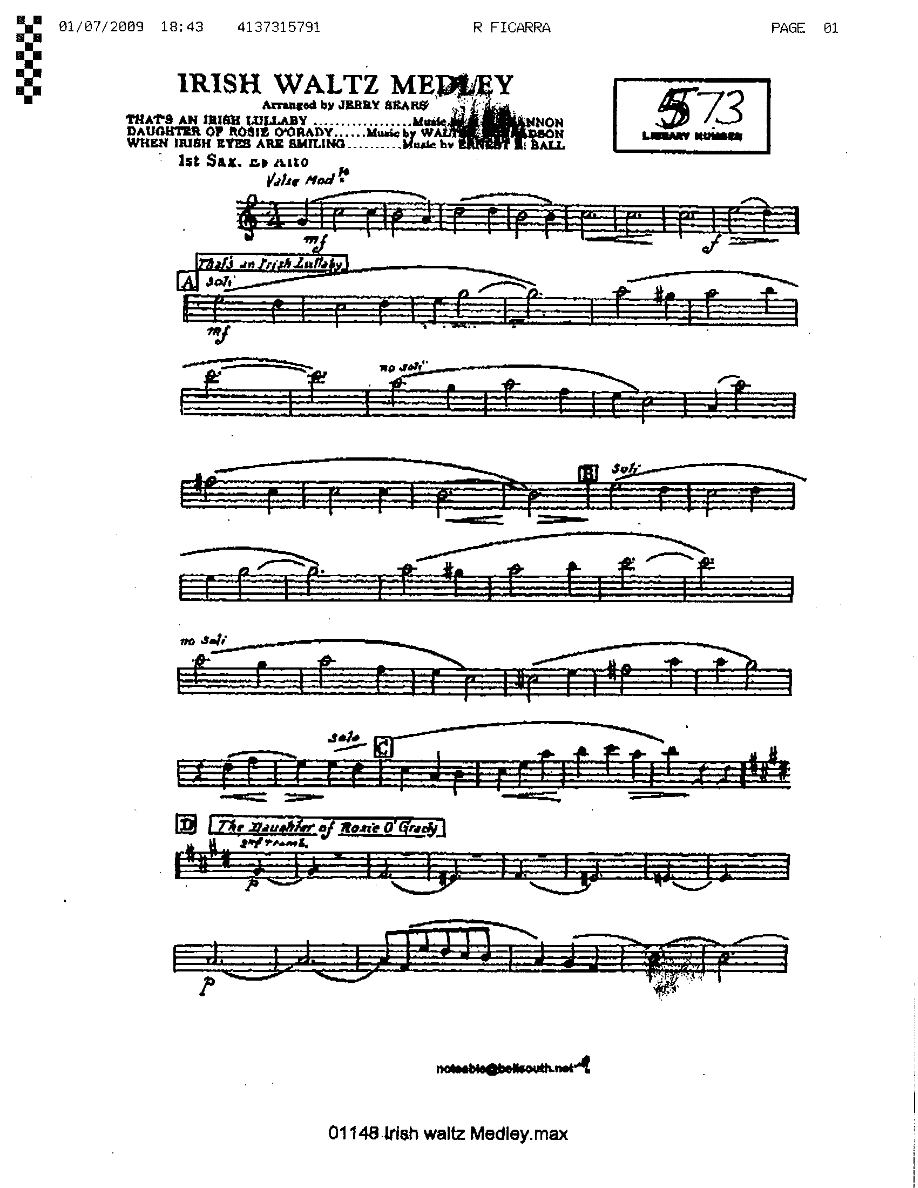
Irish Waltz Medley (J.Sears)
Composed by Traditional
Arranged by J. Sears
- Ensemble: Big Band Dance
- Style: Big Band Dance
- Pages: 22
- Instruments (17): 1st Sax. Eb Alto, 2nd Sax. Bb Tenor, 3rd Sax. Eb Alto, 4th Sax. Bb Tenor, 5th Sax. Eb Baritone, 1st Trumpet in Bb, 2nd Trumpet in Bb, 3rd Trumpet in Bb, 4th Trumpet in Bb, 1st Trombone, 2nd Trombone, 3rd Trombone, 4th Trombone, Bass, Guitar, Drums, Piano
- Difficulty: medium
- Content: Individual Parts
- Format: PDF Download (Instant)
- Price: $24.99
The rich tradition of Irish folk music, characterized by its evocative melodies and danceable rhythms, finds a sophisticated new voice in J. Sears' "Irish Waltz Medley." While the original tunes are drawn from a vast, centuries-old oral tradition, this arrangement reimagines them through the lens of the American big band dance era, a period roughly spanning the 1930s to the 1950s. Unlike typical jazz standards originating from Tin Pan Alley or Broadway, this medley takes traditional, anonymous compositions and infuses them with the lush harmonies, intricate voicings, and dynamic contrasts synonymous with classic big band charts. It evokes the spirit of a bygone era where dance halls pulsed with live orchestras, offering a unique blend of Celtic charm and swing-era sophistication. Musically, this "Irish Waltz Medley" establishes a flowing, medium waltz feel (3/4 time) throughout, maintaining a graceful yet energetic character. The primary key centers around G major, providing a bright and accessible tonality, though Sears masterfully employs modulations to A-flat major and B-flat major, adding harmonic interest and lifting the emotional trajectory of the piece. The mood is celebratory and nostalgic, evoking images of festive gatherings and elegant ballroom dancing. There's a palpable sense of joy and warmth, achieved through the careful interplay of melodic lines and rich harmonic textures. The energy builds steadily, culminating in a powerful, uplifting conclusion that leaves a lasting impression. J. Sears' distinctive arranging approach is evident in the thoughtful orchestration and dynamic shaping of this medley. The opening melody is introduced by the alto saxophone, setting a warm and inviting tone, before being passed to the full saxophone section in a beautifully voiced soli. Sears frequently utilizes layered brass figures and intricate counter-melodies, ensuring every section contributes to the overall tapestry. There are no extended improvised solos in this arrangement; instead, the focus is on the ensemble's precision and blend. The brass sections feature powerful, yet controlled, shout choruses that punctuate the melodic flow, while the trombone section often provides a robust, harmonically supportive foundation. Sears' signature technique of reharmonizing traditional melodies with extended jazz chords (9ths, 11ths, 13ths) without losing the original melodic integrity is particularly effective here, giving the familiar tunes a fresh, sophisticated sheen. Performing this medley is a rewarding experience for a well-rehearsed ensemble. The primary challenge lies in maintaining the consistent waltz feel across all sections and achieving precise articulation within the intricate soli passages. The brass sections will need to focus on blend and dynamic control, particularly in the shout sections, to ensure clarity without overpowering the woodwinds. The arrangement is well-suited for advanced high school, college, community, and professional big bands looking for a unique and engaging piece that stands apart from typical jazz repertoire. Its blend of familiar folk melodies with sophisticated big band arranging offers both accessibility for audiences and stimulating musical challenges for performers, making it a standout addition to any concert program. Conductors should emphasize a consistent, flowing medium waltz tempo (approx. quarter note = 144-152) from the outset, ensuring the rhythm section provides a solid, yet flexible, 3/4 foundation. The key technical challenges include precise articulation in the saxophone soli passages, particularly ensuring uniform phrasing and dynamic shaping. Brass sections must focus on clean entrances and releases, especially during the powerful shout choruses, where dynamic control is paramount to avoid overblowing. There are no specific extended techniques like plunger mutes or falls required, allowing musicians to concentrate on blend and balance. Rehearsal time should be dedicated to balancing the rich voicings, ensuring inner voices are heard without obscuring the main melodic lines. Pay close attention to the dynamic swells and diminuendos indicated, as these are crucial to the emotional arc of the medley. Q: What instruments are included in this arrangement? A: This arrangement is scored for a standard big band, including Alto Saxophone, Tenor Saxophone, Baritone Saxophone, Trumpet, Trombone, Piano, Bass, and Drums. It is designed for 9 instruments, with specific parts for each. Q: What is the difficulty level of "Irish Waltz Medley (J. Sears)"? A: This arrangement is considered advanced intermediate to advanced. It requires strong ensemble playing, precise articulation, and good dynamic control, making it suitable for advanced high school, college, community, and professional big bands. Q: What is the musical style and historical context of this piece? A: The arrangement blends traditional Irish folk melodies with the musical style of the American big band dance era (1930s-1950s). It reimagines these ancient tunes with sophisticated jazz harmonies and orchestration, creating a unique "Big Band Dance" interpretation. Q: What makes J. Sears' arrangement of this medley unique? A: Sears' arrangement is distinctive for its sophisticated reharmonization of traditional melodies, intricate sectional voicings, and dynamic contrasts, including powerful brass shout choruses, all while maintaining a graceful waltz feel. It focuses on ensemble precision rather than improvised solos. Q: What is the recommended tempo and approximate duration for this arrangement? A: The recommended tempo is a medium waltz, approximately quarter note = 144-152. The approximate performance duration is around 4-5 minutes, depending on the chosen tempo and interpretation.
Questions and answers
- What is included in the Irish Waltz Medley (J.Sears) PDF?
- The verified current file contains individual parts across 22 pages.
- How many instruments or parts are listed for Irish Waltz Medley (J.Sears)?
- The verified instrumentation list contains 17 entries for this Big Band Dance arrangement.
- Who is credited for Irish Waltz Medley (J.Sears)?
- Composer: Traditional. Arranger: J. Sears.
- What difficulty is listed for Irish Waltz Medley (J.Sears)?
- The verified difficulty level is medium.
- What style is listed for Irish Waltz Medley (J.Sears)?
- The catalog lists the style as Big Band Dance.
- Can I preview Irish Waltz Medley (J.Sears) before buying?
- Yes. The product page provides a preview generated from the current PDF file.
- How is Irish Waltz Medley (J.Sears) delivered?
- After successful payment, the digital PDF is made available for download. The displayed price is $24.99.
Musicians Also Search For
Irish Waltz Medley J. Sears PDF • Irish Waltz Medley J. Sears sheet music • Irish Waltz Medley arranged by J. Sears • J. Sears big band dance charts • J. Sears jazz arrangements PDF • Irish Waltz Medley Traditional sheet music • Irish Waltz Medley Traditional big band dance arrangements • Traditional big band dance charts • Irish Waltz Medley big band dance arrangements • Irish Waltz Medley big band dance PDF download • Irish Waltz Medley jazz sheet music • big band dance sheet music download • Irish Waltz Medley individual parts download • Irish Waltz Medley sheet music PDF • Irish Waltz Medley Big Band Dance charts • Big Band Dance big band dance arrangements • buy Irish Waltz Medley sheet music • download Irish Waltz Medley PDF • Irish Waltz Medley jazz charts • best J. Sears big band dance arrangements • Traditional arranged by J. Sears • Irish Waltz Medley printable sheet music • big band dance repertoire PDF