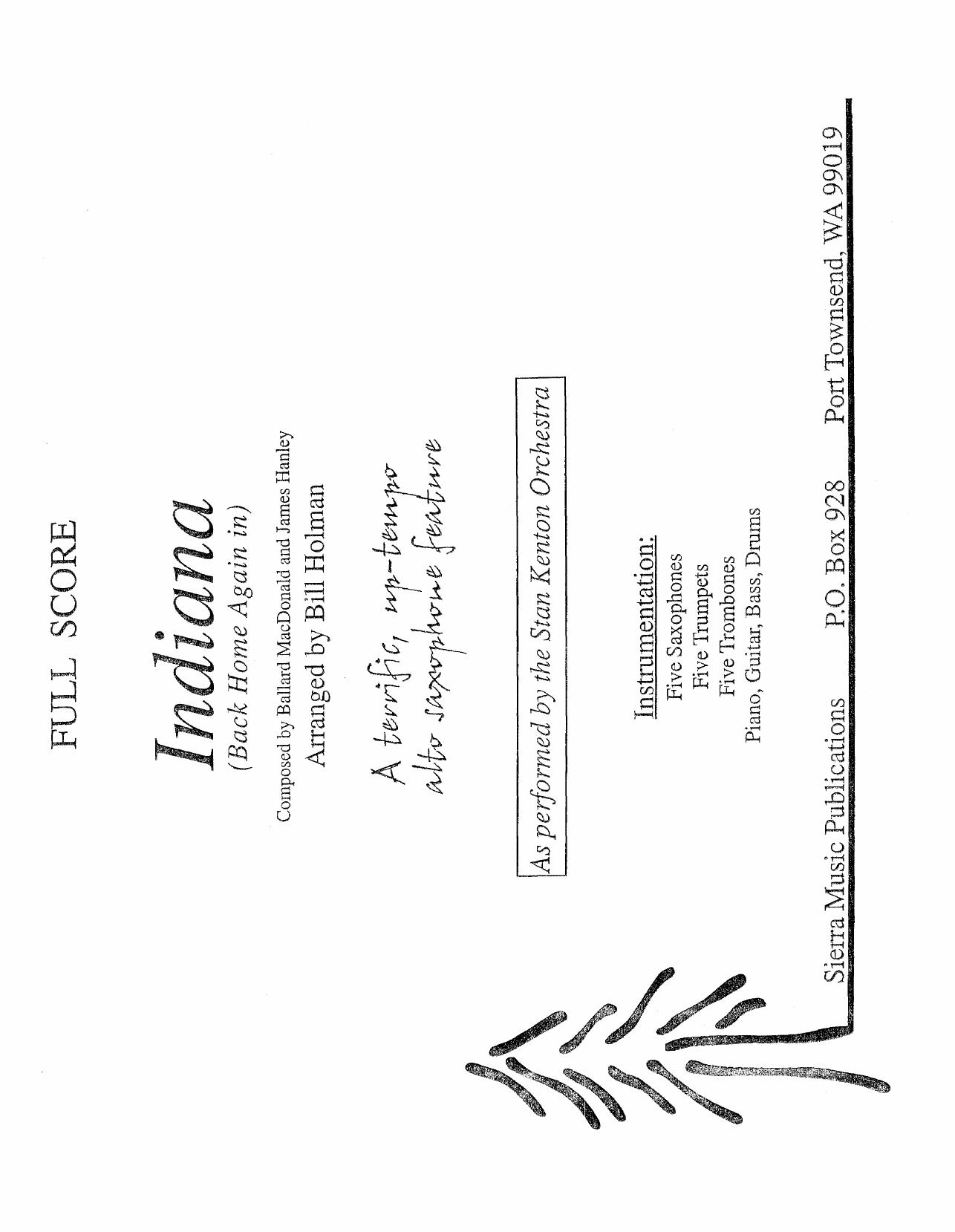
Indiana (B.Holman)
Composed by James F. Hanley
Arranged by Bill Holman
- Ensemble: Big Band
- Pages: 105
- Instruments (19): Alto Saxophone 1 (Solo), Alto Saxophone 2, Tenor Saxophone 1, Tenor Saxophone 2, Baritone Saxophone, Trumpet 1, Trumpet 2, Trumpet 3, Trumpet 4, Trumpet 5, Trombone 1, Trombone 2, Trombone 3, Trombone 4, Bass Trombone 5, Piano, Guitar, Bass, Drums
- Difficulty: advanced
- Content: Individual Parts
- Format: PDF Download (Instant)
- Price: $24.99
"Back Home Again in Indiana," written by James F. Hanley with lyrics by Ballard MacDonald in 1917, stands as one of the foundational pillars of the traditional jazz and swing repertoires. While initially a popular Tin Pan Alley tune, its rapid chord changes—closely mirroring George Gershwin's "I Got Rhythm"—transformed the composition into an essential vehicle for improvisation during the swing and bebop eras. Legendary interpretations by artists like Louis Armstrong, Lennie Tristano, and Charlie Parker cemented its status as an ultimate test of harmonic fluency. In the hands of master arranger Bill Holman, this historic standard undergoes a brilliant modernist transformation, filtering early-century optimism through the sophisticated, harmonically adventurous lens of West Coast modern jazz. Driven by an invigorating up-tempo swing feel, Holman’s chart crackles with relentless forward momentum, sharp linear counterpoint, and unexpected rhythmic displacements. The mood is high-energy, intellectually stimulating, and intensely joyful, evoking the breezy yet complex aesthetic of the 1950s Los Angeles jazz scene. Holman avoids predictable big band clichés, opting instead for labyrinthine horn lines that weave through sophisticated altered dominants and chromatic shifts. The emotional arc moves swiftly from virtuosic, high-velocity head statements to expansive, harmonically rich developmental sections that demand absolute precision and collective focus from every section of the orchestra. Holman’s signature arranging style is on full display here, characterized by angular saxophone solis, ingenious voice-leading, and dense, brass-heavy textures that avoid muddying the sonic spectrum. The arrangement brilliantly balances transparent, lightweight passages—where the rhythm section drives a crisp, linear-driven pulse—with explosive, brass-driven shout choruses that showcase his penchant for startling dynamic contrasts and rich, extended tertian harmonies. The saxophones frequently carry intricate, bebop-infused thematic material at breakneck speeds, while the brass interject with razor-sharp stabs and angular counter-melodies that challenge traditional section roles. Advanced college ensembles, elite community big bands, and professional touring orchestras will find this chart an exhilarating centerpiece for a program. The primary technical challenges lie in the lightning-fast articulation required in the woodwinds, the stamina needed for sustained high-register brass writing, and the rhythmic acuity required to execute Holman's syncopated accents cleanly. Performing this arrangement offers immense artistic rewards, particularly through its masterclass-level integration of linear counterpoint and modern big band architecture, making it a definitive showcase for bands seeking to stretch their technical boundaries and stylistic versatility. Executing Bill Holman’s chart requires supreme rhythmic discipline and a light, driving swing feel at a brisk tempo. Conductor focus should center on maintaining a feather-light ride cymbal pulse from the drummer, avoiding heavy downbeats that can bog down the rapid harmonic movement. The saxophone section must practice their intricate passages under tempo, prioritizing clean articulation and uniform breath support before attempting full speed. Brass players should approach high-register passages with a focus on core resonance rather than forced volume, ensuring that Holman’s dense chord voicings speak clearly without masking the melodic lead. Pay careful attention to dynamic markings; the contrast between whispered, linear ensemble interplay and sudden, roaring tutti hits defines the structural integrity of this piece. Rehearsals should isolate the rhythm section first to lock in the groove, followed by sectional blend work before integrating the full ensemble. Q: What instruments and parts are included in this publication? A: The physical and digital package spans 105 pages across 19 standard big band instruments, including Alto Saxophone 1, Alto Saxophone 2, Tenor Saxophone 1, Tenor Saxophone 2, Baritone Saxophone, four trumpets, four trombones, guitar, piano, bass, drums, and a comprehensive full conductor score. Q: What is the difficulty level of this Bill Holman arrangement? A: This chart is graded as advanced, demanding professional-level technical proficiency, exceptional sight-reading capabilities, and strong endurance from all sections, particularly the rhythm and saxophone sections. Q: What musical style and historical era does this arrangement represent? A: It represents West Coast modern jazz of the 1950s, taking a 1917 Tin Pan Alley traditional standard and reimagining it through sophisticated, bebop-influenced harmonic structures and linear counterpoint. Q: What makes this specific arrangement by Bill Holman unique? A: Holman's distinct compositional voice avoids predictable block-chord writing, utilizing labyrinthine linear horn lines, unexpected harmonic substitutions, and ingenious voice-leading that treats the big band like a chamber orchestra of improvisers. Q: What is the performance tempo and duration of the piece? A: The arrangement is set at a brisk up-tempo swing feel, typically clocking in around 3 to 4 minutes depending on the length of improvised solo choruses taken during the performance.
Questions and answers
- What is included in the Indiana (B.Holman) PDF?
- The verified current file contains a conductor score and individual parts across 105 pages.
- How many instruments or parts are listed for Indiana (B.Holman)?
- The verified instrumentation list contains 19 entries for this Big Band arrangement.
- Who is credited for Indiana (B.Holman)?
- Composer: James F. Hanley. Arranger: Bill Holman.
- What difficulty is listed for Indiana (B.Holman)?
- The verified difficulty level is advanced.
- Can I preview Indiana (B.Holman) before buying?
- Yes. The product page provides a preview generated from the current PDF file.
- How is Indiana (B.Holman) delivered?
- After successful payment, the digital PDF is made available for download. The displayed price is $24.99.
Musicians Also Search For
Indiana Bill Holman PDF • Indiana Bill Holman sheet music • Indiana arranged by Bill Holman • Bill Holman big band charts • Bill Holman jazz arrangements PDF • Indiana James F. Hanley sheet music • Indiana James F. Hanley big band arrangements • James F. Hanley big band charts • Indiana big band arrangements • Indiana big band PDF download • Indiana jazz sheet music • big band sheet music download • Indiana conductor score PDF • Indiana individual parts download • Indiana sheet music PDF • buy Indiana sheet music • download Indiana PDF • Indiana jazz charts • best Bill Holman big band arrangements • James F. Hanley arranged by Bill Holman • Indiana printable sheet music • big band repertoire PDF