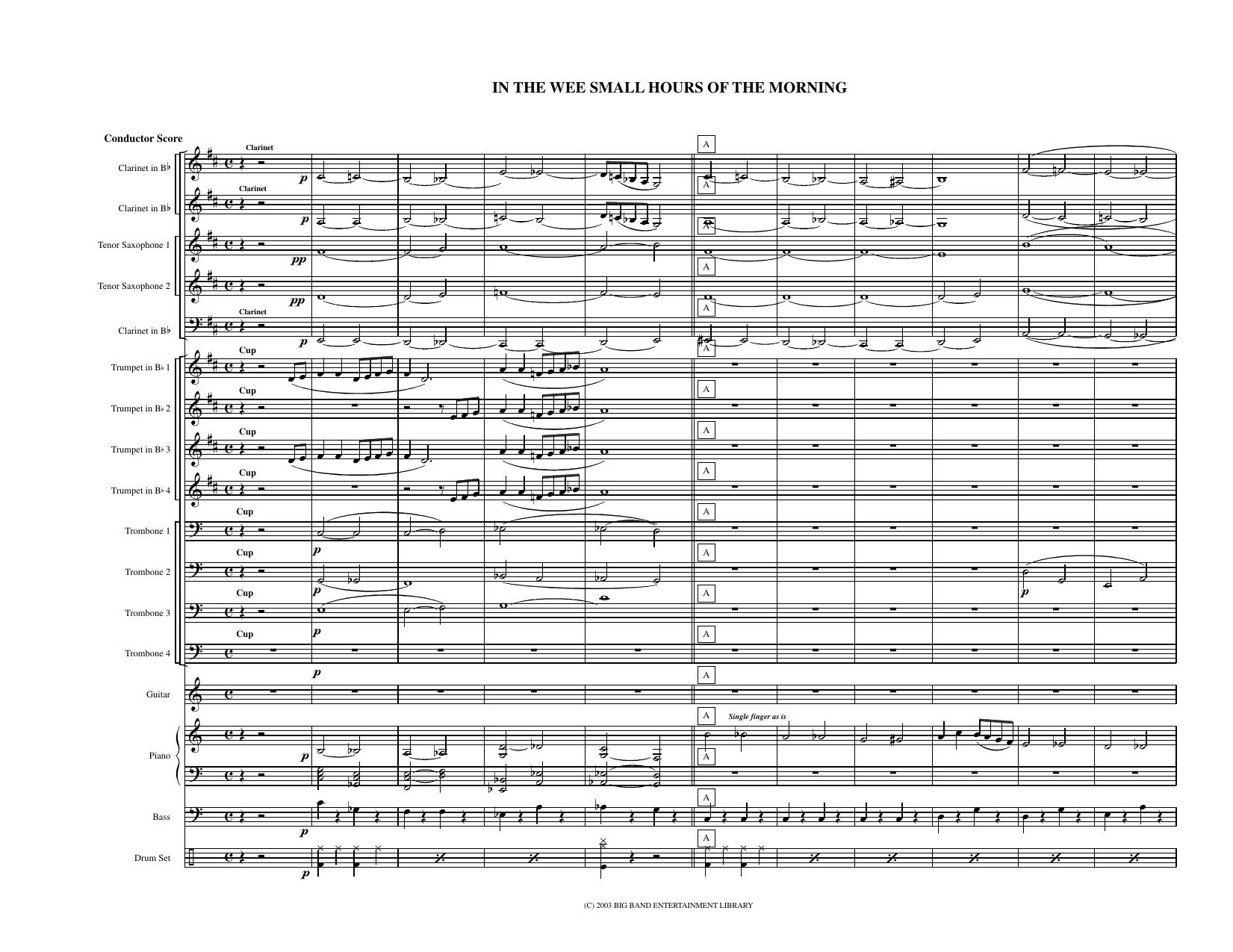
In The Wee Small Hours Of The Morning (F.Sinatra)
Composed by Frank Sinatra
Arranged by Frank Sinatra & Nelson Riddle
- Ensemble: Big Band
- Pages: 22
- Instruments (15): Alto Saxophone 1, Alto Saxophone 2, Tenor Saxophone 1, Tenor Saxophone 2, Baritone Saxophone, Trumpet in Bb 1, Trumpet in Bb 2, Trumpet in Bb 3, Trumpet in Bb 4, Trombone 1, Trombone 2, Trombone 3, Piano, Bass, Drum Set
- Difficulty: medium
- Content: Individual Parts
- Format: PDF Download (Instant)
- Price: $24.99
Midnight introspection finds its ultimate sonic expression in this definitive big band setting of "In The Wee Small Hours Of The Morning," the timeless standard co-written by David Mann and Bob Hilliard. Immortalized by Frank Sinatra on his groundbreaking 1955 Capitol concept album of the same name, this quintessential recording captures the pinnacle of the mid-century torch song tradition. As a cornerstone of the Great American Songbook, the tune evokes the poignant, solitary melancholy of city streets long after dark, maintaining a revered status among vocal jazz interpreters and instrumentalists alike for its sophisticated harmonic language and aching melodic contour. Drenched in nocturnal atmosphere, this arrangement unfolds at a slow, lingering ballad tempo in 4/4 time, prioritizing heavy, sustained emotional resonance over metric movement. The mood is deeply introspective, melancholic, and tender, wrapped in the lush, cinematic warmth characteristic of the golden age of vocal jazz. Rich, extended chord extensions and dense, beautiful chromatic cluster voicings create an enveloping sonic pillow, pulling both performers and listeners into a deeply vulnerable, late-night psychological space where every rubato-leaning phrase breathes with dramatic weight. Nelson Riddle’s legendary arranging genius shines through the masterful use of low-register woodwinds, muted brass textures, and a weeping string-substitution style adapted seamlessly for a 12-instrument jazz ensemble. Rather than relying on high-energy shout choruses, Riddle builds tension through subtle dynamic swells, harmonic suspension, and delicate counter-melodies woven intricately between the saxophone and brass sections. The arrangement treats the ensemble as a living, breathing vocal accompaniment, utilizing gorgeous chordal movement and gorgeous secondary dominants that heighten the bittersweet longing embedded in the original melody. Carried primarily by the lead alto and tenor saxophones in exposed melodic statements, the chart offers ample room for nuanced phrasing, vibrato control, and dynamic sensitivity. While technically accessible in terms of note velocity, the true challenge lies in the mature interpretation of micro-dynamics, intonation across heavy voicings, and maintaining a steady, hypnotic pulse at a very slow tempo. Solo opportunities allow featured instrumentalists to step into the spotlight with melodic paraphrasing, making it immensely rewarding for musicians who excel at lyricism and storytelling through their horns. Advanced high school, collegiate, and professional jazz ensembles will find this chart an extraordinary vehicle for teaching the subtleties of ballad playing and stylistic authenticity. Because it demands restraint, immaculate blend, and deep emotional investment rather than sheer velocity, it serves as an exceptional programming choice for groups looking to showcase maturity, tonal beauty, and stylistic versatility in a concert setting. Executing this arrangement successfully requires exceptional breath control and an uncompromising commitment to intonation, particularly during sustained, dense chord voicings at a slow tempo. The conductor must maintain a flexible, conducting hand that accommodates subtle rubato while anchoring the ensemble’s underlying pulse. Trumpets and trombones should utilize warm, dark cup or bucket mutes where indicated to achieve that velvety, distant 1950s Capitol Records ambiance, avoiding any harsh or brassy edge. Saxophones must balance their subtones carefully against the brass harmonies, ensuring the lead alto line floats effortlessly above the texture. Rehearsals should focus heavily on unified phrase shaping, dynamic shading from piano to mezzo-forte, and seamless transitions between rubato entrances and strict meter. Encourage players to listen across the ensemble to the inner voice movements, as these chromatic passing tones define Riddle's signature harmonic palette. Q: What instruments and parts are included in this 12-instrument big band arrangement? A: The instrumentation features a 12-piece ensemble configuration consisting of Alto Saxophone, Tenor Saxophone, Baritone Saxophone, Trumpet, Trombone, and a robust rhythm section to support the classic Riddle texture. Q: What is the difficulty level of this arrangement? A: This arrangement is best suited for advanced high school, collegiate, and professional jazz ensembles due to its heavy reliance on mature ballad phrasing, intonation control, and subtone blend rather than rapid technical execution. Q: What is the historical style and musical context of this piece? A: Modeled after the iconic 1955 Nelson Riddle arrangement for Frank Sinatra, this chart represents the pinnacle of the mid-century torch song era, blending lush cinematic jazz harmony with deep, nocturnal introspection. Q: What makes this Nelson Riddle arrangement unique compared to standard big band charts? A: Unlike high-energy swing charts driven by shout choruses, this arrangement derives its power from dense chromatic voicings, low-register woodwind textures, and subtle dynamic swells that mimic a classic string-backed vocal ballad. Q: What is the expected performance duration and tempo feel of the piece? A: The arrangement is performed at a slow, lingering ballad tempo in 4/4 time, typically lasting around 3 to 4 minutes depending on the conductor's handling of rubato phrasing and featured solo space.
Questions and answers
- What is included in the In The Wee Small Hours Of The Morning (F.Sinatra) PDF?
- The verified current file contains a conductor score and individual parts across 22 pages.
- How many instruments or parts are listed for In The Wee Small Hours Of The Morning (F.Sinatra)?
- The verified instrumentation list contains 15 entries for this Big Band arrangement.
- Who is credited for In The Wee Small Hours Of The Morning (F.Sinatra)?
- Composer: Frank Sinatra. Arranger: Frank Sinatra & Nelson Riddle.
- What difficulty is listed for In The Wee Small Hours Of The Morning (F.Sinatra)?
- The verified difficulty level is medium.
- Can I preview In The Wee Small Hours Of The Morning (F.Sinatra) before buying?
- Yes. The product page provides a preview generated from the current PDF file.
- How is In The Wee Small Hours Of The Morning (F.Sinatra) delivered?
- After successful payment, the digital PDF is made available for download. The displayed price is $24.99.
Musicians Also Search For
In The Wee Small Hours Of The Morning Frank Sinatra & Nelson Riddle PDF • In The Wee Small Hours Of The Morning Frank Sinatra & Nelson Riddle sheet music • In The Wee Small Hours Of The Morning arranged by Frank Sinatra & Nelson Riddle • Frank Sinatra & Nelson Riddle big band charts • Frank Sinatra & Nelson Riddle jazz arrangements PDF • In The Wee Small Hours Of The Morning Frank Sinatra sheet music • In The Wee Small Hours Of The Morning Frank Sinatra big band arrangements • Frank Sinatra big band charts • In The Wee Small Hours Of The Morning big band arrangements • In The Wee Small Hours Of The Morning big band PDF download • In The Wee Small Hours Of The Morning jazz sheet music • big band sheet music download • In The Wee Small Hours Of The Morning conductor score PDF • In The Wee Small Hours Of The Morning individual parts download • In The Wee Small Hours Of The Morning sheet music PDF • buy In The Wee Small Hours Of The Morning sheet music • download In The Wee Small Hours Of The Morning PDF • In The Wee Small Hours Of The Morning jazz charts • best Frank Sinatra & Nelson Riddle big band arrangements • Frank Sinatra arranged by Frank Sinatra & Nelson Riddle • In The Wee Small Hours Of The Morning printable sheet music • big band repertoire PDF