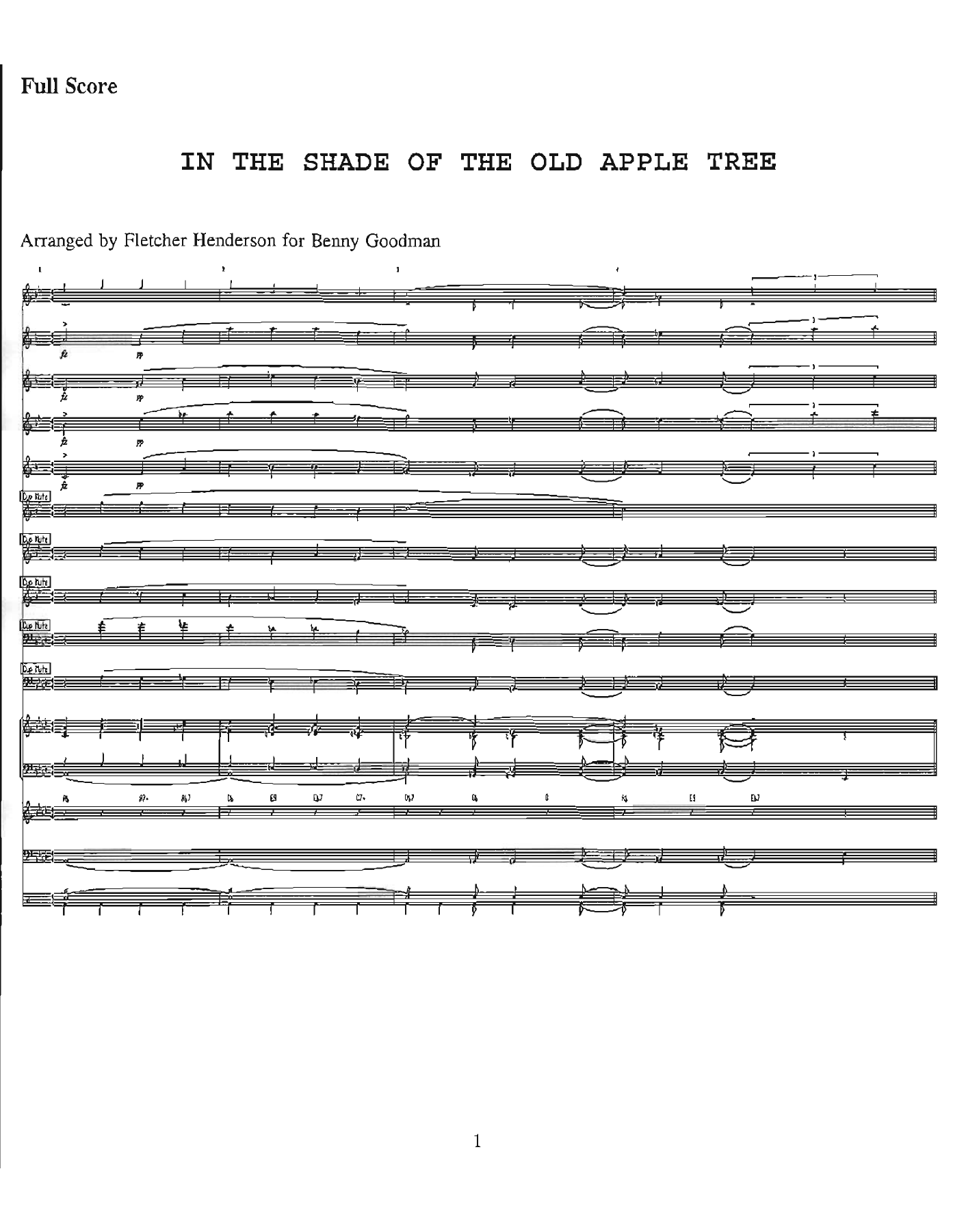
In The Shade Of The Old Apple Tree (F.Henderson) sheet music preview

In The Shade Of The Old Apple Tree (F.Henderson)

Composed by Harry Williams

Arranged by Benny Goodman

  • Ensemble: Big Band
  • Style: Jazz Standard
  • Pages: 71
  • Instruments (17): Alto Saxophone 1, Alto Saxophone 2, Tenor Saxophone 1, Tenor Saxophone 2, Baritone Saxophone, Trumpet 1, Trumpet 2, Trumpet 3, Trumpet 4, Trombone 1, Trombone 2, Trombone 3, Bass Trombone, Guitar, Piano, Bass, Drums
  • Difficulty: advanced
  • Content: Individual Parts
  • Format: PDF Download (Instant)
  • Price: $24.99

Originally penned by Harry Williams in 1905, "In The Shade Of The Old Apple Tree" emerged from the Tin Pan Alley era as a sentimental waltz, quickly becoming a beloved parlor song and vaudeville staple. Its enduring melodic charm made it a natural candidate for reinterpretation as jazz evolved, transitioning from its initial 3/4 meter into a swinging 4/4 standard. While many early jazz luminaries embraced the tune, it was often associated with the early big band sound, providing a nostalgic yet vibrant canvas for improvisation and ensemble work. This arrangement by Benny Goodman captures the essence of the Swing Era, transforming the pastoral original into a sophisticated, driving jazz vehicle that showcases the power and precision of a full big band. Benny Goodman’s arrangement of "In The Shade Of The Old Apple Tree" presents a medium-fast swing feel, typically around 180-200 BPM, imbued with an infectious energy and a bright, optimistic mood. The piece is primarily in F Major, a comfortable key that allows for brilliant brass fanfares and lyrical saxophone lines. Goodman’s signature clarity and rhythmic drive are immediately evident. The arrangement opens with a punchy, unison brass fanfare before transitioning into the iconic melody, often carried by the saxophone section with tight, harmonized voicings. The overall character is one of controlled exuberance, balancing intricate ensemble passages with moments of individual brilliance, characteristic of the Goodman orchestra's polished yet spirited sound. Goodman's distinctive arranging style is on full display, emphasizing clean articulation, precise ensemble work, and dynamic contrast. Expect tightly voiced saxophone solis that weave intricate counter-melodies, often punctuated by crisp brass interjections. The arrangement features a classic big band structure, including a compelling shout chorus where the full ensemble roars with harmonized power, driving towards a climactic finish. While specific soloists are not explicitly notated in this type of classic arrangement, the structure typically provides ample space for a featured tenor saxophone or trumpet solo over the standard chord changes, inviting improvisation that contributes to the piece's dynamic flow. The technical demands are moderate to advanced, requiring strong section playing, accurate intonation, and a keen sense of swing. Performing this arrangement is highly rewarding, offering musicians the opportunity to engage with a foundational piece of the big band repertoire as interpreted by one of its most iconic leaders. The tight ensemble passages and rhythmic interplay are particularly satisfying to execute, fostering a strong sense of musical cohesion within the band. Ideal for college, advanced high school, community, and professional jazz ensembles, this arrangement provides an excellent vehicle for developing precision, dynamic control, and an authentic swing feel. Its historical significance, combined with Goodman’s masterful treatment, makes it a standout selection for concerts, festivals, or any performance seeking to evoke the golden age of big band jazz. This arrangement demands a consistent, driving medium-fast swing feel, emphasizing a strong rhythmic pulse from the rhythm section. Conductors should ensure precise articulation, particularly in the brass, where short, crisp notes are essential for clarity. The saxophone solis require careful attention to blend and intonation, aiming for a unified, singing quality. Dynamics are crucial; observe the marked crescendos and decrescendos to build and release tension effectively, especially leading into and out of the shout chorus. Encourage soloists to embrace the Swing Era aesthetic with melodic invention and rhythmic propulsion. Rehearsal time should focus on rhythmic accuracy in unison figures, balancing the brass and saxophone sections, and ensuring the rhythm section provides a solid, unwavering foundation. The overall goal is a vibrant, polished performance that captures the infectious energy of the Benny Goodman Orchestra. Q: What instruments are included in this arrangement? A: This big band arrangement is scored for 17 instruments: Alto Saxophone 1, Alto Saxophone 2, Tenor Saxophone 1, Tenor Saxophone 2, Baritone Saxophone, Trumpet 1, Trumpet 2, Trumpet 3, Trumpet 4, Trombone 1, Trombone 2, Trombone 3, Trombone 4, Piano, Bass, Drums, and Guitar. Q: What is the difficulty level of this arrangement? A: This arrangement is considered medium-advanced. It requires strong section playing, precise articulation, and a solid understanding of swing rhythm, making it suitable for college, advanced high school, community, and professional jazz ensembles. Q: What is the musical style and historical context of this piece? A: This is a classic Swing Era big band arrangement of the jazz standard "In The Shade Of The Old Apple Tree." It showcases the distinctive sound and arranging techniques of Benny Goodman from the mid-20th century, transforming a Tin Pan Alley waltz into a vibrant 4/4 swing tune. Q: What makes Benny Goodman's arrangement of "In The Shade Of The Old Apple Tree" unique? A: Goodman's treatment is characterized by its driving medium-fast swing tempo, tightly voiced saxophone solis, clear brass fanfares, and a powerful shout chorus. It exemplifies his orchestra's precision, rhythmic vitality, and polished ensemble sound. Q: What is the typical performance duration and tempo for this arrangement? A: The typical performance duration for this arrangement is approximately 3 to 4 minutes, depending on the length of improvised solos. It is designed to be played at a medium-fast swing tempo, generally ranging from 180 to 200 beats per minute.

Musicians Also Search For

In The Shade Of The Old Apple Tree Benny Goodman PDFIn The Shade Of The Old Apple Tree Benny Goodman sheet musicIn The Shade Of The Old Apple Tree arranged by Benny GoodmanBenny Goodman big band chartsBenny Goodman jazz arrangements PDFIn The Shade Of The Old Apple Tree Harry Williams sheet musicIn The Shade Of The Old Apple Tree Harry Williams big band arrangementHarry Williams big band chartsIn The Shade Of The Old Apple Tree big band arrangementIn The Shade Of The Old Apple Tree big band PDF downloadIn The Shade Of The Old Apple Tree jazz ensemble sheet musicbig band sheet music instant downloadIn The Shade Of The Old Apple Tree individual parts downloadIn The Shade Of The Old Apple Tree sheet music with partsIn The Shade Of The Old Apple Tree Jazz Standard chartJazz Standard big band arrangementsbuy In The Shade Of The Old Apple Tree sheet music onlinedownload In The Shade Of The Old Apple Tree PDFIn The Shade Of The Old Apple Tree jazz chartbest Benny Goodman big band arrangementsHarry Williams songs arranged by Benny GoodmanIn The Shade Of The Old Apple Tree printable sheet musicbig band repertoire PDF

All arrangements by Benny Goodman All Harry Williams sheet music