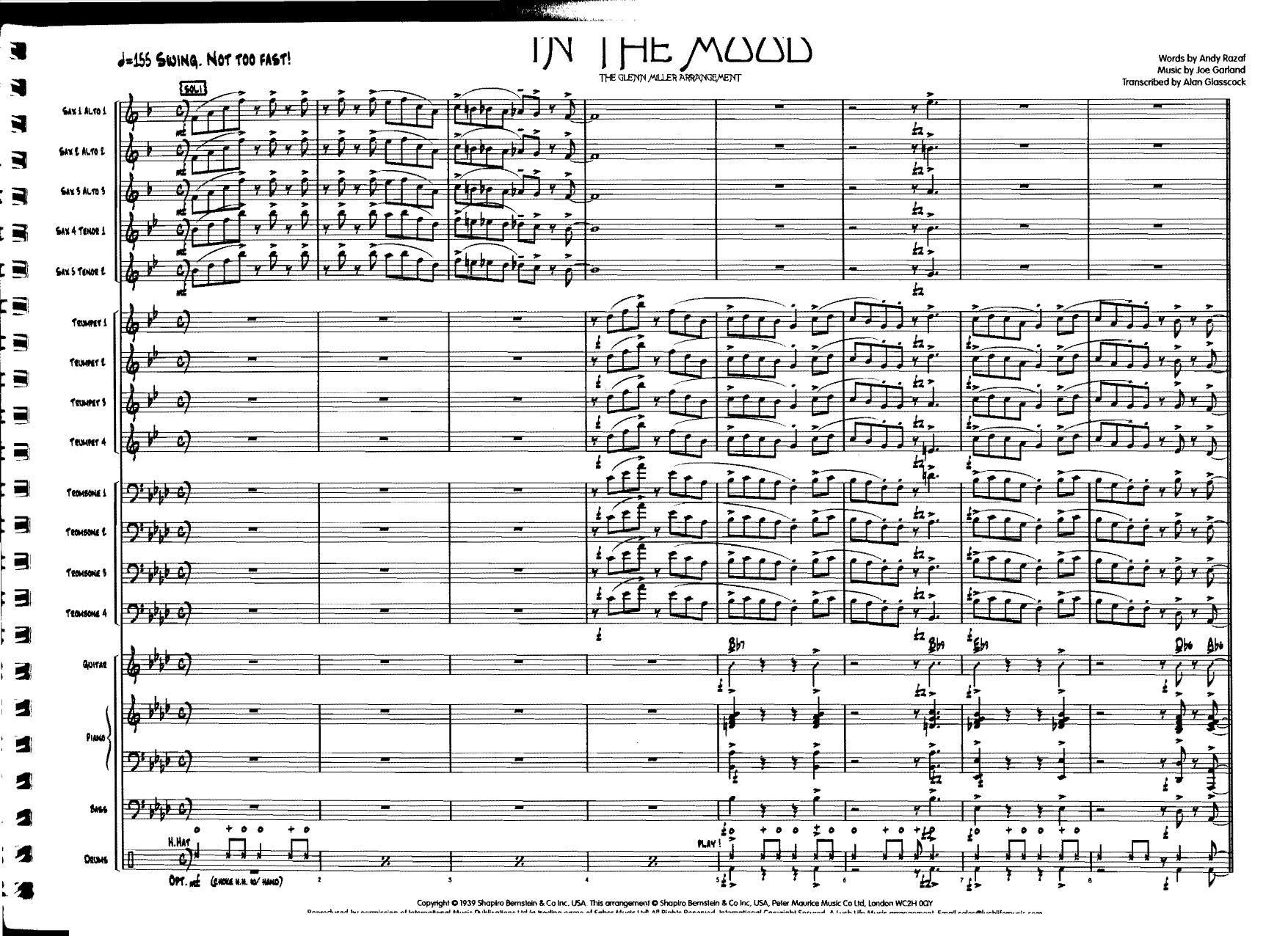
In The Mood (A.Glasscock) sheet music preview

In The Mood (A.Glasscock)

Composed by Joe Garland

Arranged by A.Glasscock

  • Ensemble: Big Band
  • Style: Jazz Standard
  • Pages: 15
  • Instruments (17): Alto Saxophone 1, Alto Saxophone 2, Alto Saxophone 3, Tenor Saxophone 1, Tenor Saxophone 2, Trumpet 1, Trumpet 2, Trumpet 3, Trumpet 4, Trombone 1, Trombone 2, Trombone 3, Trombone 4, Guitar, Piano, Bass, Drum Set
  • Difficulty: easy
  • Content: Individual Parts
  • Format: PDF Download (Instant)
  • Price: $24.99

Joe Garland's iconic "In The Mood," first recorded in 1939 by Edgar Hayes and later immortalized by Glenn Miller in 1940, stands as an undisputed cornerstone of the Swing Era. This effervescent jazz standard, with its instantly recognizable riff and driving rhythm, became synonymous with the big band sound, capturing the optimistic spirit and dance-craze energy of pre-WWII America. Its enduring popularity stems from its infectious melody, call-and-response structure, and the sheer joy it evokes, making it a perennial favorite for both performers and audiences. The piece's unique 12-bar blues-based structure, combined with its memorable tenor saxophone soli, solidified its place in jazz history and continues to define the quintessential swing aesthetic. A.Glasscock's arrangement of "In The Mood" expertly captures the authentic spirit of the original while infusing it with fresh, articulate voicings and dynamic contrasts suitable for contemporary big bands. Maintaining a medium-up swing tempo (around 180-200 bpm) in the original key of Ab major, Glasscock’s treatment emphasizes clarity and power. The arrangement opens with the familiar, syncopated saxophone riff, leading into the iconic melody carried primarily by the tenor saxophones and trumpets. What distinguishes Glasscock's approach is the meticulous attention to sectional interplay: the saxophones engage in crisp, tightly voiced soli sections, while the brass punctuates with powerful, precise hits. The arrangement skillfully builds intensity, layering textures and dynamics to create a thrilling, cohesive sound. Performance-wise, this arrangement offers a rewarding challenge and a fantastic showpiece. The famous tenor saxophone soli, a hallmark of the original, is meticulously transcribed and arranged, demanding precision and rhythmic accuracy from the sax section. There are ample opportunities for featured soloists, typically over the blues-based changes, allowing for improvisation that can range from classic swing vocabulary to more contemporary expressions. The brass section will find their parts engaging, with powerful shout choruses requiring strong breath support and unified articulation. A particularly exciting moment is the climactic shout chorus, where the entire ensemble locks into a powerful, driving groove, culminating in a dynamic finish that will leave audiences exhilarated. This arrangement is ideally suited for advanced high school, college, community, and professional big bands. Its faithful yet inventive interpretation of a classic standard makes it an excellent choice for concert programs, dance events, or educational settings focused on the Swing Era. Bands will find the detailed scoring and clear articulation highly rewarding, providing a robust framework for developing ensemble cohesion, rhythmic precision, and stylistic authenticity. The arrangement’s blend of historical reverence and modern clarity ensures that "In The Mood" continues to swing vibrantly for new generations. This arrangement thrives on a consistent, driving medium-up swing feel (quarter note = 180-200 bpm). Emphasize a light, buoyant eighth-note feel, avoiding a straight or overly heavy approach. The primary technical challenge lies in the precision required for the saxophone soli sections; ensure rhythmic accuracy and unified articulation, particularly in the iconic tenor saxophone riff. Brass players should focus on clean attacks and releases, especially in the punchy shout choruses, maintaining strong air support for sustained power. Dynamics are crucial: observe the marked crescendos and decrescendos to build excitement, particularly leading into and out of the shout sections. Rehearsal should focus on locking in the rhythmic interplay between sections and ensuring the iconic melodies are played with stylistic authenticity and flair. Q: What instruments and parts are included in this arrangement? A: This arrangement includes parts for a standard 17-instrument big band: Alto Saxophone 1, Alto Saxophone 2, Tenor Saxophone 1, Tenor Saxophone 2, Baritone Saxophone, Trumpet 1, Trumpet 2, Trumpet 3, Trumpet 4, Trombone 1, Trombone 2, Trombone 3, Trombone 4, Piano, Bass, Drums, and Guitar. A full conductor score is also included. Q: What is the difficulty level of A.Glasscock's "In The Mood" arrangement? A: This arrangement is rated as advanced, suitable for high school, college, community, and professional big bands. It requires strong ensemble precision, rhythmic accuracy, and stylistic understanding from all sections, particularly in the saxophone soli and brass shout choruses. Q: What musical style and historical context does this arrangement represent? A: This arrangement is a faithful yet fresh interpretation of "In The Mood," a quintessential jazz standard from the Swing Era (late 1930s-1940s). It embodies the energetic, dance-oriented big band sound popularized by artists like Glenn Miller. Q: What makes A.Glasscock's arrangement of "In The Mood" unique compared to other versions? A: A.Glasscock's arrangement stands out for its meticulous attention to authentic voicings and dynamic contrasts, providing a powerful and clear sound. It maintains the original's infectious energy while offering contemporary big bands a robust and engaging performance vehicle with well-crafted soli and shout sections. Q: What is the typical performance duration and tempo for this arrangement? A: The typical performance duration for this arrangement is approximately 3-4 minutes, depending on the length of any improvised solos. It is designed to be played at a medium-up swing tempo, generally between 180-200 beats per minute.

Musicians Also Search For

In The Mood A.Glasscock PDFIn The Mood A.Glasscock sheet musicIn The Mood arranged by A.GlasscockA.Glasscock big band chartsA.Glasscock jazz arrangements PDFIn The Mood Joe Garland sheet musicIn The Mood Joe Garland big band arrangementJoe Garland big band chartsIn The Mood big band arrangementIn The Mood big band PDF downloadIn The Mood jazz ensemble sheet musicbig band sheet music instant downloadIn The Mood individual parts downloadIn The Mood sheet music with partsIn The Mood Jazz Standard chartJazz Standard big band arrangementsbuy In The Mood sheet music onlinedownload In The Mood PDFIn The Mood jazz chartbest A.Glasscock big band arrangementsJoe Garland songs arranged by A.GlasscockIn The Mood printable sheet musicbig band repertoire PDF

All arrangements by A.Glasscock All Joe Garland sheet music