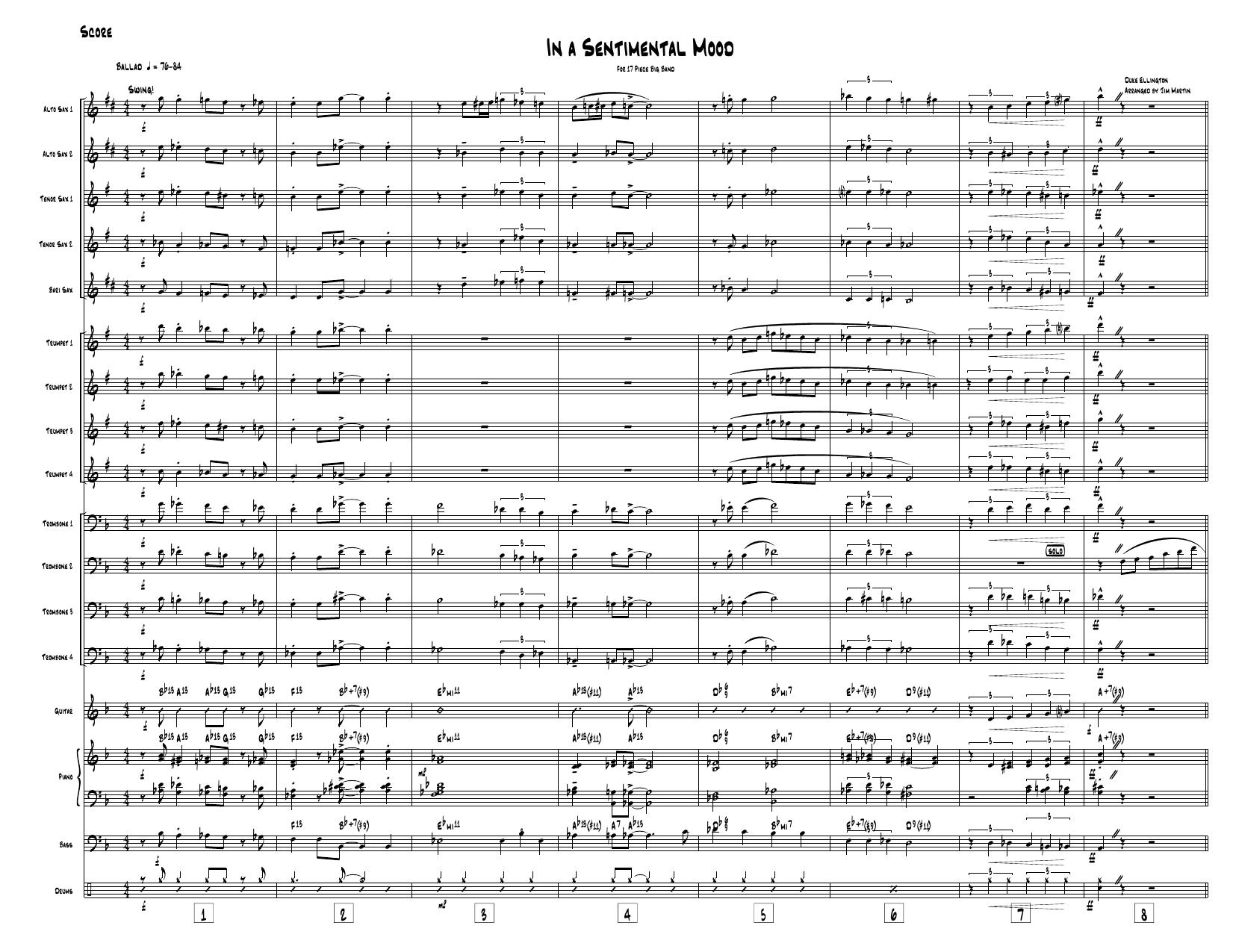
In A Sentimental Mood (J.Martin) sheet music preview

In A Sentimental Mood (J.Martin)

Composed by Duke Ellington

Arranged by Jim Martin

  • Ensemble: Big Band
  • Pages: 45
  • Instruments (17): Alto Sax 1, Alto Sax 2, Tenor Sax 1, Tenor Sax 2, Bari Sax, Trumpet 1, Trumpet 2, Trumpet 3, Trumpet 4, Trombone 1, Trombone 2, Trombone 3, Trombone 4, Guitar, Piano, Bass, Drums
  • Difficulty: medium
  • Content: Individual Parts
  • Format: PDF Download (Instant)
  • Price: $24.99

Duke Ellington’s timeless 1935 masterpiece "In A Sentimental Mood" stands as one of the towering ballad achievements in the American Songbook, forever immortalized by its composer's delicate piano touch and Johnny Hodges’ soaring alto saxophone lyricism. Later cemented in jazz lore by Ellington's legendary 1962 studio collaboration with saxophonist John Coltrane, the composition epitomizes the sophisticated elegance of the swing era while containing the harmonic depth that modern jazz innovators would later embrace. Its haunting, descending melodic motifs and luxurious chord progressions evoke a profound sense of nocturnal introspection, romantic nostalgia, and lingering melancholy, making it an eternal touchstone for jazz ensembles seeking to showcase emotional restraint and expressive maturity. In this masterful 17-instrument big band interpretation, arranger Jim Martin honors the delicate, atmospheric DNA of Ellington’s original concept while expanding its sonic palette for a full contemporary jazz orchestra. Martin frames the composition as a lush, slow ballad anchored by a warm, rubato-leaning pulse that gradually opens up into rich, textural ensemble solis. Rather than rushing into heavy textures, the arrangement relies on Ellingtonian voicing principles—utilizing close-position trumpet and trombone harmonies alongside deep, reedy saxophone cross-sections—to create a dense, velvety cushion of sound. The brass writing employs subtle mutes and warm, open-horn styling that recalls the classic Cotton Club and mid-century Ellington orchestrations, ensuring the harmonic tension of the altered dominants resolves with maximum emotional resonance. The lead alto saxophone and first trumpet carry the primary thematic weight, navigating the intricate contours of the melody with ample space for rubato phrasing before settling into a steady, breath-controlled ballad tempo. A standout feature of Martin’s chart is an expressive tenor saxophone feature spot that pays subtle homage to the Coltrane-Ellington aesthetic, allowing a capable soloist to stretch out over lush, modern chord substitutions. Technically, the arrangement demands exceptional breath support, immaculate intonation in the reed section, and precise dynamic control from the brass, particularly during soft, exposed chordal passages where blend and balance are paramount. The rhythm section acts as the subtle heartbeat, requiring a sensitive pianist who can replicate stride-inflected voicings or sparse, modern impressionistic comping, supported by a bassist playing a deep, resonant half-note or walking feel and a drummer utilizing brushes with exquisite textural variety. Advanced high school ensembles, collegiate jazz orchestras, and professional community big bands will find this chart to be an invaluable repertoire piece. It serves as an ideal vehicle for teaching stylistic authenticity, tonal blending, and micro-dynamics—skills that are frequently overlooked in faster, high-energy swing charts. Performing this arrangement offers audiences a deeply moving concert experience, contrasting the pyrotechnics of up-tempo swappers with a masterclass in subtlety, poise, and orchestral color. Conductors should approach this chart with an emphasis on horizontal line and lyrical continuity rather than strict metronomic rigidity. The tempo should hover around a relaxed ballad pulse, approximately 64 to 72 beats per minute, allowing the eighth-note subdivisions to breathe naturally without rushing. A primary technical challenge lies in the execution of the sustained, soft-dynamics chords in the brass section; players must maintain core tone quality without forcing the sound, utilizing gentle air support to prevent the pitch from sagging. Rehearsal should begin with sectional work, isolating the saxophone soli to ensure seamless blend and identical vibrato rates. The rhythm section needs careful balancing: the piano should avoid over-comping, leaving space for the rich horn voicings, while the drummer should favor brushes to maintain a silky texture behind the melody. Pay close attention to the dynamic markings, treating crescendos and decrescendos as sweeping waves that mirror the emotional arc of the soloist. Q: What instruments and parts are included in this arrangement? A: This 17-instrument big band chart includes full instrumentation for Alto Saxophone 1 & 2, Tenor Saxophone 1 & 2, Baritone Saxophone, 4 Trumpets, 4 Trombones, Piano, Guitar, Bass, Drums, and a comprehensive conductor score across 45 pages. Q: What is the difficulty level of this Jim Martin arrangement? A: It is graded as advanced-intermediate to advanced, primarily due to the intense demands placed on intonation, dynamic control, and emotional maturity rather than extreme technical velocity. Q: What is the historical and stylistic context of this piece? A: The arrangement is based on Duke Ellington's iconic 1935 jazz standard, capturing the lush, sophisticated ballad style of the swing era while incorporating modern harmonic depth inspired by subsequent classic interpretations. Q: What makes this specific arrangement by Jim Martin unique? A: Martin successfully translates the intimate, piano-and-horn dialogue of Ellington's original small-group and collaboration concepts into a rich, full-ensemble big band canvas featuring sophisticated section voicing and an expressive saxophone feature spot. Q: What is the performance duration and tempo feel of the piece? A: The arrangement runs approximately 4 to 5 minutes depending on the length of the improvised solo, played at a slow, expressive ballad tempo with a relaxed, breath-controlled swing feel.

Questions and answers

What is included in the In A Sentimental Mood (J.Martin) PDF?
The verified current file contains a conductor score and individual parts across 45 pages.
How many instruments or parts are listed for In A Sentimental Mood (J.Martin)?
The verified instrumentation list contains 17 entries for this Big Band arrangement.
Who is credited for In A Sentimental Mood (J.Martin)?
Composer: Duke Ellington. Arranger: Jim Martin.
What difficulty is listed for In A Sentimental Mood (J.Martin)?
The verified difficulty level is medium.
Can I preview In A Sentimental Mood (J.Martin) before buying?
Yes. The product page provides a preview generated from the current PDF file.
How is In A Sentimental Mood (J.Martin) delivered?
After successful payment, the digital PDF is made available for download. The displayed price is $24.99.

Musicians Also Search For

In A Sentimental Mood Jim Martin PDFIn A Sentimental Mood Jim Martin sheet musicIn A Sentimental Mood arranged by Jim MartinJim Martin big band chartsJim Martin jazz arrangements PDFIn A Sentimental Mood Duke Ellington sheet musicIn A Sentimental Mood Duke Ellington big band arrangementsDuke Ellington big band chartsIn A Sentimental Mood big band arrangementsIn A Sentimental Mood big band PDF downloadIn A Sentimental Mood jazz sheet musicbig band sheet music downloadIn A Sentimental Mood conductor score PDFIn A Sentimental Mood individual parts downloadIn A Sentimental Mood sheet music PDFbuy In A Sentimental Mood sheet musicdownload In A Sentimental Mood PDFIn A Sentimental Mood jazz chartsbest Jim Martin big band arrangementsDuke Ellington arranged by Jim MartinIn A Sentimental Mood printable sheet musicbig band repertoire PDF

All arrangements by Jim Martin All Duke Ellington sheet music