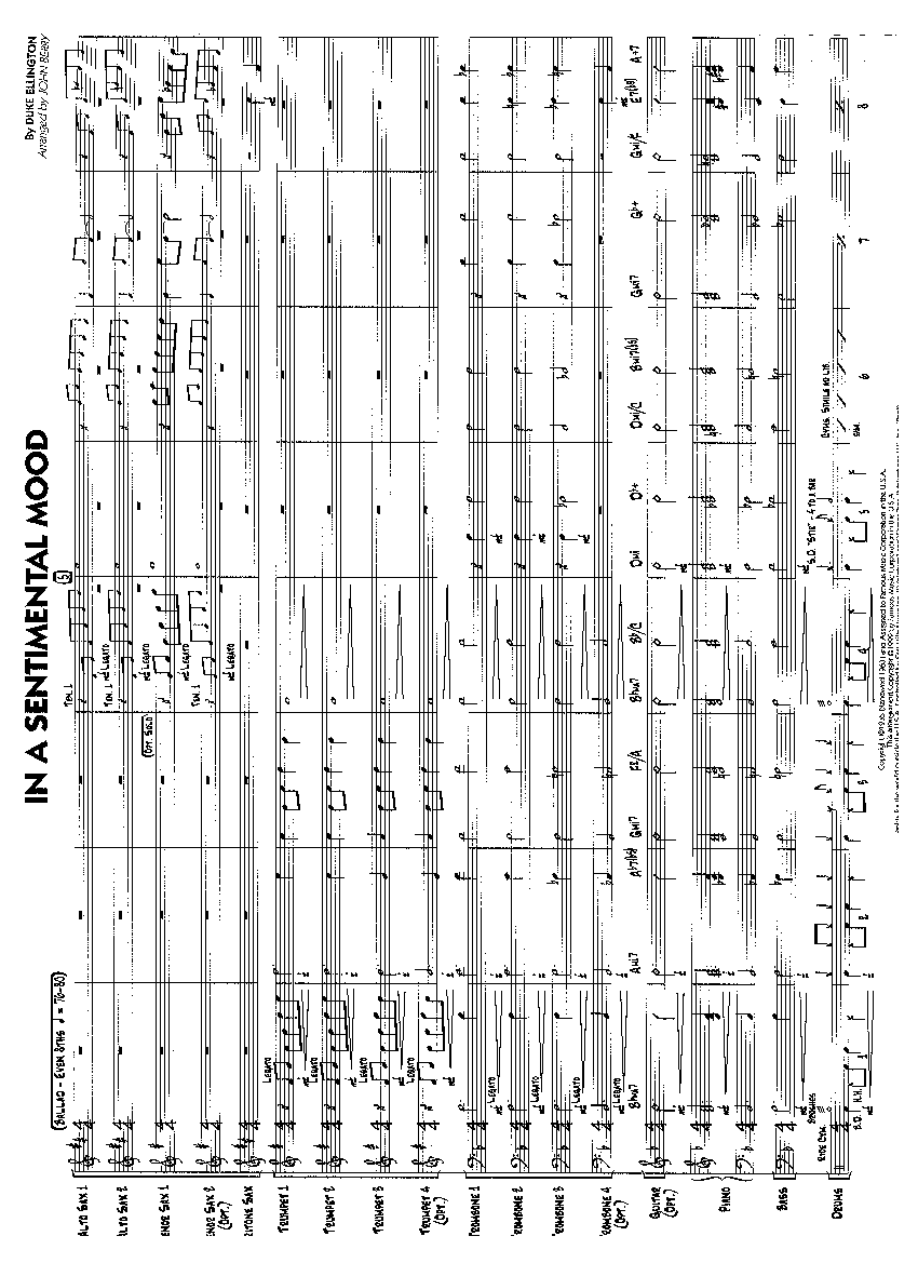
In A Sentimental Mood (J.Berry) sheet music preview

In A Sentimental Mood (J.Berry)

Composed by Duke Ellington

Arranged by John Berry

  • Ensemble: Big Band
  • Pages: 25
  • Instruments (17): Alto Sax 1, Alto Sax 2, Tenor Sax 1, Tenor Sax 2, Baritone Sax, Trumpet 1, Trumpet 2, Trumpet 3, Trumpet 4, Trombone 1, Trombone 2, Trombone 3, Trombone 4, Guitar, Piano, Bass, Drums
  • Difficulty: medium
  • Content: Individual Parts
  • Format: PDF Download (Instant)
  • Price: $24.99

Duke Ellington penned "In a Sentimental Mood" in 1935 under legendary, somewhat spontaneous circumstances—supposedly improvising the tune at a party in North Carolina to calm down two arguing friends. When recorded shortly thereafter with saxophonist Johnny Hodges and Ellington on piano, the composition instantly solidified its place in the canon of American jazz ballads. Representing the sophisticated, lush elegance of the early swing era, the piece has since evolved into a quintessential jazz standard, famously revisited by everyone from John Coltrane to Art Tatum. Its enduring appeal lies in its melancholic, sophisticated harmony and a seductive melody that balances bittersweet nostalgia with profound warmth. John Berry’s masterwork big band arrangement captures the timeless essence of Ellington's original conception while translating it into a lush, dynamic landscape for the modern 17-piece jazz orchestra. Unfolding at a sultry, relaxed ballad tempo, the chart bathes the ensemble in rich, Ellingtonian voicings where section writing mimics the distinctive textures of the maestro's classic orchestra. The mood is deeply romantic and reflective, transitioning effortlessly from delicate, exposed solo statements to sweeping, full-ensemble climaxes that evoke the smoky atmosphere of a classic Harlem supper club. The harmonic language relies heavily on extended tertian chords, gorgeous suspension resolutions, and subtle chromatic inner-voice movements that give the brass and reeds a remarkably warm, velvety timbre. The melodic narrative primarily highlights the saxophone section, with Alto Saxophone 1 taking a prominent, highly expressive lead role on the head. Berry strategically deploys subtle plunger effects and muted brass accents to honor the stylistic roots of the Ellington tradition without demanding specialized avant-garde techniques. The technical challenges of the chart reside not in breakneck velocity, but rather in the realm of mature musicality: maintaining consistent breath support during prolonged phrases, balancing internal chord tones across the reed and brass choirs, and executing rubato-esque phrasing within a controlled macro-tempo. The brass section enjoys rich, warm pads that occasionally open up into soaring, harmonically rich shout passages, demanding exquisite intonation and dynamic control from top to bottom. Advanced high school, collegiate, and community jazz ensembles will find this arrangement an exceptional vehicle for developing ballad-playing maturity, sectional blend, and expressive phrasing. Because it avoids frantic technical demands while requiring a high degree of tonal refinement and emotional commitment, it serves as an ideal programming choice for festival adjudications or sophisticated concert settings where musicality takes precedence over volume and speed. Conductors should approach John Berry’s chart with an emphasis on horizontal line rather than vertical rhythm. The foundational tempo feel is a relaxed, breathing 4/4 ballad, where subdivision must remain internal and elastic rather than metronomic. The primary technical hurdle for the ensemble is maintaining pitch center and rich timbre during soft, sustained passages; spend considerable time in rehearsal tuning the inner-voice chord extensions within the saxophones and trombones. Muted brass sections should use harmonic or straight mutes unless specified otherwise, ensuring that the volume never overpowers the featured alto saxophone soloist. Encourage the lead alto player to treat the melody with vocal flexibility, incorporating subtle vibrato and expressive rubato while keeping the rhythm section anchored. Balance is critical during the transitional dynamic swells; the rhythm section—particularly the piano and guitar—should voice comping chords sparsely, leaving ample sonic space for the horn voicings to bloom naturally. Q: What instruments and parts are included in this big band arrangement? A: The 17-instrument orchestration includes standard big band instrumentation: Alto Saxophone 1 & 2, Tenor Saxophone 1 & 2, Baritone Saxophone, 4 Trumpets, 4 Trombones, Piano, Guitar, Bass, and Drum Set. Full score and individual instrument parts are completely accounted for in the 25-page packet. Q: What is the difficulty level of this arrangement? A: This chart is rated at an intermediate-advanced level (Grade 4), making it exceptionally well-suited for accomplished high school bands, collegiate ensembles, and community jazz orchestras seeking to refine ballad phrasing and intonation. Q: How does this chart fit into the historical jazz tradition? A: It honors Duke Ellington’s 1935 classic swing-era ballad style, incorporating traditional voicings and mood elements reminiscent of the legendary Ellington-Hodges collaborations while utilizing contemporary big band scoring techniques. Q: What makes John Berry’s arrangement uniquely distinctive? A: Berry expertly bridges the gap between classic Ellingtonian texture and modern big band accessibility, utilizing rich harmonic extensions, lush section solis, and tasteful muted brass writing that capture a smoky, romantic atmosphere. Q: What is the recommended performance duration and tempo feel? A: The arrangement plays out over approximately 3.5 to 4 minutes at a relaxed, sultry ballad tempo, requiring careful attention to sustained breath control, rubato phrasing, and dynamic shading.

Questions and answers

What is included in the In A Sentimental Mood (J.Berry) PDF?
The verified current file contains a conductor score and individual parts across 25 pages.
How many instruments or parts are listed for In A Sentimental Mood (J.Berry)?
The verified instrumentation list contains 17 entries for this Big Band arrangement.
Who is credited for In A Sentimental Mood (J.Berry)?
Composer: Duke Ellington. Arranger: John Berry.
What difficulty is listed for In A Sentimental Mood (J.Berry)?
The verified difficulty level is medium.
Can I preview In A Sentimental Mood (J.Berry) before buying?
Yes. The product page provides a preview generated from the current PDF file.
How is In A Sentimental Mood (J.Berry) delivered?
After successful payment, the digital PDF is made available for download. The displayed price is $24.99.

Musicians Also Search For

In A Sentimental Mood John Berry PDFIn A Sentimental Mood John Berry sheet musicIn A Sentimental Mood arranged by John BerryJohn Berry big band chartsJohn Berry jazz arrangements PDFIn A Sentimental Mood Duke Ellington sheet musicIn A Sentimental Mood Duke Ellington big band arrangementsDuke Ellington big band chartsIn A Sentimental Mood big band arrangementsIn A Sentimental Mood big band PDF downloadIn A Sentimental Mood jazz sheet musicbig band sheet music downloadIn A Sentimental Mood conductor score PDFIn A Sentimental Mood individual parts downloadIn A Sentimental Mood sheet music PDFbuy In A Sentimental Mood sheet musicdownload In A Sentimental Mood PDFIn A Sentimental Mood jazz chartsbest John Berry big band arrangementsDuke Ellington arranged by John BerryIn A Sentimental Mood printable sheet musicbig band repertoire PDF

All arrangements by John Berry All Duke Ellington sheet music