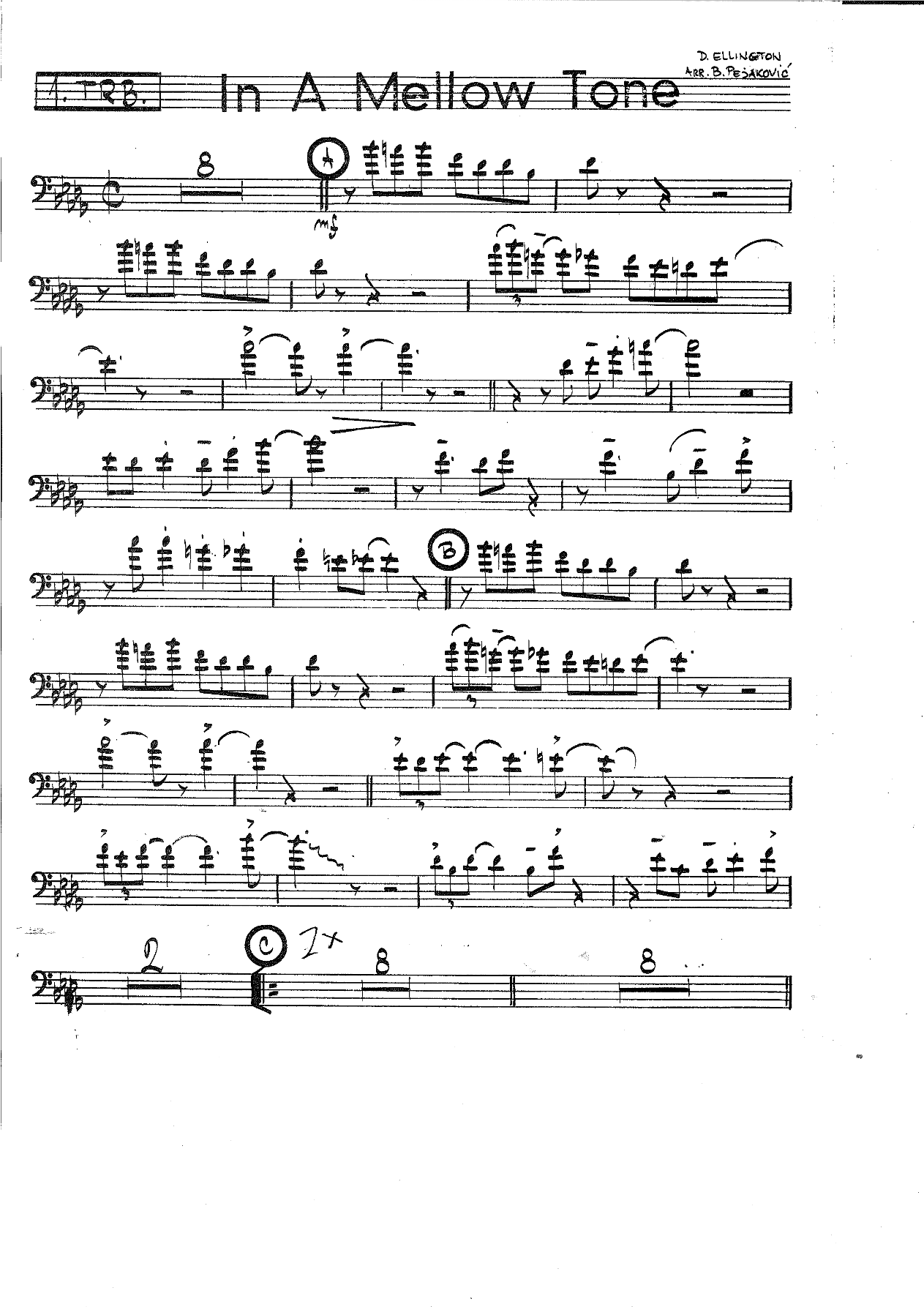
In A Mellow Tone (A.Glasscock) sheet music preview

In A Mellow Tone (A.Glasscock)

Composed by Duke Ellington

Arranged by A.Glasscock

  • Ensemble: Big Band
  • Style: Jazz Standard
  • Pages: 51
  • Instruments (20): Voice, Alto Saxophone 1, Alto Saxophone 2, Tenor Saxophone 1, Tenor Saxophone 2, Baritone Saxophone, Trumpet 1, Trumpet 2, Trumpet 3, Trumpet 4, Solo Trumpet, Solo Tenor Saxophone, Trombone 1, Trombone 2, Trombone 3, Trombone 4, Guitar, Piano, Bass, Drums
  • Difficulty: easy
  • Content: Individual Parts
  • Format: PDF Download (Instant)
  • Price: $24.99

Duke Ellington's "In A Mellow Tone," a timeless jazz standard, emerged from the prolific and innovative era of the late 1930s, first recorded in 1939 with his legendary orchestra. This period marked a zenith for big band jazz, where Ellington, alongside his co-composer Billy Strayhorn, crafted a repertoire that transcended mere dance music, elevating jazz to a sophisticated art form. "In A Mellow Tone" quickly became a staple, celebrated for its elegant melody, sophisticated harmonic progressions, and its quintessential embodiment of the swing era's relaxed yet vibrant pulse. It represents the pinnacle of Ellington's ability to blend accessible melodies with complex arrangements, ensuring its enduring status as a jazz standard performed by countless artists across generations. A.Glasscock's arrangement of "In A Mellow Tone" captures the essence of its medium swing feel, presenting it in the original key of A-flat major, a comfortable key for big band brass and saxophones. The overall mood is one of relaxed sophistication, evoking the classic big band sound with a warm, inviting energy. Glasscock's distinctive approach is evident in the artful voicings, which pay homage to Ellington's rich harmonic palette while infusing a contemporary clarity. The arrangement features a compelling interplay between sections, with carefully crafted soli passages that highlight the saxophone and brass sections, building dynamic interest throughout. The arrangement masterfully balances ensemble cohesion with opportunities for individual section brilliance, culminating in a powerful shout chorus that provides a thrilling climax without sacrificing the piece's inherent "mellow" character. The melody is primarily carried by the lead alto saxophone in the initial statement, later passed to the trumpet section, showcasing the arrangement's dynamic contour. Featured solo opportunities are thoughtfully provided for tenor saxophone, allowing an improviser to explore the tune's rich harmonic landscape. Technical challenges include precise articulation in the swing rhythms, ensuring a unified ensemble sound in the soli sections, and achieving a balanced blend, particularly in the brass voicings. The rewarding aspect of performing this arrangement lies in its ability to transport both musicians and audience to the golden age of big band jazz, offering a deeply satisfying musical experience through its elegant structure and soulful expression. This arrangement is ideally suited for college and advanced high school jazz ensembles, as well as community big bands, providing a challenging yet accessible vehicle for developing ensemble precision, stylistic authenticity, and improvisational skills within a classic jazz framework. Conductors should emphasize a relaxed, medium swing feel from the outset, ensuring the rhythm section lays down a solid, unhurried groove. Articulation is paramount; encourage a light, detached approach for eighth notes, with clear separation between phrases, avoiding a heavy or overly legato sound. The brass section should focus on precise attacks and releases, particularly in the soli sections, aiming for a unified, warm tone. Saxophone soli passages require careful attention to blend and intonation, ensuring the lines sing together as one voice. While no specific special techniques like plunger mutes are explicitly notated, encouraging subtle falls and scoops in the brass and saxophones, where appropriate, can enhance the authentic swing era feel. Rehearsal time should be dedicated to balancing the ensemble during the shout chorus, ensuring all voices contribute to the powerful climax without overpowering the core melodic and harmonic lines. The solo section offers an excellent opportunity for stylistic coaching and encouraging creative improvisation. Q: What instruments and parts are included in this arrangement? A: This arrangement is scored for a standard big band instrumentation, including five saxophones (Alto 1, Alto 2, Tenor 1, Tenor 2, Baritone), four trumpets, four trombones, and a full rhythm section (piano, bass, drums, guitar). Q: What is the difficulty level of A.Glasscock's "In A Mellow Tone" arrangement? A: This arrangement is rated as medium-advanced, making it suitable for college, advanced high school, and proficient community big bands. It presents challenges in ensemble precision, stylistic articulation, and solo improvisation. Q: What is the musical style and historical context of "In A Mellow Tone"? A: "In A Mellow Tone" is a quintessential jazz standard from the swing era, originally composed by Duke Ellington and first recorded in 1939. It embodies the relaxed, sophisticated medium swing style characteristic of Ellington's legendary orchestra. Q: What makes A.Glasscock's arrangement of "In A Mellow Tone" unique? A: Glasscock's arrangement uniquely balances reverence for Ellington's original harmonic sophistication with contemporary clarity in voicings. It features well-crafted soli sections, dynamic interplay between sections, and a compelling shout chorus, offering a fresh yet authentic interpretation. Q: What is the approximate performance duration and tempo of this arrangement? A: The approximate performance duration is around 4-5 minutes, depending on the length of the improvised solos. It is designed to be performed at a medium swing tempo, typically around 120-130 beats per minute.

Questions and answers

What is included in the In A Mellow Tone (A.Glasscock) PDF?
The verified current file contains a conductor score and individual parts across 51 pages.
How many instruments or parts are listed for In A Mellow Tone (A.Glasscock)?
The verified instrumentation list contains 20 entries for this Big Band arrangement.
Who is credited for In A Mellow Tone (A.Glasscock)?
Composer: Duke Ellington. Arranger: A.Glasscock.
What difficulty is listed for In A Mellow Tone (A.Glasscock)?
The verified difficulty level is easy.
What style is listed for In A Mellow Tone (A.Glasscock)?
The catalog lists the style as Jazz Standard.
Can I preview In A Mellow Tone (A.Glasscock) before buying?
Yes. The product page provides a preview generated from the current PDF file.
How is In A Mellow Tone (A.Glasscock) delivered?
After successful payment, the digital PDF is made available for download. The displayed price is $24.99.

Musicians Also Search For

In A Mellow Tone A.Glasscock PDFIn A Mellow Tone A.Glasscock sheet musicIn A Mellow Tone arranged by A.GlasscockA.Glasscock big band chartsA.Glasscock jazz arrangements PDFIn A Mellow Tone Duke Ellington sheet musicIn A Mellow Tone Duke Ellington big band arrangementsDuke Ellington big band chartsIn A Mellow Tone big band arrangementsIn A Mellow Tone big band PDF downloadIn A Mellow Tone jazz sheet musicbig band sheet music downloadIn A Mellow Tone conductor score PDFIn A Mellow Tone individual parts downloadIn A Mellow Tone sheet music PDFIn A Mellow Tone Jazz Standard chartsJazz Standard big band arrangementsbuy In A Mellow Tone sheet musicdownload In A Mellow Tone PDFIn A Mellow Tone jazz chartsbest A.Glasscock big band arrangementsDuke Ellington arranged by A.GlasscockIn A Mellow Tone printable sheet musicbig band repertoire PDF

All arrangements by A.Glasscock All Duke Ellington sheet music