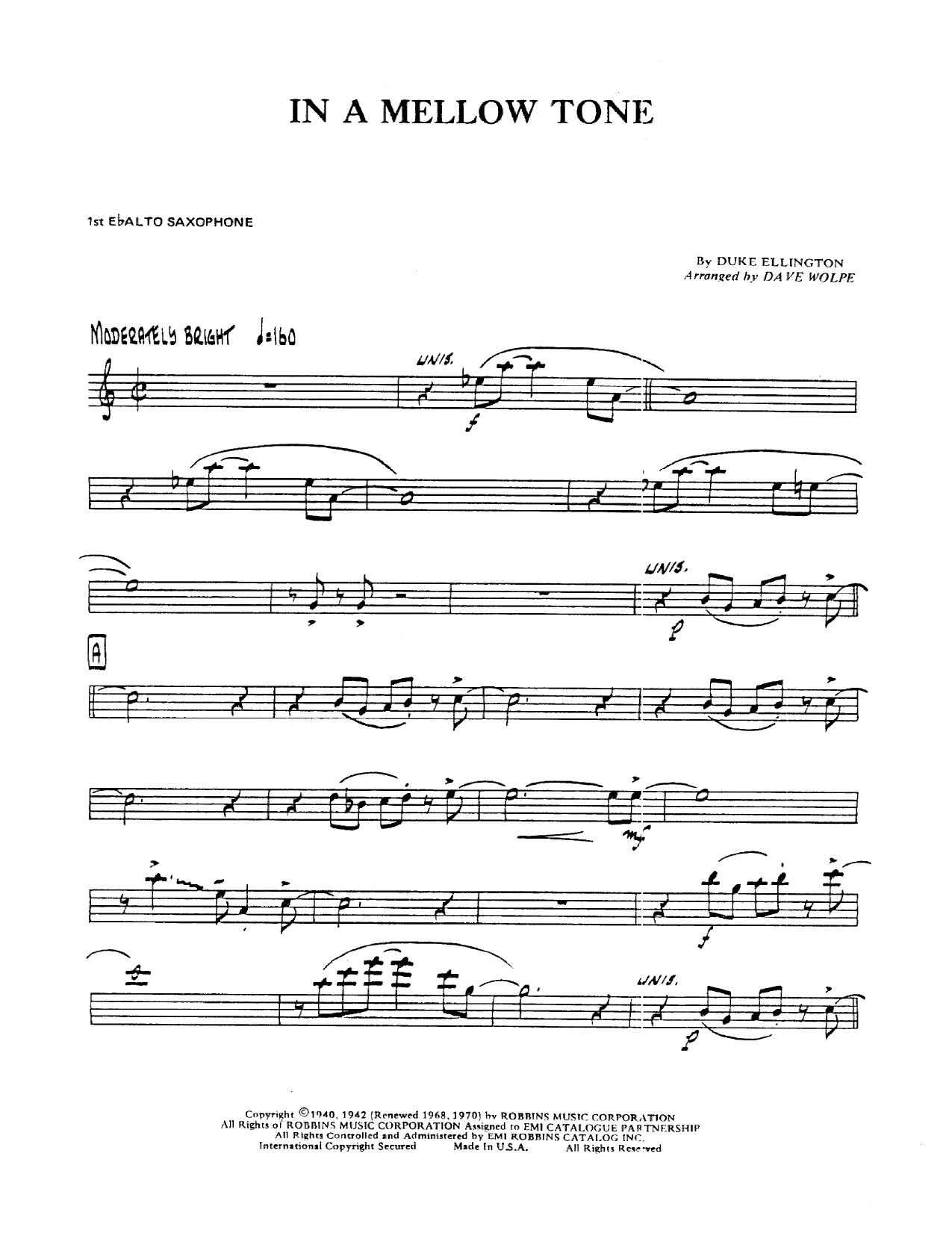
In a Mellow Tone (D.Wolpe) sheet music preview

In a Mellow Tone (D.Wolpe)

Composed by Duke Ellington

Arranged by Dave Wolpe

  • Ensemble: Big Band
  • Pages: 53
  • Instruments (17): 1st Eb Alto Saxophone, 2nd Eb Alto Saxophone, 1st Bb Tenor Saxophone, 2nd Bb Tenor Saxophone, Eb Baritone Saxophone, 1st Bb Trumpet, 2nd Bb Trumpet, 3rd Bb Trumpet, 4th Bb Trumpet, 1st Trombone, 2nd Trombone, 3rd Trombone, Bass Trombone, Guitar, Bass, Drums, Piano
  • Difficulty: advanced
  • Content: Individual Parts
  • Format: PDF Download (Instant)
  • Price: $24.99

Duke Ellington penned "In a Mellow Tone" in 1939, utilizing the chord changes of the 1917 pop standard "Rose Room" to create one of the definitive swing era anthems. First recorded by the legendary Duke Ellington Orchestra with Johnny Hodges prominently featured, the tune quickly cemented its status as an indispensable jazz standard. Representing the sophisticated pinnacle of Harlem-inflected swing and big band counterpoint, the composition bridges the joyous accessibility of dance-hall swing with the harmonic ingenuity that would soon blossom into modern jazz. Its enduring appeal lies in its infectious, blues-inflected melody and a relaxed, optimistic harmonic framework that invites both casual listeners and discerning jazz aficionados into a state of pure euphoria. Dave Wolpe’s masterful big band adaptation captures the swinging essence of the Ellington tradition while infusing it with the polished, crisp punch characteristic of contemporary studio and educational writing. Set in a comfortable, infectious medium-swing groove, the arrangement radiates warmth, sophistication, and buoyant energy. Wolpe treats the iconic melody with deep respect, opening with rich saxophone voicings that evoke the smooth, buttery tone of the classic Hodges-led reed section. The chart progresses through clever dynamic contrasts, driving rhythm section punctuations, and a textbook shout chorus that builds organically, propelling the entire ensemble toward a triumphant, high-energy climax without ever losing its underlying relaxed swagger. Throughout the 53-page score, the distribution of melodic material is expertly balanced across the ensemble. The saxophones frequently carry the primary thematic statements, anchored by lush brass pads and a relentless, driving swing beat from the rhythm section. Featured solo space allows a competent soloist to stretch out over standard blues-derived changes, providing a focal point for audience engagement. Technical demands are thoughtfully managed, making this chart wonderfully accessible while still offering rich educational and artistic rewards. Performers will particularly relish the vibrant ensemble solis and the clever transitional figures that keep the momentum fresh from the first downbeat to the final chord. Advanced high school ensembles, collegiate jazz orchestras, and professional community big bands will find this arrangement to be an absolute cornerstone for festival programming or standard concert repertoire. Because Wolpe understands the acoustic realities of a standard 17-piece big band, the scoring naturally reinforces weaker sections while letting strong soloists soar. It provides an ideal vehicle for teaching stylistic authenticity, ensemble blend, and the nuances of swing articulation, ensuring that directors can achieve a polished, professional sound with reasonable rehearsal investment. Achieving an authentic performance of this Dave Wolpe arrangement requires careful attention to traditional swing articulation and dynamic control. The tempo should remain a steady, unhurried medium swing—avoiding the temptation to rush, as the groove relies entirely on a relaxed, behind-the-beat feel in the rhythm section. Brass players should utilize standard cup or straight mutes where indicated, ensuring that background figures remain supportive rather than overpowering the lead voices. Pay close attention to short, clipped quarter notes and well-supported long tones in the saxes to emulate the classic Ellington reed section sound. Rehearsal time should be heavily invested in achieving a unified articulation style between the brass and reeds during the ensemble solis. Directors should encourage the rhythm section—particularly the ride cymbal and hi-hat on beats two and four—to drive the ensemble effortlessly, maintaining a buoyant foundation beneath the melodic lines. Q: What instruments and parts are included in this big band arrangement? A: The 17-instrument orchestration includes standard big band instrumentation: 5 saxophones (Alto 1, Alto 2, Tenor 1, Tenor 2, Baritone), 4 trumpets, 4 trombones, and a complete 4-piece rhythm section comprising piano, guitar, bass, and drums, spread across a comprehensive 53-page score and parts set. Q: What is the difficulty level of this Dave Wolpe chart? A: This arrangement is graded as medium-advanced, making it an ideal fit for accomplished high school jazz bands, collegiate ensembles, and professional community big bands looking for rewarding stylistic challenges. Q: What is the historical style and background of the music? A: Rooted in the 1939 swing era classic composed by Duke Ellington over the chord changes of "Rose Room," this arrangement honors the traditional jazz standard format while updating it with crisp, modern big band scoring techniques. Q: What makes this specific arrangement unique? A: Dave Wolpe’s treatment stands out for its masterful balance of lush, classic Ellingtonian reed voicings with contemporary dynamic contrasts, driving rhythm section charts, and an exhilarating shout chorus that energizes performers and audiences alike. Q: What is the recommended performance tempo and duration? A: The piece is designed to be performed at a comfortable medium-swing tempo, typically lasting around 3 to 4 minutes depending on the length of the improvised solos and the chosen number of choruses.

Questions and answers

What is included in the In a Mellow Tone (D.Wolpe) PDF?
The verified current file contains individual parts across 53 pages.
How many instruments or parts are listed for In a Mellow Tone (D.Wolpe)?
The verified instrumentation list contains 17 entries for this Big Band arrangement.
Who is credited for In a Mellow Tone (D.Wolpe)?
Composer: Duke Ellington. Arranger: Dave Wolpe.
What difficulty is listed for In a Mellow Tone (D.Wolpe)?
The verified difficulty level is advanced.
Can I preview In a Mellow Tone (D.Wolpe) before buying?
Yes. The product page provides a preview generated from the current PDF file.
How is In a Mellow Tone (D.Wolpe) delivered?
After successful payment, the digital PDF is made available for download. The displayed price is $24.99.

Musicians Also Search For

In a Mellow Tone Dave Wolpe PDFIn a Mellow Tone Dave Wolpe sheet musicIn a Mellow Tone arranged by Dave WolpeDave Wolpe big band chartsDave Wolpe jazz arrangements PDFIn a Mellow Tone Duke Ellington sheet musicIn a Mellow Tone Duke Ellington big band arrangementsDuke Ellington big band chartsIn a Mellow Tone big band arrangementsIn a Mellow Tone big band PDF downloadIn a Mellow Tone jazz sheet musicbig band sheet music downloadIn a Mellow Tone individual parts downloadIn a Mellow Tone sheet music PDFbuy In a Mellow Tone sheet musicdownload In a Mellow Tone PDFIn a Mellow Tone jazz chartsbest Dave Wolpe big band arrangementsDuke Ellington arranged by Dave WolpeIn a Mellow Tone printable sheet musicbig band repertoire PDF

All arrangements by Dave Wolpe All Duke Ellington sheet music