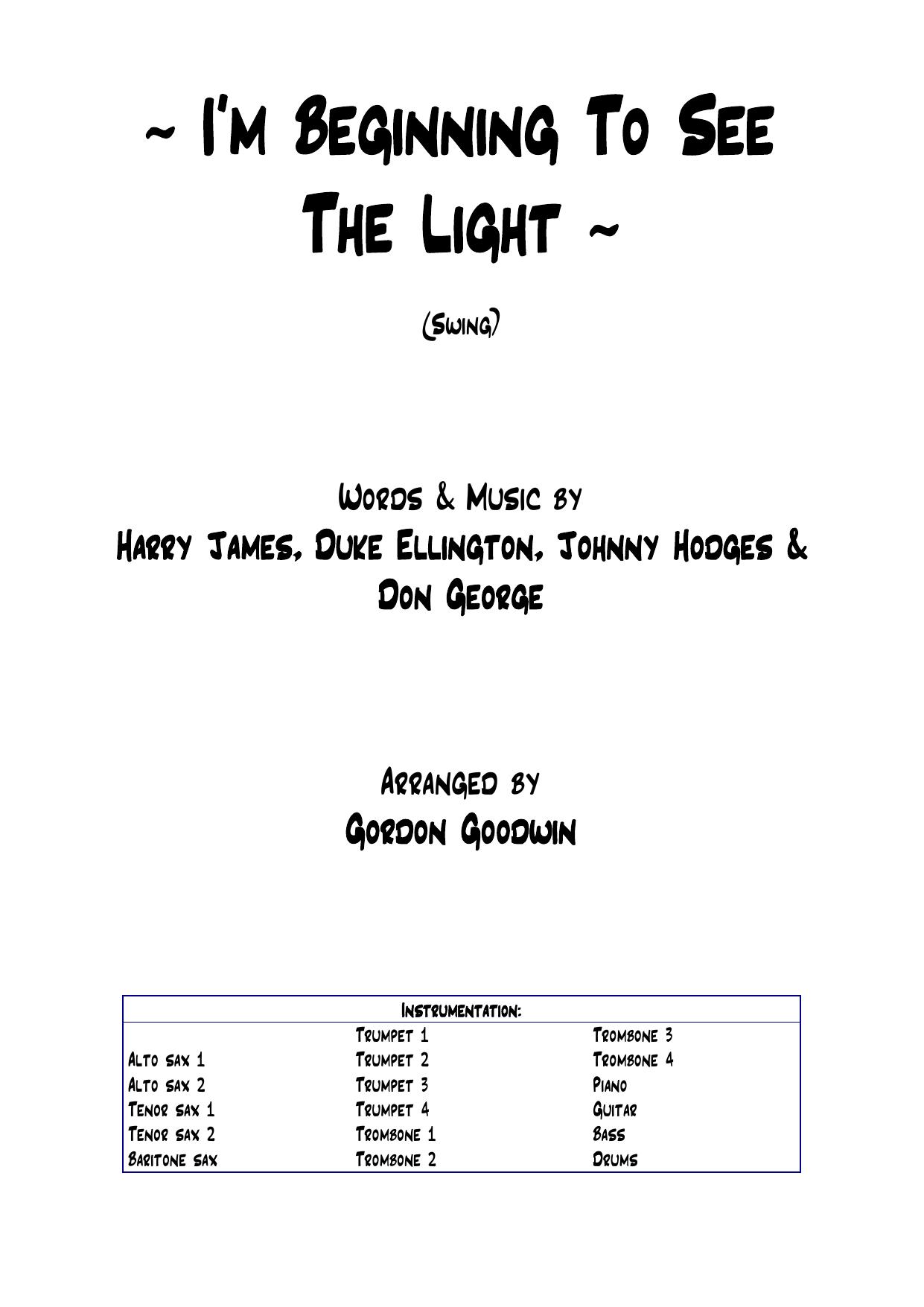
I'm Beginning To See The Light (G.Goodwin)
Composed by Duke Ellington
Arranged by Gordon Goodwin
- Ensemble: Big Band
- Pages: 37
- Instruments (17): Alto Sax 1, Alto Sax 2, Tenor Sax 1, Tenor Sax 2, Baritone Sax, Trumpet 1, Trumpet 2, Trumpet 3, Trumpet 4, Trombone 1, Trombone 2, Trombone 3, Trombone 4, Piano, Guitar, Bass, Drums
- Difficulty: medium
- Content: Individual Parts
- Format: PDF Download (Instant)
- Price: $24.99
Duke Ellington, Johnny Hodges, Harry Carney, and Don George first introduced "I'm Beginning to See the Light" to the world in 1944, anchoring it firmly in the golden era of swing and big band jazz. Initially popularized by Harry James and His Orchestra—featuring vocalist Kitty Kallen—alongside Ellington’s own definitive recordings, this timeless standard bridges the sophisticated vocal jazz tradition with driving, infectious swing. Its memorable, conversational melody and blues-infused harmonic framework have made it an enduring vehicle for improvisers across generations, cementing its status as a staple of the American Songbook. Gordon Goodwin brings his signature contemporary West Coast big band brilliance to this classic vehicle, transforming a 1940s swing standard into a high-energy powerhouse. Written with a vibrant, driving medium-up swing feel, the chart crackles with optimistic energy, playful syncopation, and lush, extended contemporary harmonies. Goodwin respects the buoyant character of the original Ellington composition while supercharging it with modern big band vocabulary, characterized by crisp, punchy brass voicings, intricate sax solis, and an irrepressible rhythmic momentum that instantly captivates both performers and audiences. Goodwin’s arrangement is meticulously crafted to showcase the entire ensemble, distributing melodic interest and technical challenges across every section. The saxophones enjoy tightly knit, intricate soli passages that demand precision and a unified articulation style, while the brass section alternates between warm, muted textures and blistering, open-bell shout choruses. Featured solo space allows improvisers to stretch out over standard changes energized by Goodwin's clever background figures. The arrangement utilizes subtle dynamic contrast, razor-sharp rhythmic unisons, and unexpected harmonic turnarounds that keep the listener engaged from the first downbeat to the final explosive chord. Advanced high school ensembles, collegiate jazz orchestras, and professional community big bands will find this chart to be an exhilarating centerpiece for a concert or festival program. While accessible to bands with strong reading skills and a solid grasp of modern swing subdivision, it demands a mature rhythm section capable of driving a relentless groove and horn sections with the endurance and agility to handle contemporary big band demands. The payoff is an exceptionally rewarding, crowd-pleasing performance that brilliantly merges historical jazz royalty with modern arranging mastery. Executing this Gordon Goodwin arrangement successfully requires meticulous attention to articulation, balance, and stylistic consistency. The tempo should be kept at a bright, driving medium-up swing—never rushed, but maintaining an effortless forward propulsion anchored by a steady, buoyant ride cymbal pattern. Rhythmic figures demand absolute precision; short notes must be clipped and uniform across all sections, particularly during the punctuated ensemble hits that punctuate Goodwin’s charts. Brass players should utilize appropriate section mutes (such as cup or harmon mutes where indicated) to achieve the authentic color contrasts Goodwin specifies, ensuring that dynamic swells never overpower the lead voices or the soloist. The rhythm section is the engine of this chart: the pianist should voice chords sparingly using upper-structure extensions, while the bassist walks a strong, linear line that locks tightly with the drummer's hi-hat on beats two and four. Rehearsal should initially focus on isolated sectional work—specifically the saxophone soli—before bringing the ensemble together to balance the intricate background figures behind the featured soloists. Q: What instruments and parts are included in this arrangement? A: This 37-page arrangement is scored for a standard 17-instrument big band, consisting of 5 saxophones (Alto 1-2, Tenor 1-2, Baritone), 4 trumpets, 4 trombones, and a 4-piece rhythm section comprising piano, guitar, bass, and drums. Q: What is the difficulty level of this Gordon Goodwin chart? A: This arrangement is graded as advanced, making it best suited for accomplished high school jazz bands, collegiate ensembles, and professional or advanced community big bands with strong section players and confident soloists. Q: What is the musical style and historical context of the piece? A: The chart reimagines Duke Ellington's 1944 swing standard through a contemporary big band lens, blending classic 1940s American Songbook harmony with modern West Coast arranging techniques, dynamic shout choruses, and sophisticated voicings. Q: What makes this specific arrangement unique? A: Gordon Goodwin injects his signature contemporary flair into the classic standard by utilizing crisp ensemble unisons, lush extended chord voicings, clever background figures, and high-energy transitional moments that breathe new life into the familiar melody. Q: What is the recommended performance tempo and duration? A: The arrangement is set in a bright, driving medium-up swing feel (typically around quarter note = 160-168 BPM), with a standard performance duration of approximately 3.5 to 4.5 minutes depending on the length of the improvised solos.
Questions and answers
- What is included in the I'm Beginning To See The Light (G.Goodwin) PDF?
- The verified current file contains individual parts across 37 pages.
- How many instruments or parts are listed for I'm Beginning To See The Light (G.Goodwin)?
- The verified instrumentation list contains 17 entries for this Big Band arrangement.
- Who is credited for I'm Beginning To See The Light (G.Goodwin)?
- Composer: Duke Ellington. Arranger: Gordon Goodwin.
- What difficulty is listed for I'm Beginning To See The Light (G.Goodwin)?
- The verified difficulty level is medium.
- Can I preview I'm Beginning To See The Light (G.Goodwin) before buying?
- Yes. The product page provides a preview generated from the current PDF file.
- How is I'm Beginning To See The Light (G.Goodwin) delivered?
- After successful payment, the digital PDF is made available for download. The displayed price is $24.99.
Musicians Also Search For
I'm Beginning To See The Light Gordon Goodwin PDF • I'm Beginning To See The Light Gordon Goodwin sheet music • I'm Beginning To See The Light arranged by Gordon Goodwin • Gordon Goodwin big band charts • Gordon Goodwin jazz arrangements PDF • I'm Beginning To See The Light Duke Ellington sheet music • I'm Beginning To See The Light Duke Ellington big band arrangements • Duke Ellington big band charts • I'm Beginning To See The Light big band arrangements • I'm Beginning To See The Light big band PDF download • I'm Beginning To See The Light jazz sheet music • big band sheet music download • I'm Beginning To See The Light individual parts download • I'm Beginning To See The Light sheet music PDF • buy I'm Beginning To See The Light sheet music • download I'm Beginning To See The Light PDF • I'm Beginning To See The Light jazz charts • best Gordon Goodwin big band arrangements • Duke Ellington arranged by Gordon Goodwin • I'm Beginning To See The Light printable sheet music • big band repertoire PDF