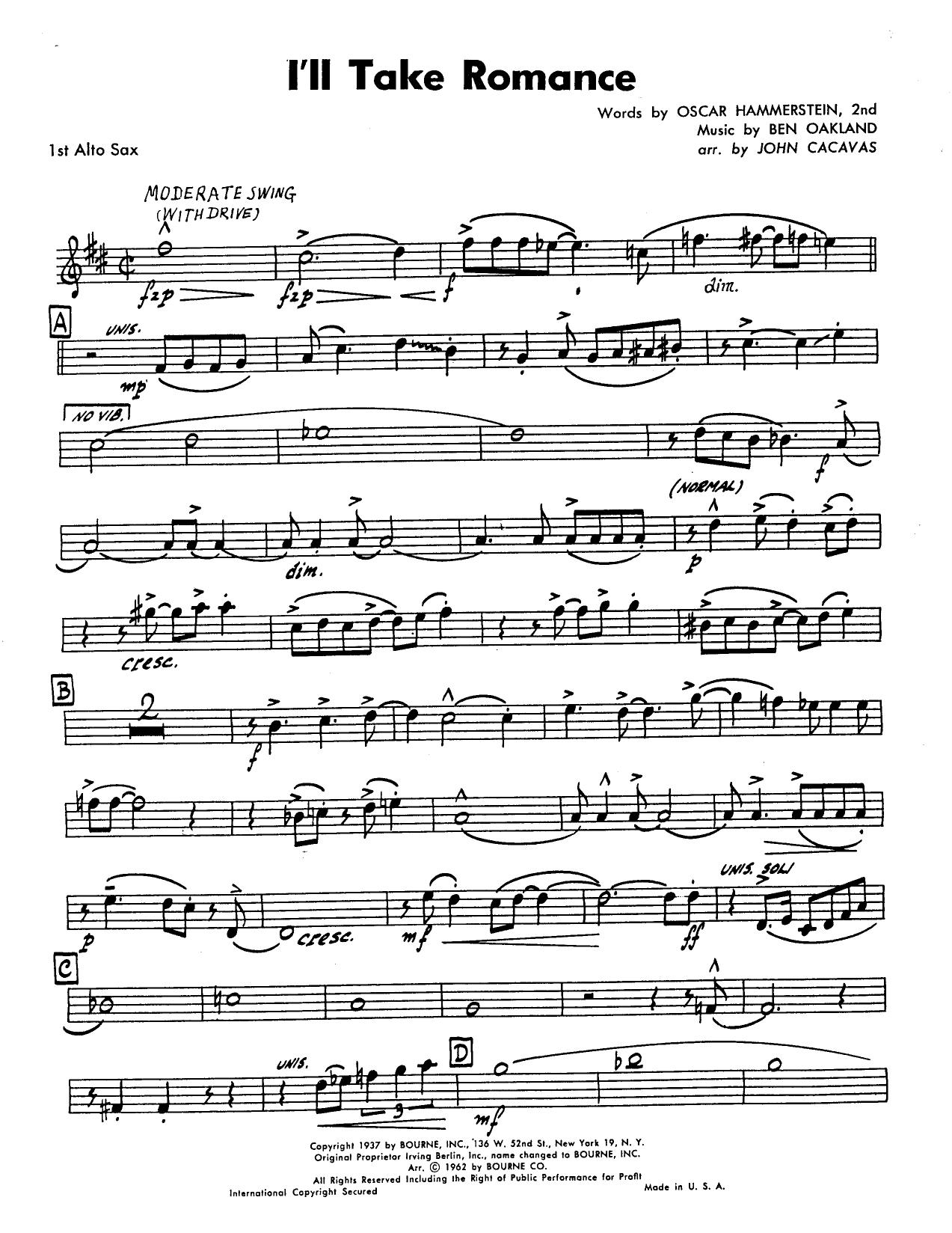
I'LL Take Romance (J.Cacavas) sheet music preview

I'LL Take Romance (J.Cacavas)

Composed by Oscar Hammerstein II

Arranged by John Cacavas

  • Ensemble: Big Band
  • Pages: 36
  • Instruments (17): 1st Alto Sax, 2nd Alto Sax, 1st Tenor Sax, 2nd Tenor Sax, Baritone Sax, 1st Trumpet, 2nd Trumpet, 3rd Trumpet, 4th Trumpet, 1st Trombone, 2nd Trombone, 3rd Trombone, 4th Trombone, String Bass (Tuba), Guitar, Drums, Piano
  • Difficulty: medium
  • Content: Individual Parts
  • Format: PDF Download (Instant)
  • Price: $24.99

Written by Oscar Hammerstein II and Ben Oakland in 1937 for the musical film of the same name starring Grace Moore, "I'll Take Romance" quickly crossed over from cinematic balladry into the permanent consciousness of the Great American Songbook. While initially conceived as a soaring vehicle for operatic pop vocals, the song's lush harmonic progression, soaring melodic leaps, and inherent rhythmic drive made it an irresistible vehicle for jazz interpreters. Over the decades, it has been revisited by legendary instrumentalists and vocalists alike, cementing its status as a sophisticated staple of mid-century swing and mainstream jazz repertoire. Propelled by an infectious, driving medium-swing groove, this big band interpretation radiates an atmosphere of vintage sophistication and buoyant optimism. The arrangement opens with a bright, inviting momentum in 4/4 time, moving fluidly between rich, cascading brass voicings and crisp, syncopated reed figures. The emotional character shifts gracefully between lyrical, romantic expansiveness during the melodic statements and an irrepressible, foot-tapping energy when the full ensemble locks into the groove. The harmonic language remains true to classic swing era conventions while incorporating tasteful, extended chord extensions that give the chart a lush, contemporary depth without alienating traditionalists. Master arranger John Cacavas brings his signature cinematic flair and meticulous craftsmanship to the scoring, balancing transparent wind writing with full-ensemble power. Cacavas constructs a brilliant architectural roadmap, utilizing tightly knit sax solis and punchy, dynamic brass interjections to create constant textural variety. Rather than relying on overcomplicated modern substitutions, the arrangement achieves its sophistication through clever counterpoint, seamless voice-leading, and a brilliantly structured shout chorus that builds organically out of the rhythm section's foundational drive. The scoring gives each section equal ownership of the texture, ensuring that accompaniment figures remain musically engaging rather than purely functional. The melody is primarily introduced by the saxophone section working in smooth, unison harmony, before being handed off to collaborative brass statements and featured solo spaces. Technically approachable yet musically demanding in its requirement for clean articulation and stylistic uniformity, this chart rewards bands that excel at precise swing phrasing and dynamic contrast. Advanced high school ensembles, collegiate jazz orchestras, and professional community big bands will find it an ideal centerpiece for a concert program. Its combination of historic charm, accessible ranges, and clever arranging makes it a guaranteed crowd-pleaser that offers genuine educational and artistic fulfillment. Success with this John Cacavas arrangement hinges on maintaining a relaxed yet authoritative medium-swing feel, avoiding the trap of rushing the tempo when the ensemble crescendos during the shout chorus. The rhythm section should anchor the groove with a steady, unhurried quarter-note pulse on the ride cymbal, while the bass player focuses on a clean, acoustic-style walking bassline that locks tightly with the kick drum. Horn players must pay close attention to short, crisp articulations on off-beat figures, ensuring that eighth notes are swung naturally in the traditional Kansas City style rather than articulated as stiff double-tongued triplets. Rehearsal should begin by isolating the saxophone soli to balance intonation and blend before integrating the brass counter-lines. Watch out for dynamic balance during ensemble passages; the brass must back off slightly when the saxophones carry the primary melodic line. Encourage the featured soloists to reference the changes gracefully while maintaining the buoyant, romantic spirit of the composition. No specialized effects like plungers or extreme flutter-tonguing are required, allowing the ensemble to focus entirely on blend, swing phrasing, and tonal warmth. Q: What instruments and parts are included in this arrangement? A: This chart is scored for a standard 8-instrument big band instrumentation, featuring parts for Alto Saxophone, Tenor Saxophone, Baritone Saxophone, Trumpet, and Trombone, alongside a full rhythm section, totaling 36 pages of performance material. Q: What is the difficulty level of this arrangement? A: It is moderately rated, making it exceptionally well-suited for advanced high school jazz ensembles, college groups, and community big bands looking for rewarding, professional-grade repertoire without prohibitive technical hurdles. Q: What is the historical style and background of "I'll Take Romance"? A: Originally composed in 1937 by Oscar Hammerstein II and Ben Oakland for film, the tune evolved into a classic jazz standard championed by swing era and mainstream jazz artists for its sophisticated, romantic changes. Q: What makes this specific arrangement by John Cacavas unique? A: Cacavas applies his signature cinematic arranging style, blending lush, traditional swing voicings with clever counterpoint, tight saxophone solis, and a dynamically progressive shout chorus that keeps players and audiences engaged. Q: What is the performance duration and tempo feel of this piece? A: The arrangement runs approximately 3 to 4 minutes and is anchored by an energetic, driving medium-swing groove in 4/4 time designed to showcase ensemble precision and stylistic fluidity.

Questions and answers

What is included in the I'LL Take Romance (J.Cacavas) PDF?
The verified current file contains individual parts across 36 pages.
How many instruments or parts are listed for I'LL Take Romance (J.Cacavas)?
The verified instrumentation list contains 17 entries for this Big Band arrangement.
Who is credited for I'LL Take Romance (J.Cacavas)?
Composer: Oscar Hammerstein II. Arranger: John Cacavas.
What difficulty is listed for I'LL Take Romance (J.Cacavas)?
The verified difficulty level is medium.
Can I preview I'LL Take Romance (J.Cacavas) before buying?
Yes. The product page provides a preview generated from the current PDF file.
How is I'LL Take Romance (J.Cacavas) delivered?
After successful payment, the digital PDF is made available for download. The displayed price is $24.99.

Musicians Also Search For

I'LL Take Romance John Cacavas PDFI'LL Take Romance John Cacavas sheet musicI'LL Take Romance arranged by John CacavasJohn Cacavas big band chartsJohn Cacavas jazz arrangements PDFI'LL Take Romance Oscar Hammerstein II sheet musicI'LL Take Romance Oscar Hammerstein II big band arrangementsOscar Hammerstein II big band chartsI'LL Take Romance big band arrangementsI'LL Take Romance big band PDF downloadI'LL Take Romance jazz sheet musicbig band sheet music downloadI'LL Take Romance individual parts downloadI'LL Take Romance sheet music PDFbuy I'LL Take Romance sheet musicdownload I'LL Take Romance PDFI'LL Take Romance jazz chartsbest John Cacavas big band arrangementsOscar Hammerstein II arranged by John CacavasI'LL Take Romance printable sheet musicbig band repertoire PDF

All arrangements by John Cacavas All Oscar Hammerstein II sheet music