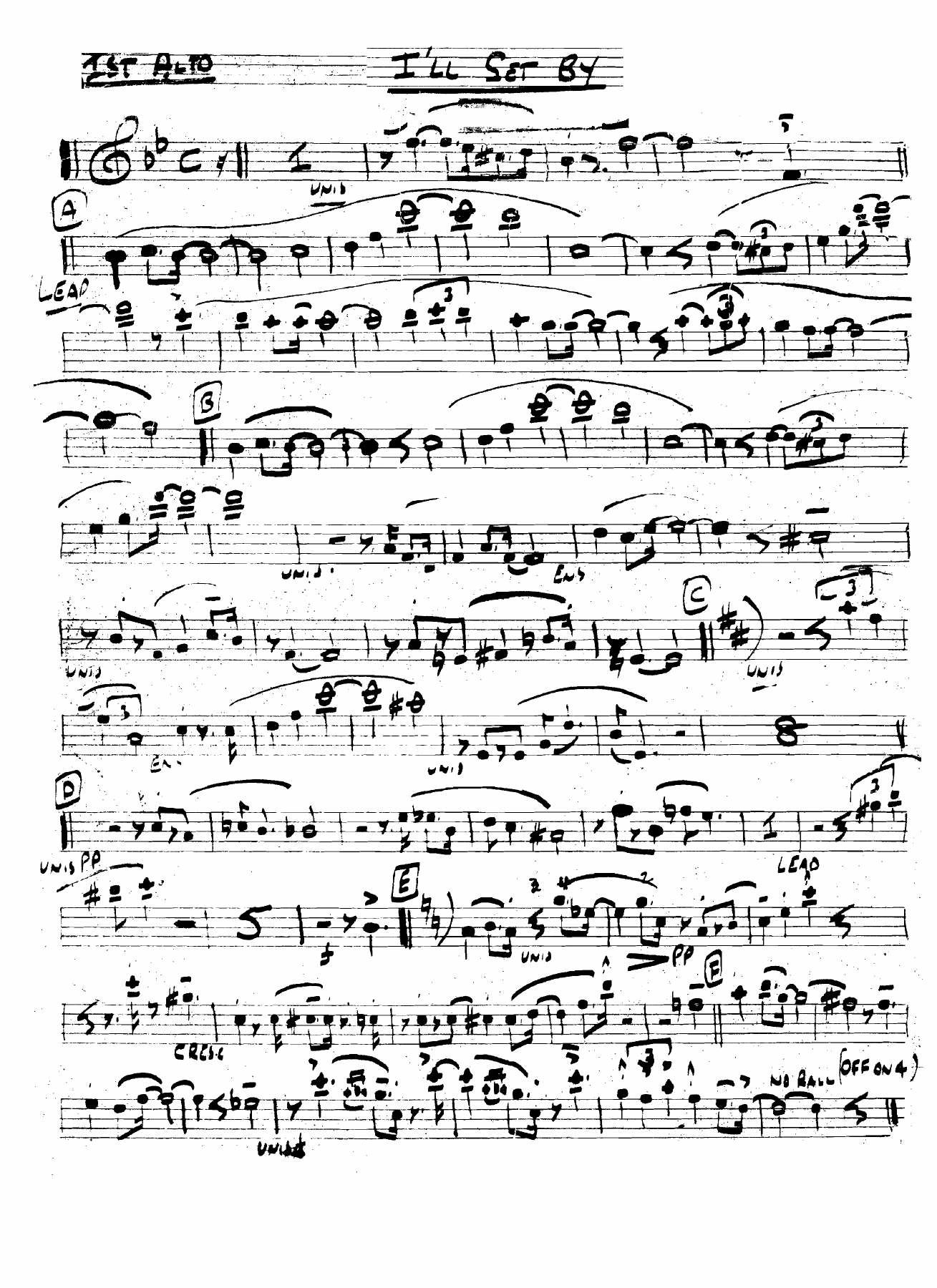
I'll Get By (J.Farley) sheet music preview

I'll Get By (J.Farley)

Composed by Fred E. Ahlert

Arranged by Billy May

  • Ensemble: Big Band
  • Style: Jazz Standard
  • Pages: 19
  • Instruments (17): 1st Alto Saxophone, 2nd Alto Saxophone, 1st Tenor Saxophone, 2nd Tenor Saxophone, Baritone Saxophone, 1st Trumpet, 2nd Trumpet, 3rd Trumpet, 4th Trumpet, 1st Trombone, 2nd Trombone, 3rd Trombone, 4th Trombone, Piano, Guitar, Bass, Drums
  • Difficulty: easy
  • Content: Individual Parts
  • Format: PDF Download (Instant)
  • Price: $24.99

"I'll Get By (As Long As I Have You)," penned by Fred E. Ahlert in 1928, stands as a quintessential American popular song that gracefully transitioned into the jazz standard repertoire. Emerging from the Tin Pan Alley tradition, its enduring melody and heartfelt lyrics resonated deeply during the Great Depression, offering a message of steadfast devotion amidst hardship. The song was famously introduced by Ruth Etting and subsequently popularized by numerous artists across various genres, including a notable 1944 recording by Harry James with Frank Sinatra, solidifying its place in the American songbook. Its harmonic sophistication and lyrical structure make it a favorite for improvisation, ensuring its continued relevance as a jazz standard that evokes a timeless sense of romantic longing and resilience. Billy May's arrangement of "I'll Get By (J. Farley)" masterfully reinterprets this classic, infusing it with his signature "slurpy" brass and sophisticated, yet accessible, big band aesthetic. This particular chart captures a medium swing tempo, establishing a relaxed yet propulsive groove in 4/4 time. The arrangement is primarily in the key of F major, allowing for a warm, inviting sonic landscape. May's genius lies in his ability to craft rich, often close-voiced harmonies that give the brass sections a distinctive, almost vocal quality, while the reeds weave intricate counter-melodies and harmonized lines. The overall mood is one of nostalgic elegance, imbued with a subtle energy that builds throughout the piece. It evokes the golden age of big band jazz, balancing lush romanticism with the swinging drive characteristic of the era. The arrangement features a classic big band structure, opening with a beautifully voiced saxophone soli that introduces the melody with May's characteristic blend of smoothness and harmonic depth. The melody then passes to the brass, often with plunger mutes, creating that iconic "slurpy" sound that is a hallmark of May's style. Solos are strategically placed, offering opportunities for a tenor saxophone and a trumpet to shine, each backed by carefully constructed ensemble figures that maintain momentum and provide harmonic support. A powerful shout chorus builds dynamically towards the climax, showcasing the full ensemble's power and precision before a refined, often understated, coda brings the piece to a satisfying close. The interplay between sections, the dynamic contrasts, and the meticulous voicing make this arrangement a rewarding experience for both performers and listeners. This arrangement is ideally suited for advanced high school, collegiate, community, and professional jazz ensembles. Its technical demands, while significant, are within reach for bands with solid section playing and experienced soloists. The challenge lies in achieving May's specific stylistic nuances—the precise articulations, the dynamic shaping, and the blend required for his distinctive voicings. Successfully performing "I'll Get By" under May's pen offers an invaluable lesson in big band history and arrangement, allowing musicians to engage with a master's work and deliver a sophisticated, swinging performance that honors the legacy of both the song and the arranger. Approaching Billy May's "I'll Get By (J. Farley)" requires attention to stylistic detail. The medium swing feel should be established with a relaxed, yet consistent, quarter-note pulse, avoiding any rushed or stiff interpretations. Articulation is paramount; brass players must master May's characteristic "slurpy" plunger mute techniques, ensuring smooth glissandi and precise releases, often indicated with falls and doits. Reeds need to focus on blend and intonation within the close-voiced soli sections, maintaining a unified sound. Dynamic contrast is crucial, particularly in the build-up to the shout chorus and the subtle tapering of the coda. Conductors should emphasize the interplay between sections, ensuring that background figures support rather than overpower the soloists or melodic lines. Rehearsal time should be dedicated to perfecting the ensemble's rhythmic precision, especially in the unison and harmonized brass figures, and to developing a cohesive, swinging groove throughout. Q: What instruments and parts are included in this arrangement? A: This arrangement is scored for a standard big band with 16 instruments: Alto Saxophone 1, Alto Saxophone 2, Tenor Saxophone 1, Tenor Saxophone 2, Baritone Saxophone, Trumpet 1, Trumpet 2, Trumpet 3, Trumpet 4, Trombone 1, Trombone 2, Trombone 3, Bass Trombone, Piano, Bass, and Drums. Q: What is the difficulty level of this arrangement? A: This arrangement is considered advanced, suitable for high school, collegiate, community, and professional jazz ensembles. It requires solid section playing, experienced soloists, and attention to specific stylistic articulations and dynamics. Q: What is the musical style and historical context of "I'll Get By (J. Farley)"? A: "I'll Get By" is a classic American popular song from 1928 that became a jazz standard. Billy May's arrangement presents it in a medium swing big band style, characteristic of the mid-20th century, showcasing his distinctive "slurpy" brass and sophisticated voicings. Q: What makes Billy May's arrangement of "I'll Get By" unique? A: Billy May's signature "slurpy" brass voicings, achieved through precise plunger mute work, are a hallmark of this arrangement. It also features his characteristic close-voiced harmonies, intricate saxophone soli sections, and a classic big band shout chorus, all contributing to a lush, swinging interpretation. Q: What is the typical performance duration or tempo for this piece? A: This arrangement is designed for a medium swing tempo. While exact duration can vary with interpretation, a typical performance would fall within the 3 to 4-minute range, maintaining a relaxed yet propulsive 4/4 groove.

Questions and answers

What is included in the I'll Get By (J.Farley) PDF?
The verified current file contains individual parts across 19 pages.
How many instruments or parts are listed for I'll Get By (J.Farley)?
The verified instrumentation list contains 17 entries for this Big Band arrangement.
Who is credited for I'll Get By (J.Farley)?
Composer: Fred E. Ahlert. Arranger: Billy May.
What difficulty is listed for I'll Get By (J.Farley)?
The verified difficulty level is easy.
What style is listed for I'll Get By (J.Farley)?
The catalog lists the style as Jazz Standard.
Can I preview I'll Get By (J.Farley) before buying?
Yes. The product page provides a preview generated from the current PDF file.
How is I'll Get By (J.Farley) delivered?
After successful payment, the digital PDF is made available for download. The displayed price is $24.99.

Musicians Also Search For

I'll Get By Billy May PDFI'll Get By Billy May sheet musicI'll Get By arranged by Billy MayBilly May big band chartsBilly May jazz arrangements PDFI'll Get By Fred E. Ahlert sheet musicI'll Get By Fred E. Ahlert big band arrangementsFred E. Ahlert big band chartsI'll Get By big band arrangementsI'll Get By big band PDF downloadI'll Get By jazz sheet musicbig band sheet music downloadI'll Get By individual parts downloadI'll Get By sheet music PDFI'll Get By Jazz Standard chartsJazz Standard big band arrangementsbuy I'll Get By sheet musicdownload I'll Get By PDFI'll Get By jazz chartsbest Billy May big band arrangementsFred E. Ahlert arranged by Billy MayI'll Get By printable sheet musicbig band repertoire PDF

All arrangements by Billy May All Fred E. Ahlert sheet music