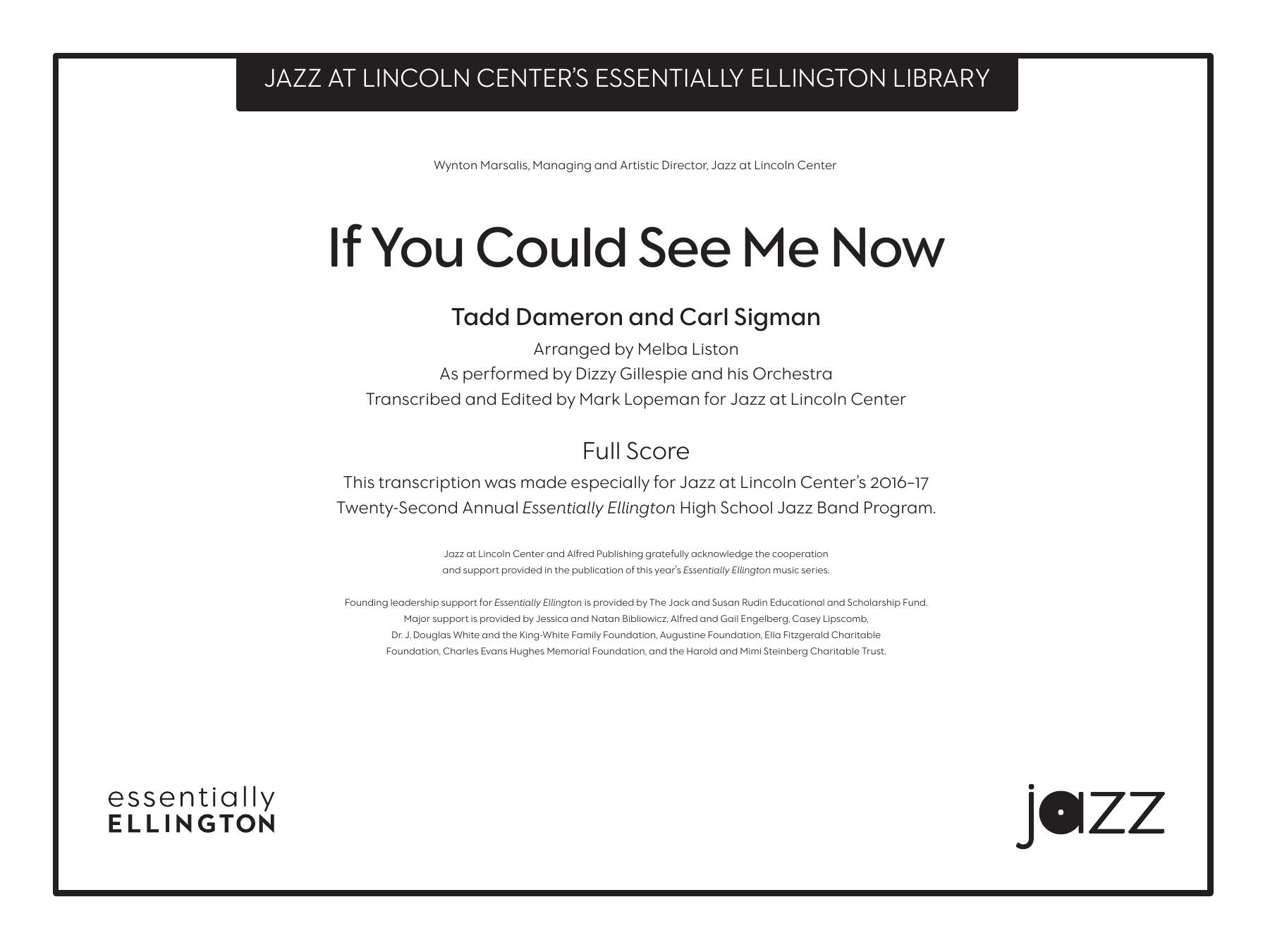
If You Could See Me Now (M.Liston) T.Dameron. Voc sheet music preview

If You Could See Me Now (M.Liston) T.Dameron. Voc

Composed by Tadd Dameron

Arranged by M.Liston

  • Ensemble: Big Band
  • Style: Jazz Standard
  • Pages: 11
  • Instruments (17): Vocal, Reed 1 - Alto Sax, Reed 2 - Alto Sax, Reed 3 - Tenor Sax, Reed 4 - Tenor Sax, Reed 5 - Bari Sax, Trumpet 1, Trumpet 2, Trumpet 3, Trumpet 4, Trumpet Solo, Trombone 1, Trombone 2, Trombone 3, Piano, Bass, Drums
  • Difficulty: easy
  • Content: Individual Parts
  • Format: PDF Download (Instant)
  • Price: $24.99

"If You Could See Me Now," composed by the legendary Tadd Dameron, stands as a quintessential jazz ballad, first introduced in 1946. Dameron, a pivotal figure in the bebop era renowned for his sophisticated harmonic and melodic constructions, wrote this piece specifically for vocalist Sarah Vaughan, with whom he frequently collaborated. Vaughan's 1946 recording, featuring trumpeter Freddie Webster, became one of her signature songs and was later inducted into the Grammy Hall of Fame in 1998, solidifying its status as a timeless jazz standard. The tune, often performed as a slow ballad, is celebrated for its lyrical beauty, impressionistic harmonies, and extended chords, moving beyond the angular lines typically associated with bebop. It evokes a mood of poignant reflection and deep emotion, making it a powerful vehicle for expressive interpretation. This particular arrangement by the esteemed Melba Liston (M. Liston) transforms Dameron's classic into a rich, authoritative big band setting. Liston, a trailblazing trombonist, composer, and arranger, was celebrated for her command of big band and bebop idioms, often blending powerful brass and woodwind textures with expressive solo opportunities. Her work with Dizzy Gillespie's big band, for whom this arrangement was originally created, showcases her innovative approach to orchestration. In this chart, Liston masterfully preserves the haunting quality of the original while expanding its harmonic and textural possibilities. Expect her signature voicings, which provide lush support for the featured vocal and instrumental solos, creating a tapestry of sound that is both intricate and deeply moving. The arrangement is cast as a slow, expressive ballad, typically in 4/4 time, allowing for ample space and rubato in performance. The melody is predominantly carried by the vocalist, who is central to the piece's emotional delivery. Following the vocal presentation, there is a featured solo section, commonly for trumpet, allowing an instrumentalist to interpret Dameron's intricate changes and Liston's rich harmonic backdrop. Technical challenges include maintaining precise intonation and blend within the brass and saxophone sections, particularly in the sustained, harmonized passages. The rhythm section must provide a sensitive and supportive foundation, emphasizing the ballad feel without dragging. Rewarding moments abound in the interplay between the vocalist and the ensemble, as well as the opportunity for the band to collectively shape the profound emotional arc of the piece. This arrangement is ideally suited for college-level jazz ensembles, advanced community big bands, and professional groups. Its demands on ensemble blend, dynamic control, and expressive interpretation require experienced musicians who can navigate complex harmonies and articulate a mature jazz ballad style. While challenging, the meticulous scoring and the inherent beauty of Dameron's composition, coupled with Liston's brilliant orchestration, make it an incredibly rewarding piece to rehearse and perform, offering a deep dive into the artistry of two jazz giants. Conductors should emphasize a unified, warm tone throughout the ensemble, particularly in the brass and saxophone sections, to achieve the lush harmonic textures characteristic of this ballad. The tempo should be a slow, deliberate 4/4, allowing for expressive phrasing and slight rubato, especially from the vocalist. Pay close attention to dynamic contrasts, building intensity gradually and receding to create moments of profound intimacy. Intonation is paramount in the sustained chords; encourage musicians to listen across sections. Rehearsal should focus on balancing the intricate voicings, ensuring that no single voice dominates the blend. The rhythm section needs to maintain a delicate, flowing feel, with the bassist providing a steady, lyrical foundation and the drummer using brushes or mallets for a soft, supportive texture. The featured instrumental soloist should be encouraged to explore the harmonic depth with a lyrical, singing approach. **Q: What instruments are included in this arrangement?** A: This arrangement is scored for a standard big band of 16 instruments, including Vocal, Alto Saxophone 1, Alto Saxophone 2, Tenor Saxophone 1, Tenor Saxophone 2, Baritone Saxophone, Trumpet 1, Trumpet 2, Trumpet 3, Trumpet 4, Trombone 1, Trombone 2, Trombone 3, Bass Trombone, Piano, Bass, and Drums. **Q: What is the difficulty level of this arrangement?** A: This arrangement is considered medium-difficult, making it appropriate for college, advanced community, and professional jazz ensembles that possess strong technical skills and a mature understanding of ballad interpretation. **Q: What is the musical style and historical context of "If You Could See Me Now"?** A: "If You Could See Me Now" is a classic jazz standard composed by Tadd Dameron in 1946, representing the bebop era. It is a slow, poignant ballad known for its sophisticated harmonies and lyrical melody, famously introduced by Sarah Vaughan. **Q: What makes Melba Liston's arrangement of this piece unique?** A: Melba Liston's arrangement is distinctive for its masterful orchestration, preserving Dameron's original harmonic richness while adding her signature lush voicings and providing a compelling big band backdrop for the featured vocal and instrumental (typically trumpet) solos. **Q: What is the approximate performance duration or tempo of this piece?** A: As a slow ballad, "If You Could See Me Now" is typically performed at a tempo around 60 BPM (beats per minute), resulting in a performance duration that can range from approximately 4 to 6 minutes, depending on the interpretation and length of solos.

Questions and answers

What is included in the If You Could See Me Now (M.Liston) T.Dameron. Voc PDF?
The verified current file contains a conductor score across 11 pages.
How many instruments or parts are listed for If You Could See Me Now (M.Liston) T.Dameron. Voc?
The verified instrumentation list contains 17 entries for this Big Band arrangement.
Who is credited for If You Could See Me Now (M.Liston) T.Dameron. Voc?
Composer: Tadd Dameron. Arranger: M.Liston.
What difficulty is listed for If You Could See Me Now (M.Liston) T.Dameron. Voc?
The verified difficulty level is easy.
What style is listed for If You Could See Me Now (M.Liston) T.Dameron. Voc?
The catalog lists the style as Jazz Standard.
Can I preview If You Could See Me Now (M.Liston) T.Dameron. Voc before buying?
Yes. The product page provides a preview generated from the current PDF file.
How is If You Could See Me Now (M.Liston) T.Dameron. Voc delivered?
After successful payment, the digital PDF is made available for download. The displayed price is $24.99.

Musicians Also Search For

If You Could See Me Now M.Liston PDFIf You Could See Me Now M.Liston sheet musicIf You Could See Me Now arranged by M.ListonM.Liston big band chartsM.Liston jazz arrangements PDFIf You Could See Me Now Tadd Dameron sheet musicIf You Could See Me Now Tadd Dameron big band arrangementsTadd Dameron big band chartsIf You Could See Me Now big band arrangementsIf You Could See Me Now big band PDF downloadIf You Could See Me Now jazz sheet musicbig band sheet music downloadIf You Could See Me Now conductor score PDFIf You Could See Me Now sheet music PDFIf You Could See Me Now Jazz Standard chartsJazz Standard big band arrangementsbuy If You Could See Me Now sheet musicdownload If You Could See Me Now PDFIf You Could See Me Now jazz chartsbest M.Liston big band arrangementsTadd Dameron arranged by M.ListonIf You Could See Me Now printable sheet musicbig band repertoire PDF

All arrangements by M.Liston All Tadd Dameron sheet music