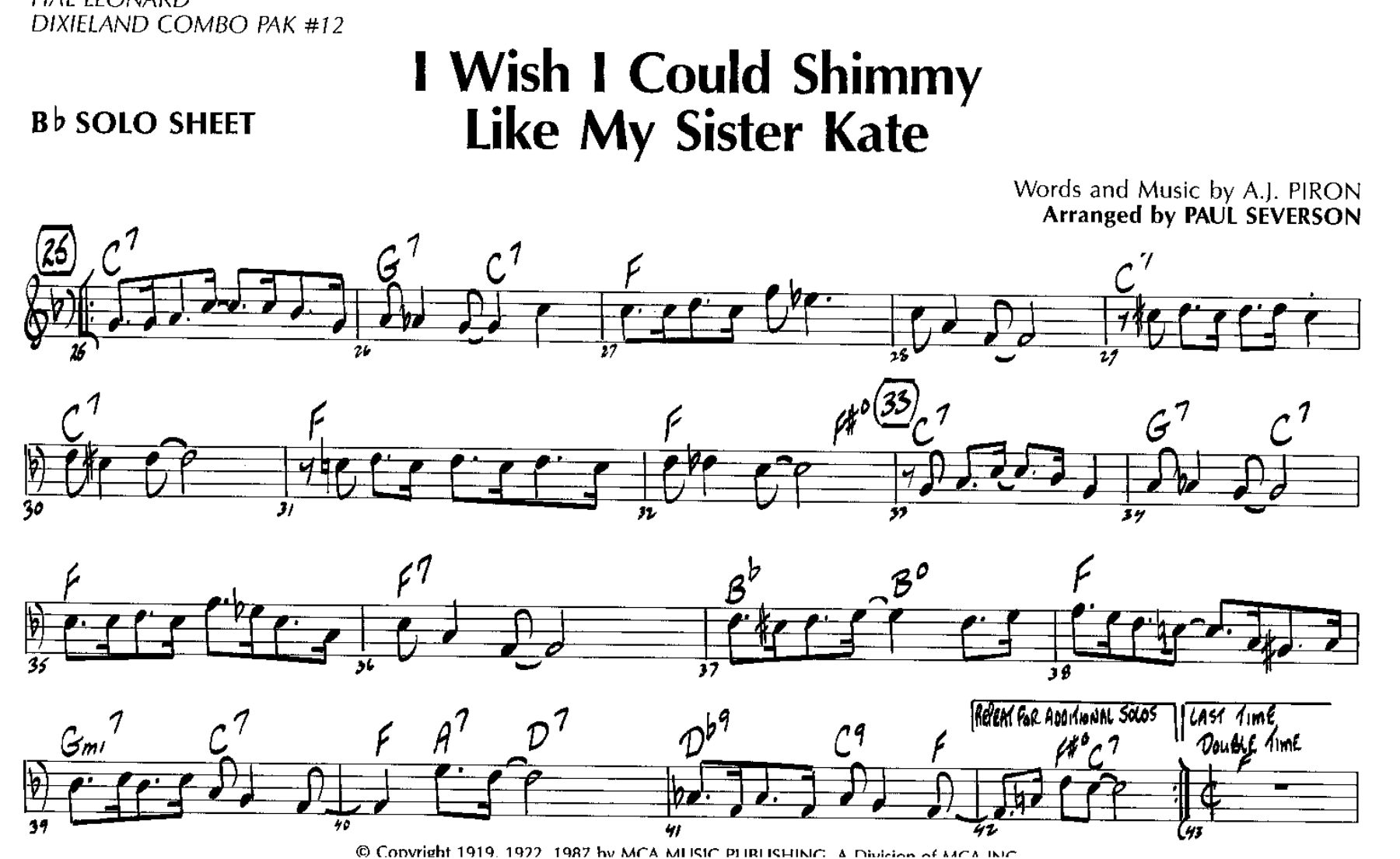
I Wish I Could Shimmy (Severson)
Composed by Spencer Williams
Arranged by Severson
- Ensemble: Dixieland Band
- Style: Dixieland
- Pages: 12
- Instruments (10): Bb Solo Sheet, Clarinet, Tenor Sax, Trumpet, C Bass Clef Solo Sheet, Trombone, Bass/Tuba, Drums, Guitar/Banjo, Piano/Conductor
- Difficulty: easy
- Content: Individual Parts
- Format: PDF Download (Instant)
- Price: $18.99
"I Wish I Could Shimmy," originally penned by the prolific composer Spencer Williams, stands as a vibrant cornerstone of the early jazz repertoire. Composed in 1919, this spirited tune emerged during the nascent years of jazz, capturing the infectious energy and burgeoning dance crazes of the Roaring Twenties. Williams, a key figure in the development of popular music and jazz standards, crafted a melody that quickly became a favorite, embodying the exuberant spirit of Dixieland and early New Orleans jazz. Its catchy refrain and driving rhythm made it an instant hit, frequently performed by pioneering jazz ensembles and vaudeville acts, solidifying its place as a quintessential example of the era's musical landscape. The piece's historical significance lies in its direct connection to the birth of jazz as a popular art form, reflecting the social and cultural shifts of a nation eager for new sounds and expressions. Severson's arrangement of "I Wish I Could Shimmy" masterfully channels this historical essence into a dynamic Dixieland band setting. The musical character is defined by a bright, up-tempo 4/4 feel, typically performed with a driving two-beat or four-beat swing that encourages spontaneous foot-tapping. The arrangement is set in a bright key, often C or F major, which contributes to its joyful and uninhibited mood. Severson's distinctive approach is evident in the clever interplay between the frontline instruments—trumpet, clarinet, and trombone—which weave intricate counter-melodies and harmonized soli sections that are characteristic of traditional Dixieland. Expect crisp, articulate voicings that maintain clarity even at brisk tempos, ensuring each instrumental voice contributes to the overall texture. The arrangement emphasizes the collective improvisation feel inherent in the style, providing a framework that allows for individual expression while maintaining structural integrity. The performance details of this arrangement highlight its authentic Dixieland character. The melody is predominantly carried by the trumpet, often with the clarinet embellishing above and the trombone providing harmonic and rhythmic support through tailgate-style lines. While specific written solos are provided, the arrangement encourages ad-libbed breaks and choruses, offering ample space for each frontline player to showcase their improvisational skills. The technical challenges lie primarily in maintaining the relentless up-tempo swing feel, achieving tight ensemble articulation, and executing the rapid-fire melodic exchanges between instruments. Rewardingly, the piece culminates in a rousing shout chorus, often featuring collective improvisation that builds excitement to a thrilling conclusion. This arrangement is particularly well-suited for college and community Dixieland bands seeking an authentic and engaging piece that challenges their musicianship while delivering an exhilarating performance for audiences. Professional ensembles will also appreciate its faithful adherence to the genre's traditions and its potential for spirited interpretation. Conductors should aim for a bright, unflagging tempo, typically around quarter note = 180-200 bpm, to capture the infectious energy of the Dixieland style. Emphasize a strong two-beat feel in the rhythm section, with the banjo or piano providing a crisp, driving accompaniment. Technical challenges include maintaining precise articulation in the fast melodic lines, particularly for the clarinet and trumpet, and ensuring the trombone’s tailgate smears are executed with flair and accuracy. Encourage the rhythm section to provide a solid, unwavering foundation, allowing the frontline instruments to interact freely. Rehearsal tips include isolating the soli sections to refine intonation and rhythmic precision, and dedicating time to developing the collective improvisation sections, guiding musicians to listen and respond to each other. No special mutes or effects are explicitly required, allowing the natural timbres of the instruments to shine. Q: What instruments and parts are included in this arrangement? A: This Dixieland band arrangement typically includes parts for Trumpet, Clarinet, Trombone, Piano/Banjo, Bass, and Drums. The specific instrumentation is designed to capture the classic New Orleans sound. Q: What is the difficulty level of "I Wish I Could Shimmy (Severson)"? A: This arrangement is rated as medium-advanced. It requires proficient instrumentalists capable of navigating fast tempos, executing clear articulation, and engaging in improvisational sections characteristic of the Dixieland style. Q: What musical style and historical context does this arrangement represent? A: This arrangement is firmly rooted in the Dixieland jazz style, reflecting the vibrant and energetic sounds of early 20th-century New Orleans jazz. It brings to life a classic tune from the 1919 repertoire of Spencer Williams. Q: What makes Severson's arrangement of "I Wish I Could Shimmy" unique? A: Severson's arrangement is distinguished by its authentic Dixieland voicings, clever interplay between the frontline instruments, and a structure that encourages both tight ensemble playing and spirited individual improvisation, culminating in an exciting shout chorus. Q: What is the typical performance duration and tempo for this piece? A: "I Wish I Could Shimmy (Severson)" typically has a performance duration of approximately 3 to 4 minutes. It is designed to be played at a bright, up-tempo swing feel, generally around quarter note = 180-200 beats per minute.
Questions and answers
- What is included in the I Wish I Could Shimmy (Severson) PDF?
- The verified current file contains a conductor score and individual parts across 12 pages.
- How many instruments or parts are listed for I Wish I Could Shimmy (Severson)?
- The verified instrumentation list contains 10 entries for this Dixieland Band arrangement.
- Who is credited for I Wish I Could Shimmy (Severson)?
- Composer: Spencer Williams. Arranger: Severson.
- What difficulty is listed for I Wish I Could Shimmy (Severson)?
- The verified difficulty level is easy.
- What style is listed for I Wish I Could Shimmy (Severson)?
- The catalog lists the style as Dixieland.
- Can I preview I Wish I Could Shimmy (Severson) before buying?
- Yes. The product page provides a preview generated from the current PDF file.
- How is I Wish I Could Shimmy (Severson) delivered?
- After successful payment, the digital PDF is made available for download. The displayed price is $18.99.
Musicians Also Search For
I Wish I Could Shimmy Severson PDF • I Wish I Could Shimmy Severson sheet music • I Wish I Could Shimmy arranged by Severson • Severson dixieland band charts • Severson jazz arrangements PDF • I Wish I Could Shimmy Spencer Williams sheet music • I Wish I Could Shimmy Spencer Williams dixieland band arrangements • Spencer Williams dixieland band charts • I Wish I Could Shimmy dixieland band arrangements • I Wish I Could Shimmy dixieland band PDF download • I Wish I Could Shimmy jazz sheet music • dixieland band sheet music download • I Wish I Could Shimmy conductor score PDF • I Wish I Could Shimmy individual parts download • I Wish I Could Shimmy sheet music PDF • I Wish I Could Shimmy Dixieland charts • Dixieland dixieland band arrangements • buy I Wish I Could Shimmy sheet music • download I Wish I Could Shimmy PDF • I Wish I Could Shimmy jazz charts • best Severson dixieland band arrangements • Spencer Williams arranged by Severson • I Wish I Could Shimmy printable sheet music • dixieland band repertoire PDF