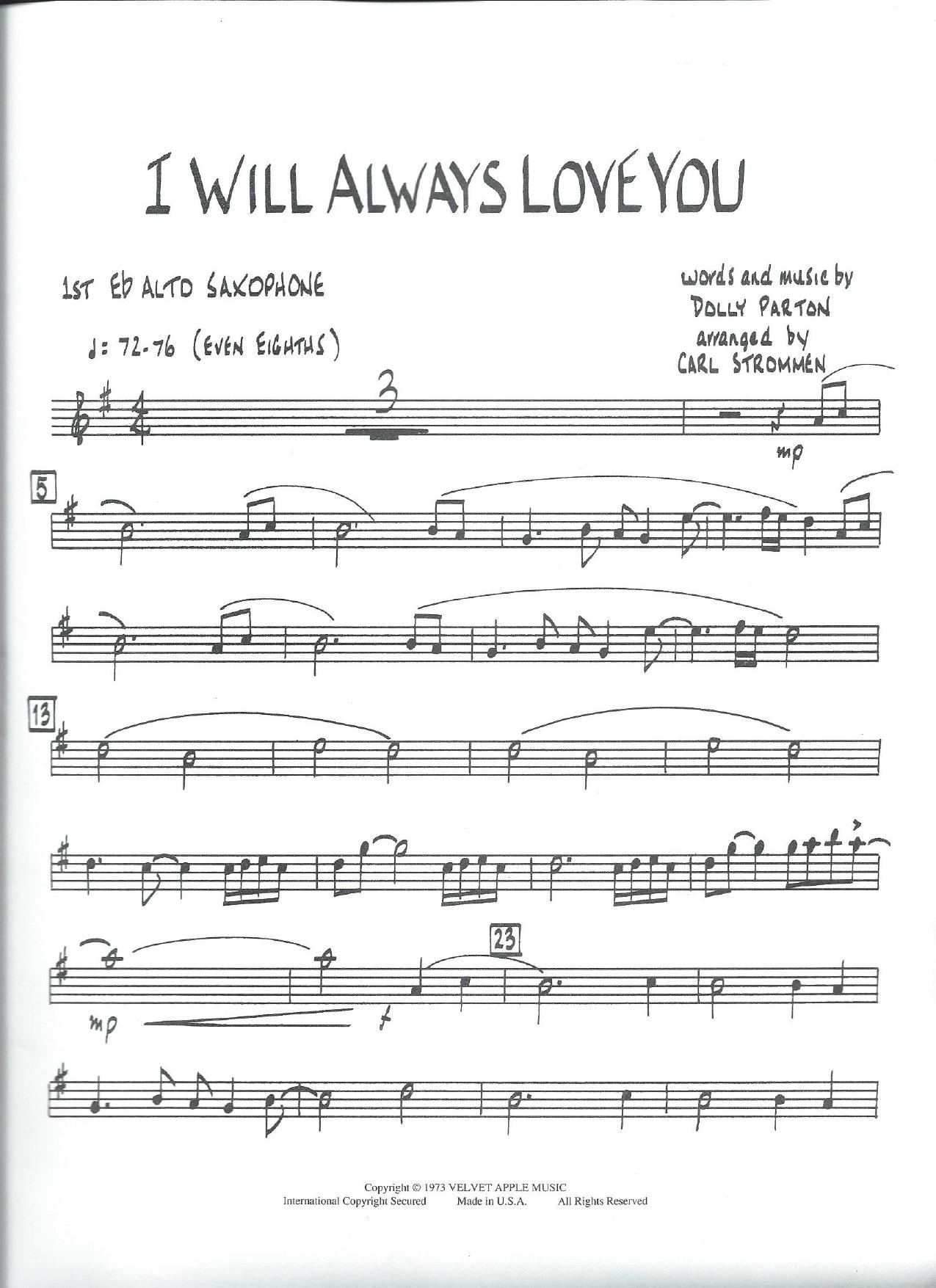
I Will Always Love You (C.Strommen)
Composed by Dolly Parton
Arranged by Carl Strommen
- Ensemble: Big Band
- Pages: 32
- Instruments (15): 1st Eb Alto Saxophone, 2nd Eb Alto Saxophone, 1st Bb Tenor Saxophone, 2nd Bb Tenor Saxophone, Eb Baritone Saxophone, 1st Bb Trumpet, 2nd Bb Trumpet, 3rd Bb Trumpet, 1st Trombone, 2nd Trombone, 3rd Trombone, Guitar, Bass, Piano, Drums
- Difficulty: medium
- Content: Individual Parts
- Format: PDF Download (Instant)
- Price: $24.99
Dolly Parton originally penned and recorded her timeless masterpiece "I Will Always Love You" in 1973 as a heartfelt farewell to her mentor and business partner, Porter Wagoner. While country music history was instantly made upon its initial release, the composition crossed into global pop ubiquity in 1992 through Whitney Houston’s soaring, dramatic vocal rendition for *The Bodyguard*. In the hands of esteemed jazz arranger and composer Carl Strommen, this iconic melody is brilliantly reimagined for the modern big band, transforming a legendary ballad into a lush, emotionally resonant instrumental vehicle that bridges the gap between contemporary vocal jazz and classic ensemble writing. Strommen’s arrangement approaches the familiar 4/4 thematic material with a deeply sensitive, expressive ballad feel characterized by rubato-esque passages, rich chromatic harmony, and sweeping dynamic swells. Opening with an atmospheric, rubato introduction that allows the woodwinds and flugelhorns to establish a melancholic yet hopeful mood, the chart gradually builds in texture and harmonic density. The primary melody is initially delivered with aching lyricism by the lead alto saxophone or a featured trumpet, before expanding into full ensemble voicings that utilize sophisticated extended chord structures—major seventh sonorities, sharp-elevenths, and altered dominants—typical of advanced contemporary jazz writing. The emotional trajectory moves from quiet introspection to a powerful, soaring climax that echoes the dramatic release of the famous chorus, though filtered through a sophisticated jazz idiom rather than pop bombast. Technical execution in this 32-page chart centers heavily on breath support, intonation, and stylistic cohesion rather than breakneck speed. The rhythm section—comprising piano, guitar, bass, and drums—acts as the primary engine for maintaining a subtle, flowing pulse, utilizing sparse comping and delicate cymbal work to avoid cluttering the expansive textures. Horn players must possess immaculate control over long tones, dynamic gradation, and blend, especially during dense chordal solis where sectional balance is critical. While there are brief, tasteful improvised solo opportunities designed to highlight a featured soloist (typically tenor saxophone or piano), the true brilliance of the arrangement lies in its collective ensemble interplay and the seamless way Strommen passes melodic fragments between sections. Advanced high school ensembles, collegiate jazz orchestras, and professional community big bands will find this arrangement to be an exceptional programming choice. It serves as a phenomenal showcase for developing mature musicality, teaching players how to approach a slower, lyrical chart with the same intensity and precision usually reserved for up-tempo swingers. Directors looking to program a concert closer, a poignant emotional center, or a sophisticated ballad that will captivate both adjudicators and general audiences will discover that Strommen’s treatment of "I Will Always Love You" is an essential, rewarding addition to the modern big band library. Conductors should approach Carl Strommen’s arrangement of "I Will Always Love You" with an emphasis on narrative pacing and sustained lyrical line. The tempo should remain flexible and breathing, avoiding a rigid mechanical click, particularly in the rubato introduction and transitional interludes. Saxophone sections must focus on seamless intonation during closely voiced chord clusters, ensuring that the inner voices do not overpower the lead player. Brass players should utilize a warm, round tone color—encouraging flugelhorns if available—to soften the overall attack and match the vocal quality of the original composition. The rhythm section plays a pivotal role in creating a cushion of sound; the pianist should voice chords cleanly in the middle register, avoiding heavy block chords that muddy the harmony. Rehearsals should initially isolate the dynamic contrasts, ensuring the ensemble can drop down to a whisper before executing the swelling crescendos leading into the climactic statements without forcing their sound. Q: What instruments and parts are included in this 15-instrument big band arrangement? A: The instrumentation features a standard 15-instrument big band setup, including Alto Saxophone 1, Alto Saxophone 2, Tenor Saxophone 1, Tenor Saxophone 2, Baritone Saxophone, plus full brass and rhythm sections across 32 pages of music. Q: What is the difficulty level of this arrangement? A: This chart is graded as advanced-intermediate to advanced, making it ideal for skilled high school, collegiate, and professional big bands that excel at ballad playing and sophisticated harmonic interpretation. Q: What is the musical style and historical context of this chart? A: Arranged by Carl Strommen, it reimagines Dolly Parton’s 1973 country-pop classic (later popularized by Whitney Houston) as a lush, contemporary jazz ballad focused on rich harmonic textures and expressive phrasing. Q: What makes this specific arrangement by Carl Strommen unique? A: Strommen utilizes contemporary extended jazz harmonies, transparent sectional voicings, and subtle dynamic builds that elevate a famous pop melody into a sophisticated, emotionally gripping instrumental feature. Q: What is the performance duration and tempo feel of the piece? A: The piece is structured as a slow, expressive ballad with a flexible, breathing tempo feel, typically clocking in around 3.5 to 4.5 minutes depending on the rubato pacing chosen by the conductor.
Questions and answers
- What is included in the I Will Always Love You (C.Strommen) PDF?
- The verified current file contains individual parts across 32 pages.
- How many instruments or parts are listed for I Will Always Love You (C.Strommen)?
- The verified instrumentation list contains 15 entries for this Big Band arrangement.
- Who is credited for I Will Always Love You (C.Strommen)?
- Composer: Dolly Parton. Arranger: Carl Strommen.
- What difficulty is listed for I Will Always Love You (C.Strommen)?
- The verified difficulty level is medium.
- Can I preview I Will Always Love You (C.Strommen) before buying?
- Yes. The product page provides a preview generated from the current PDF file.
- How is I Will Always Love You (C.Strommen) delivered?
- After successful payment, the digital PDF is made available for download. The displayed price is $24.99.
Musicians Also Search For
I Will Always Love You Carl Strommen PDF • I Will Always Love You Carl Strommen sheet music • I Will Always Love You arranged by Carl Strommen • Carl Strommen big band charts • Carl Strommen jazz arrangements PDF • I Will Always Love You Dolly Parton sheet music • I Will Always Love You Dolly Parton big band arrangements • Dolly Parton big band charts • I Will Always Love You big band arrangements • I Will Always Love You big band PDF download • I Will Always Love You jazz sheet music • big band sheet music download • I Will Always Love You individual parts download • I Will Always Love You sheet music PDF • buy I Will Always Love You sheet music • download I Will Always Love You PDF • I Will Always Love You jazz charts • best Carl Strommen big band arrangements • Dolly Parton arranged by Carl Strommen • I Will Always Love You printable sheet music • big band repertoire PDF