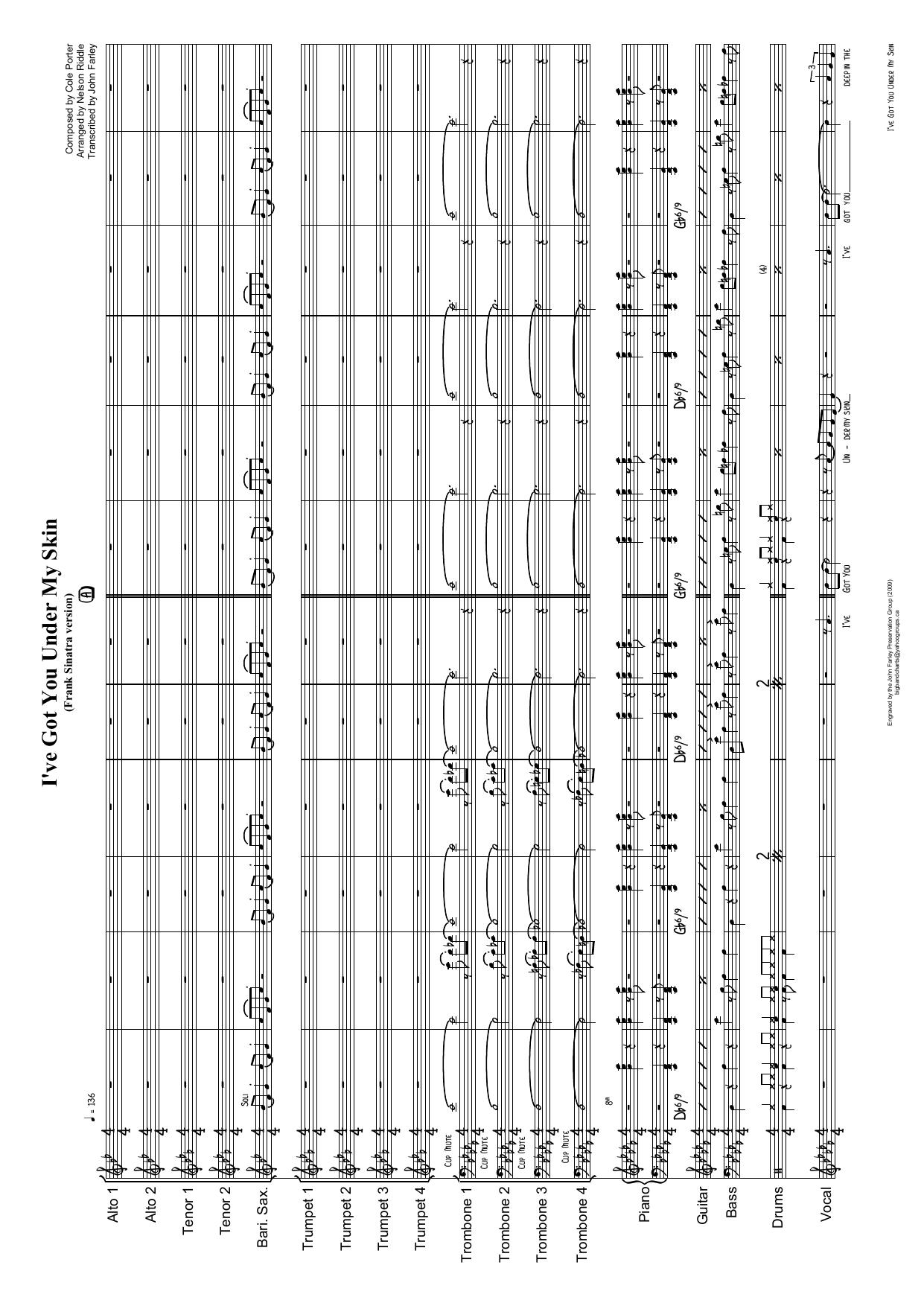
I'Ve Got You Under My Skin (Cole Porter ) Vocal + parts
Composed by Cole Porter
Arranged by Cole Porter
- Ensemble: Big Band Vocal
- Style: Jazz Standard
- Pages: 56
- Instruments (18): Alto 1, Alto 2, Tenor 1, Tenor 2, Bari. Sax., Trumpet 1, Trumpet 2, Trumpet 3, Trumpet 4, Trombone 1, Trombone 2, Trombone 3, Trombone 4, Piano, Guitar, Bass, Drums, Vocal
- Difficulty: medium
- Content: Individual Parts
- Format: PDF Download (Instant)
- Price: $24.99
Cole Porter's iconic "I've Got You Under My Skin," a cornerstone of the Great American Songbook, emerged in 1936 for the musical film "Born to Dance." While initially a hit for Virginia Bruce, it was Frank Sinatra's definitive 1956 Capitol recording with Nelson Riddle's iconic arrangement that cemented its status as an enduring jazz standard, forever linking it to the sophisticated, swinging big band era. The piece encapsulates the golden age of American popular song, showcasing Porter's unparalleled lyrical wit and harmonic ingenuity. Its enduring appeal lies in its captivating melody, compelling narrative of irresistible obsession, and a harmonic progression that invites endless interpretation and improvisation within the jazz idiom. This arrangement, penned by the composer himself, offers a unique window into Porter's vision for his own work within a big band context, emphasizing the elegance and rhythmic drive inherent in the original composition. This particular arrangement presents "I've Got You Under My Skin" as a vibrant, medium-swing vocal feature in 4/4 time, typically set in the key of C major or D-flat major to accommodate a male vocalist, though adaptable. The mood is one of sophisticated romance and playful intensity, building from a smooth, almost understated opening to a powerful, brass-driven climax. The energy is consistently engaging, propelled by a walking bass line and a crisp drum feel that underscores the vocal narrative. Porter's own arranging style, while perhaps less overtly 'jazzy' in the improvisational sense than some contemporaries, is characterized by meticulous attention to melodic counterpoint, rich block voicings for the brass and saxophones, and a keen understanding of how to build dynamic tension and release. The arrangement evokes the classic big band sound of the 1930s and 40s, prioritizing clarity, ensemble precision, and a lush harmonic backdrop for the vocalist. The arrangement opens with an instrumental introduction that establishes the medium-swing feel and harmonic landscape before the vocalist enters, carrying the primary melody with the band providing supportive, often call-and-response figures. Porter's voicings are notably full and warm, particularly in the saxophone soli sections which often echo or embellish the vocal line. There are no extended improvised solo sections in this particular arrangement, keeping the focus squarely on the vocal performance and the ensemble's tight interplay. The challenge lies in maintaining a consistent, relaxed swing feel throughout, ensuring precise articulation from all sections, and achieving a balanced blend that allows the vocalist to soar without being overpowered. A standout moment is the dynamic build towards the final chorus, often featuring a powerful brass soli or a full ensemble shout chorus that culminates in a grand, satisfying finish, making it incredibly rewarding for a big band to perform with precision and flair. This arrangement is ideally suited for college-level jazz ensembles, community big bands, or semi-professional groups looking to perform a classic big band vocal chart with historical authenticity. While not overly complex harmonically, the demands for tight ensemble playing, dynamic control, and a solid swing feel require experienced musicians. High school bands with strong sections and a capable vocalist could tackle it, provided they dedicate ample rehearsal time to articulation, blend, and rhythmic cohesion. Its timeless appeal and the opportunity to feature a vocalist make it a compelling choice for concerts, dances, or any program celebrating the legacy of the Great American Songbook. Achieving the authentic medium-swing feel is paramount; emphasize a relaxed, unhurried 4/4 pulse with a clear articulation of eighth notes. The primary technical challenge lies in the precise rhythmic unison and blend within the saxophone and brass sections, particularly during the block-voiced soli passages. Encourage players to listen across sections to match phrasing and dynamics. The brass should aim for a warm, full sound, avoiding overly bright or harsh attacks, especially when accompanying the vocalist. No special mutes or extended techniques are explicitly notated, but a tasteful use of cup or straight mutes in the brass during softer accompanying passages can add texture. Rehearsal should focus on the interplay between the band and vocalist, ensuring the accompaniment breathes with the vocal line. Pay close attention to dynamic contrasts, building energy gradually towards the shout chorus and grand finale. Q: What instruments are included in this arrangement? A: This big band vocal arrangement includes parts for a vocalist, 5 saxophones (AATTB), 4 trumpets, 4 trombones, piano, bass, and drums. Q: What is the difficulty level of this arrangement? A: This arrangement is rated as medium-difficult, making it suitable for college, community, or experienced high school jazz ensembles. It requires solid section playing and a strong vocalist. Q: What musical style and historical context does this arrangement represent? A: This arrangement is a classic jazz standard in a medium-swing style, reflecting the sophisticated big band sound of the 1930s and 40s, particularly influenced by the era of Frank Sinatra and Nelson Riddle. Q: What makes this specific arrangement by Cole Porter unique? A: This arrangement is unique because it was penned by the original composer, Cole Porter, offering a direct insight into his intended big band interpretation of his own work, emphasizing melodic clarity, rich voicings, and ensemble precision over extended improvisation. Q: What is the typical performance duration and tempo for this piece? A: The typical performance duration for this arrangement is approximately 3-4 minutes, performed at a medium-swing tempo, generally around 120-130 beats per minute.
Questions and answers
- What is included in the I'Ve Got You Under My Skin (Cole Porter ) Vocal + parts PDF?
- The verified current file contains a conductor score and individual parts across 56 pages.
- How many instruments or parts are listed for I'Ve Got You Under My Skin (Cole Porter ) Vocal + parts?
- The verified instrumentation list contains 18 entries for this Big Band Vocal arrangement.
- Who is credited for I'Ve Got You Under My Skin (Cole Porter ) Vocal + parts?
- Composer: Cole Porter. Arranger: Cole Porter.
- What difficulty is listed for I'Ve Got You Under My Skin (Cole Porter ) Vocal + parts?
- The verified difficulty level is medium.
- What style is listed for I'Ve Got You Under My Skin (Cole Porter ) Vocal + parts?
- The catalog lists the style as Jazz Standard.
- Can I preview I'Ve Got You Under My Skin (Cole Porter ) Vocal + parts before buying?
- Yes. The product page provides a preview generated from the current PDF file.
- How is I'Ve Got You Under My Skin (Cole Porter ) Vocal + parts delivered?
- After successful payment, the digital PDF is made available for download. The displayed price is $24.99.
Musicians Also Search For
I'Ve Got You Under My Skin Cole Porter PDF • I'Ve Got You Under My Skin Cole Porter sheet music • I'Ve Got You Under My Skin arranged by Cole Porter • Cole Porter big band vocal charts • Cole Porter jazz arrangements PDF • I'Ve Got You Under My Skin Cole Porter big band vocal arrangements • I'Ve Got You Under My Skin big band vocal arrangements • I'Ve Got You Under My Skin big band vocal PDF download • I'Ve Got You Under My Skin jazz sheet music • big band vocal sheet music download • I'Ve Got You Under My Skin conductor score PDF • I'Ve Got You Under My Skin individual parts download • I'Ve Got You Under My Skin sheet music PDF • I'Ve Got You Under My Skin Jazz Standard charts • Jazz Standard big band vocal arrangements • buy I'Ve Got You Under My Skin sheet music • download I'Ve Got You Under My Skin PDF • I'Ve Got You Under My Skin jazz charts • best Cole Porter big band vocal arrangements • I'Ve Got You Under My Skin printable sheet music • big band vocal repertoire PDF