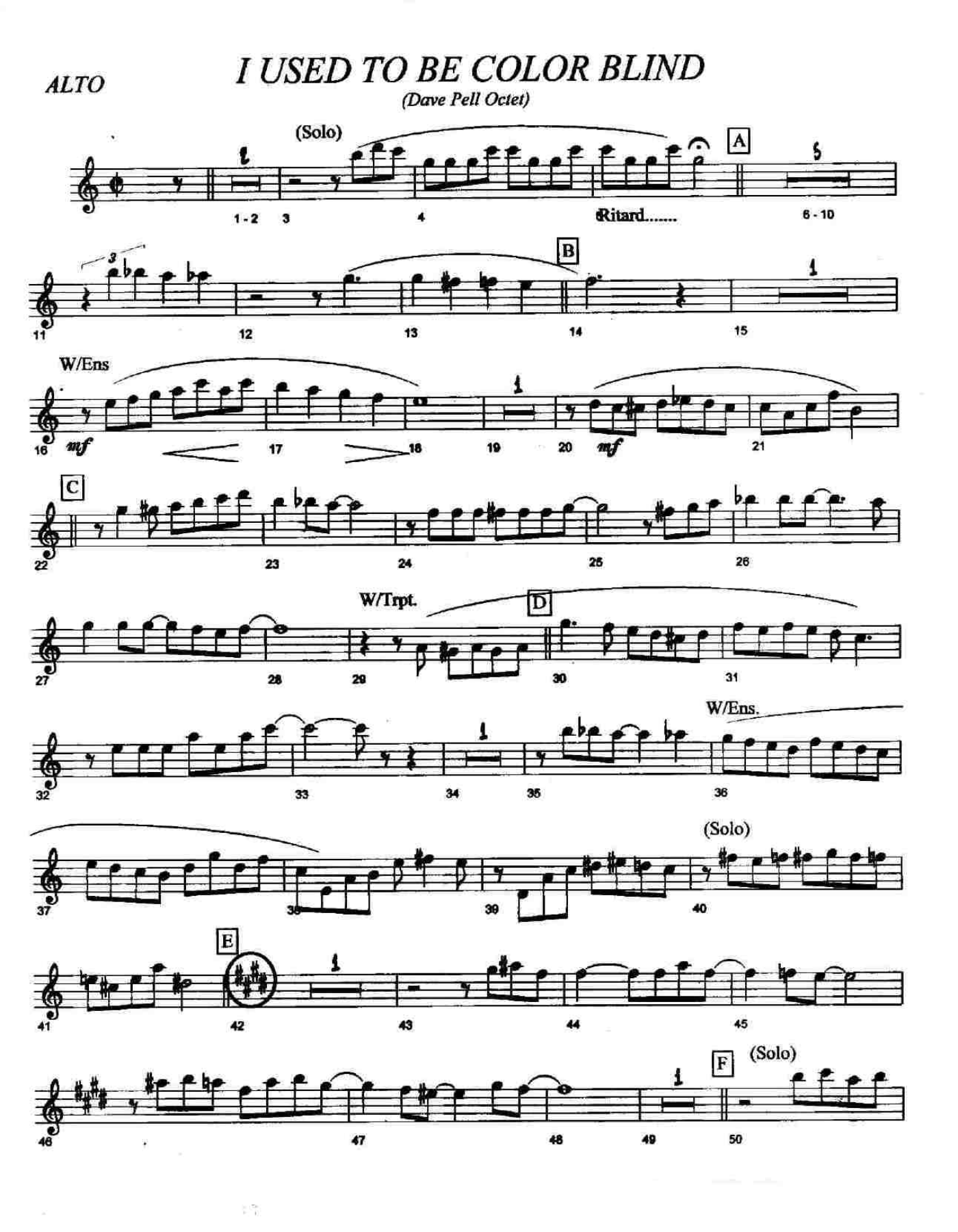
I Used To Be Color Blind (D.Ts,Bs,Trp,Trb+Rhythm)
Composed by Irving Berlin
Arranged by Dave Pell Octet - Ts,Bs,Trp,Trb+Rhythm
- Ensemble: Small Ensemble
- Style: Jazz Standard
- Pages: 40
- Difficulty: easy
- Content: Sheet Music
- Format: PDF Download (Instant)
- Price: $12.99
Irving Berlin's timeless ballad, "I Used To Be Color Blind," first graced the silver screen in the 1938 film *Carefree*, famously introduced by Fred Astaire. This poignant melody, a testament to Berlin's unparalleled gift for crafting enduring standards, quickly transcended its cinematic origins to become a cherished part of the Great American Songbook. Its lyrical introspection and elegant harmonic structure have made it a favorite among jazz vocalists and instrumentalists alike, representing the sophisticated melodicism characteristic of the pre-bebop era. The piece evokes a tender, reflective mood, often performed as a slow ballad, allowing its beautiful changes to unfold with grace and emotional depth. This particular arrangement, crafted by the esteemed Dave Pell Octet, reimagines Berlin's classic with a distinctive medium-swing feel in the key of C Major, transforming its inherent melancholic beauty into a gently swinging, sophisticated instrumental showcase. Pell's signature approach to small-group jazz is evident throughout, characterized by meticulously voiced soli sections that highlight the unique blend of tenor saxophone, baritone saxophone, trumpet, and trombone. Rather than a direct transcription of a specific Pell recording, this arrangement captures the essence of his West Coast cool jazz aesthetic: clean lines, understated elegance, and a focus on melodic clarity within a harmonically rich framework. The mood is one of relaxed confidence, maintaining the original's emotional core while infusing it with a subtle, infectious groove. The arrangement opens with the full ensemble presenting the melody, allowing the rich voicings to establish the piece's character immediately. Following this, the chart features an open solo section over the form, providing ample opportunity for improvisation from any of the horn players or rhythm section members. The technical demands are moderate, focusing more on precise ensemble playing, blend, and articulation rather than extreme ranges or rapid-fire passages. The rewarding aspect of performing this arrangement lies in achieving a seamless, cohesive sound within the octet, allowing the interplay between the horns and the rhythm section to shine. Specific musical moments, such as the carefully constructed counter-melodies within the soli passages and the dynamic shifts, contribute to a performance that is both engaging for the musicians and captivating for the audience. This arrangement is ideally suited for college-level jazz ensembles, advanced community big bands with a strong small-group contingent, or professional groups seeking a polished, classic sound. Its moderate difficulty makes it accessible for developing musicians to tackle sophisticated voicings and ensemble precision, while its inherent musicality offers seasoned players a rewarding vehicle for expression. The focus on blend, balance, and stylistic authenticity makes it an excellent teaching tool for understanding the nuances of West Coast jazz arranging and small-group interaction. Conductors should emphasize a relaxed, medium-swing feel, ensuring the rhythm section maintains a consistent, understated groove without rushing. The key technical challenge lies in achieving precise intonation and blend within the horn soli sections, particularly between the saxophones and brass. Encourage musicians to listen across the section, matching articulation and dynamics carefully. Phrasing should be lyrical and long, avoiding overly staccato attacks. The arrangement is in 4/4 time, and the tempo should be around 110-120 BPM. No special techniques like plunger mutes or falls are explicitly notated, but subtle stylistic inflections (e.g., slight scoops or controlled vibrato) can enhance the authentic jazz feel, particularly in solo sections. Rehearsal time should be dedicated to isolating and balancing the horn voicings, ensuring each voice is heard clearly within the overall texture. Q: What instruments and parts are included in this arrangement? A: This arrangement includes parts for Tenor Saxophone, Baritone Saxophone, Trumpet, Trombone, Piano, Bass, and Drums. It is scored for a small ensemble, specifically an octet with a standard rhythm section. Q: What is the difficulty level of this arrangement? A: This arrangement is rated as medium difficulty, making it suitable for college-level jazz ensembles, advanced high school groups, or experienced community and professional musicians. It requires good ensemble playing and a solid understanding of jazz harmony. Q: What is the musical style and historical context of "I Used To Be Color Blind (D.Ts,Bs,Trp,Trb+Rhythm)"? A: The original piece is a classic Irving Berlin jazz standard from 1938. This arrangement by the Dave Pell Octet reimagines it with a sophisticated West Coast cool jazz aesthetic, featuring a medium-swing feel and intricate horn voicings. Q: What makes this Dave Pell Octet arrangement unique compared to other versions of "I Used To Be Color Blind"? A: This arrangement stands out due to Dave Pell's signature small-group voicings, which create a clean, elegant sound. It transforms the original ballad into a gently swinging instrumental feature, emphasizing melodic clarity and ensemble blend within a cool jazz framework. Q: What is the typical performance duration and tempo for this arrangement? A: The typical performance duration for this arrangement is approximately 3-4 minutes, depending on the length of improvised solos. It is designed to be performed at a medium-swing tempo, generally around 110-120 beats per minute.
Musicians Also Search For
I Used To Be Color Blind Dave Pell Octet - Ts,Bs,Trp,Trb+Rhythm PDF • I Used To Be Color Blind Dave Pell Octet - Ts,Bs,Trp,Trb+Rhythm sheet music • I Used To Be Color Blind arranged by Dave Pell Octet - Ts,Bs,Trp,Trb+Rhythm • Dave Pell Octet - Ts,Bs,Trp,Trb+Rhythm small ensemble charts • Dave Pell Octet - Ts,Bs,Trp,Trb+Rhythm jazz arrangements PDF • I Used To Be Color Blind Irving Berlin sheet music • I Used To Be Color Blind Irving Berlin small ensemble arrangement • Irving Berlin small ensemble charts • I Used To Be Color Blind small ensemble arrangement • I Used To Be Color Blind small ensemble PDF download • I Used To Be Color Blind jazz ensemble sheet music • small ensemble sheet music instant download • I Used To Be Color Blind sheet music with parts • I Used To Be Color Blind Jazz Standard chart • Jazz Standard small ensemble arrangements • buy I Used To Be Color Blind sheet music online • download I Used To Be Color Blind PDF • I Used To Be Color Blind jazz chart • best Dave Pell Octet - Ts,Bs,Trp,Trb+Rhythm small ensemble arrangements • Irving Berlin songs arranged by Dave Pell Octet - Ts,Bs,Trp,Trb+Rhythm • I Used To Be Color Blind printable sheet music • small ensemble repertoire PDF