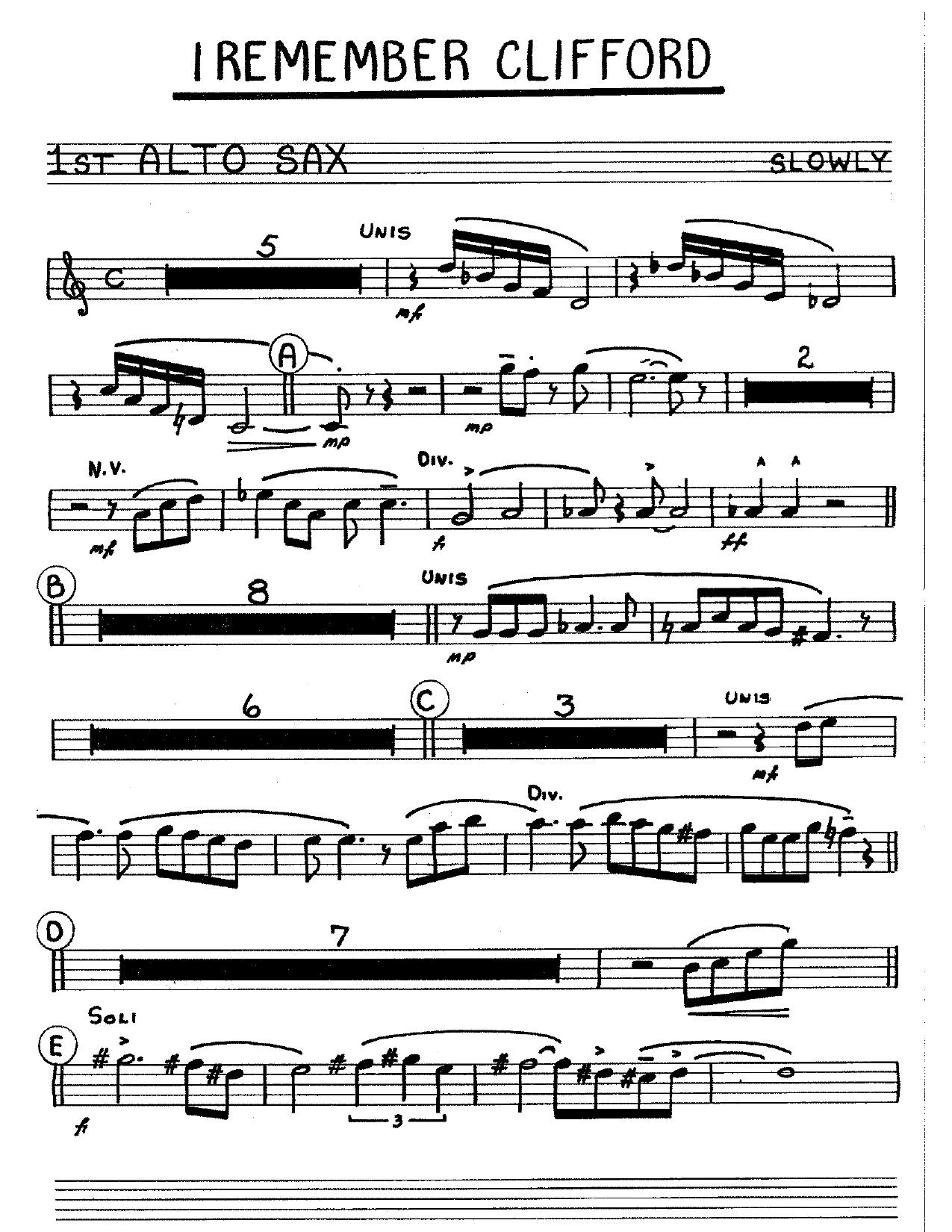
I Remember Clifford (D.G'Witt)
Composed by Benny Golson
Arranged by Don G'Witt
- Ensemble: Big Band
- Style: Jazz Standard
- Pages: 30
- Instruments (17): 1st Alto Sax, 2nd Alto Sax, 1st Tenor Sax, 2nd Tenor Sax, Baritone Sax, 1st Trombone, 2nd Trombone, 3rd Trombone, 4th Trombone, 1st Trumpet, 2nd Trumpet, 3rd Trumpet, 4th Trumpet, Bass, Drums, Guitar, Piano
- Difficulty: medium
- Content: Individual Parts
- Format: PDF Download (Instant)
- Price: $24.99
Benny Golson's immortal "I Remember Clifford" stands as a poignant tribute and a cornerstone of the jazz ballad repertoire. Composed in 1957, shortly after the tragic death of trumpet virtuoso Clifford Brown, the piece quickly became an elegy, celebrated for its lyrical beauty and harmonic sophistication. It emerged from the hard bop era, a period characterized by soulful melodies, intricate improvisations, and a deep respect for harmonic structure, yet it transcends its origins with a timeless, reflective quality. Golson himself, along with many other jazz luminaries, recorded definitive versions, cementing its status as an indispensable jazz standard. Its enduring appeal lies in its ability to evoke profound emotion, balancing sorrow with a sense of reverence and admiration for a lost genius. Don G'Witt's masterful big band arrangement of "I Remember Clifford" reimagines this classic with a distinctive blend of respect for the original and innovative textural development. G'Witt, known for his ability to craft arrangements that are both challenging and deeply rewarding, approaches this ballad with characteristic elegance. The piece unfolds at a slow ballad tempo in 4/4, allowing ample space for the rich harmonies to breathe and resonate. While maintaining the original key, G'Witt employs lush, extended voicings throughout the brass and saxophone sections, creating a tapestry of sound that is both warm and complex. His signature use of interwoven lines and carefully sculpted dynamics ensures that the emotional arc of the piece is meticulously conveyed, building from tender introspection to moments of soaring passion, then returning to a reflective close. The arrangement opens with a beautifully voiced saxophone choir presenting the iconic melody, setting a contemplative mood. Throughout the piece, G'Witt skillfully alternates melodic duties, featuring the lead alto and trumpet in various sections, often supported by rich, sustained brass pads or flowing saxophone counter-melodies. A significant feature is the extended solo section, typically showcasing the lead trumpet, which allows for expressive improvisation over the familiar, yet subtly reharmonized, chord changes. The ensemble's role shifts between supportive accompaniment and powerful soli passages, particularly in the brass, which provide dramatic counterpoints to the solo voice. Technical challenges include precise control of dynamics, particularly in soft passages, and achieving a unified, expressive blend across the entire ensemble, especially in the sustained chords and intricate inner voices. The rewarding aspect lies in the collective creation of a deeply moving musical narrative, demanding sensitivity and musical maturity from every player. This arrangement is ideally suited for advanced high school, collegiate, community, and professional big bands. Its demands for nuanced phrasing, excellent intonation, and sophisticated ensemble interplay make it an exceptional vehicle for developing musicality and expressive performance. The depth of G'Witt's writing provides ample opportunity for a mature ensemble to explore the emotional core of this timeless standard, offering a profound and memorable experience for both performers and audience. Conductors should emphasize a unified, expressive approach to phrasing, particularly in the sustained melodic lines and rich harmonic passages. The slow ballad tempo (around quarter note = 50-60 bpm) requires meticulous attention to breath control and intonation, ensuring chords bloom rather than sound static. Encourage players to listen across sections to achieve G'Witt's intended lush voicings. Dynamics are crucial; ensure the ensemble can execute true pianissimo sections, building gradually to the fortissimo climaxes without rushing. There are no special techniques like plunger mutes or falls, but a consistent, warm vibrato from the brass and saxophones will enhance the ballad feel. Rehearsal time should be dedicated to balancing the inner voices of the saxophone soli and brass pads, and to shaping the solo section to allow the soloist maximum expressive freedom while maintaining ensemble support. Q: What instruments are included in this arrangement? A: This big band arrangement is scored for 17 instruments, including Alto Saxophone 1, Alto Saxophone 2, Tenor Saxophone 1, Tenor Saxophone 2, Baritone Saxophone, Trumpet 1, Trumpet 2, Trumpet 3, Trumpet 4, Trombone 1, Trombone 2, Trombone 3, Bass Trombone, Piano, Bass, Drums, and Guitar. Q: What is the difficulty level of Don G'Witt's "I Remember Clifford" arrangement? A: This arrangement is considered advanced, suitable for collegiate, community, and professional big bands. It demands strong technical proficiency, excellent intonation, and a high level of musical maturity for expressive performance. Q: What style and historical context does this arrangement represent? A: This is a big band arrangement of the jazz standard "I Remember Clifford," originally composed by Benny Golson in 1957. It embodies the lyrical and harmonically rich ballad style prevalent during the hard bop era. Q: What makes Don G'Witt's arrangement of "I Remember Clifford" unique? A: Don G'Witt's distinctive approach features lush, extended voicings, intricate ensemble interplay, and a focus on dynamic shaping to enhance the emotional depth of the original standard. His arrangement offers a fresh yet respectful interpretation of this classic. Q: What is the typical performance duration and tempo for this arrangement? A: The arrangement is a slow ballad, typically performed at a tempo of approximately quarter note = 50-60 bpm. Depending on the soloist's improvisation, the performance duration is usually around 5-7 minutes.
Questions and answers
- What is included in the I Remember Clifford (D.G'Witt) PDF?
- The verified current file contains individual parts across 30 pages.
- How many instruments or parts are listed for I Remember Clifford (D.G'Witt)?
- The verified instrumentation list contains 17 entries for this Big Band arrangement.
- Who is credited for I Remember Clifford (D.G'Witt)?
- Composer: Benny Golson. Arranger: Don G'Witt.
- What difficulty is listed for I Remember Clifford (D.G'Witt)?
- The verified difficulty level is medium.
- What style is listed for I Remember Clifford (D.G'Witt)?
- The catalog lists the style as Jazz Standard.
- Can I preview I Remember Clifford (D.G'Witt) before buying?
- Yes. The product page provides a preview generated from the current PDF file.
- How is I Remember Clifford (D.G'Witt) delivered?
- After successful payment, the digital PDF is made available for download. The displayed price is $24.99.
Musicians Also Search For
I Remember Clifford Don G'Witt PDF • I Remember Clifford Don G'Witt sheet music • I Remember Clifford arranged by Don G'Witt • Don G'Witt big band charts • Don G'Witt jazz arrangements PDF • I Remember Clifford Benny Golson sheet music • I Remember Clifford Benny Golson big band arrangements • Benny Golson big band charts • I Remember Clifford big band arrangements • I Remember Clifford big band PDF download • I Remember Clifford jazz sheet music • big band sheet music download • I Remember Clifford individual parts download • I Remember Clifford sheet music PDF • I Remember Clifford Jazz Standard charts • Jazz Standard big band arrangements • buy I Remember Clifford sheet music • download I Remember Clifford PDF • I Remember Clifford jazz charts • best Don G'Witt big band arrangements • Benny Golson arranged by Don G'Witt • I Remember Clifford printable sheet music • big band repertoire PDF