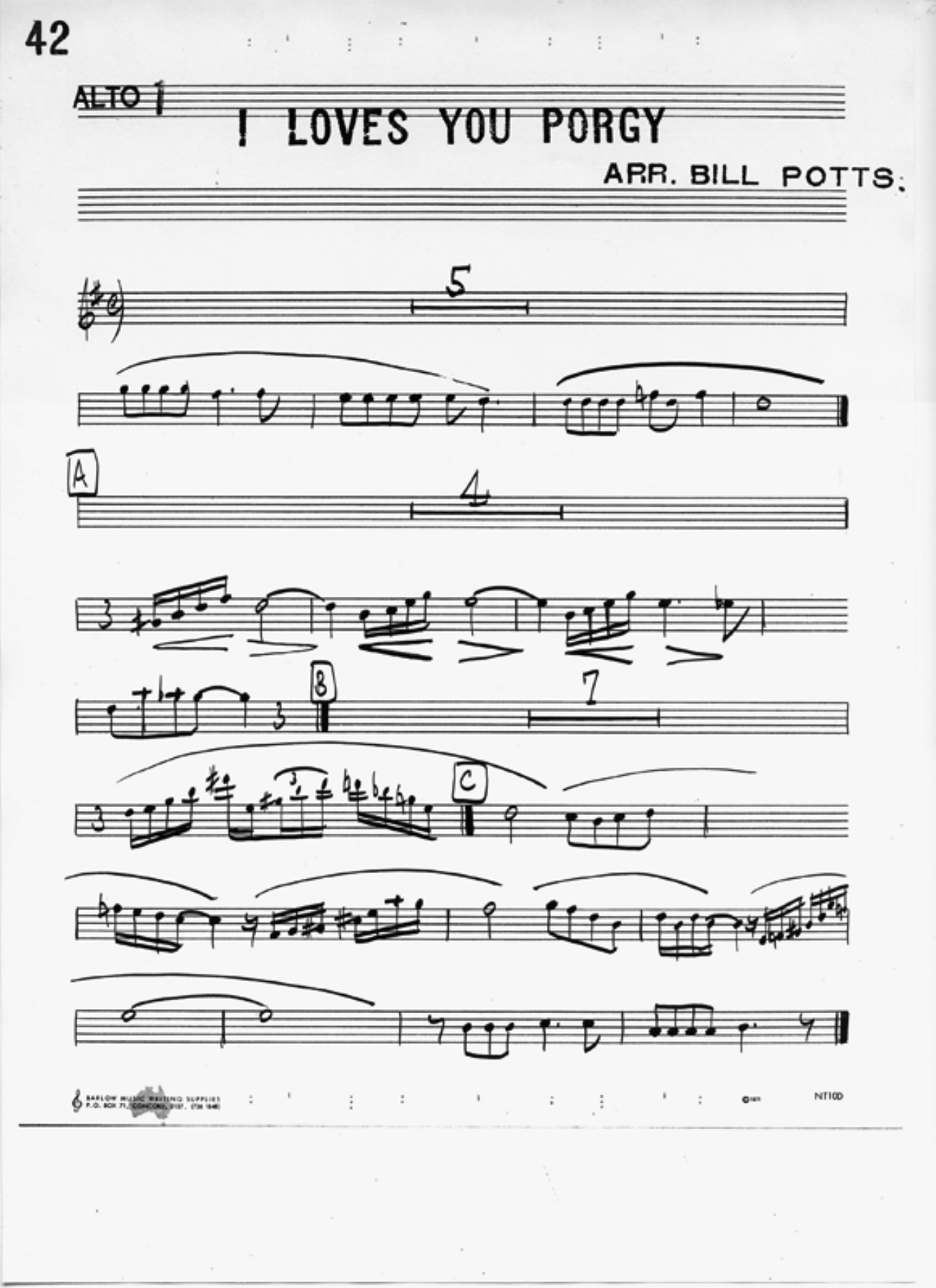
I Loves You Porgy (B.Potts)
Composed by George Gershwin
Arranged by Bill Potts
- Ensemble: Big Band
- Style: Jazz Standard
- Pages: 34
- Instruments (17): Alto 1, Alto 2, Tenor 1, Tenor 2, Baritone, Trumpet 1, Trumpet 2, Trumpet 3, Trumpet 4, Trombone 1, Trombone 2, Trombone 3, Trombone 4, Piano, Guitar, Bass, Drums
- Difficulty: medium
- Content: Individual Parts
- Format: PDF Download (Instant)
- Price: $24.99
George Gershwin's timeless aria "I Loves You Porgy," originally penned for his groundbreaking 1935 opera *Porgy and Bess*, stands as a cornerstone of the American musical theater canon and a perennial jazz standard. This poignant ballad, sung by Bess to Porgy, encapsulates themes of devotion and vulnerability, its melodic beauty and harmonic depth making it ripe for jazz interpretation. The piece gained widespread recognition beyond the opera stage through iconic recordings by artists such as Nina Simone, whose 1958 rendition on *Little Girl Blue* became definitive, and Bill Evans, whose introspective piano trio version further cemented its place in the jazz lexicon. Its enduring popularity stems from its lyrical melody, rich harmonic possibilities, and the profound emotional narrative it conveys, allowing countless improvisers to explore its expressive contours. Bill Potts's big band arrangement of "I Loves You Porgy" transforms this intimate ballad into a lush, expansive soundscape. Potts, known for his sophisticated harmonic palette and masterful orchestration, approaches this piece as a slow, tender ballad in 4/4 time, likely in the key of B-flat minor, which allows for deep emotional resonance. The mood is one of profound introspection and heartfelt expression, evoking a sense of melancholic beauty and tender longing. Potts's signature style often features rich, dense voicings, particularly in the saxophone and brass sections, creating a warm, enveloping texture that supports the delicate melody. Expect intricate counterlines and carefully crafted inner voices that add harmonic color without ever overshadowing the core melodic statement. Potts's arrangement showcases his distinctive approach through a thoughtful narrative arc. The melody is initially presented with a delicate, almost ethereal quality, likely carried by a solo instrument or a small, blended section of the saxophones, perhaps with subtle brass pads. As the piece develops, Potts gradually builds intensity, employing his characteristic full ensemble voicings and perhaps a carefully placed, lyrical saxophone soli that weaves through the harmonic progression. While the arrangement is primarily a ballad, there may be moments of understated swing feel to propel the narrative forward, though always maintaining its slow, deliberate pace. Featured solos, if present, would typically be for a tenor or alto saxophone, providing an opportunity for expressive improvisation over Potts's reharmonized changes. The arrangement culminates in a powerful yet controlled statement, resolving with a sense of quiet dignity rather than a bombastic shout chorus. This arrangement is ideally suited for advanced high school, college, community, or professional big bands seeking to explore the expressive depth of a jazz ballad. Its technical challenges lie not in blistering tempos or complex rhythmic figures, but in achieving precise intonation, balanced voicings, and a unified emotional delivery. The demand for sensitive phrasing and dynamic control across all sections makes it a rewarding piece for ensembles committed to musical artistry. The blend required for Potts's voicings and the sustained breath control needed for long phrases will push musicians to refine their ensemble playing, resulting in a truly moving performance that highlights the band's maturity and musicality. Conductors should emphasize a consistent, unhurried slow ballad tempo, allowing ample space for phrases to breathe and harmonies to resonate. The primary technical challenge lies in achieving impeccable intonation and blend within the dense voicings, particularly in the saxophone and brass sections. Encourage musicians to listen across the ensemble, tuning to each other rather than relying solely on their individual pitch. Dynamics are crucial; guide the band through a nuanced emotional arc, from delicate pianissimos to rich fortissimos, ensuring that crescendos and diminuendos are smooth and controlled. Pay close attention to articulation, aiming for a warm, sustained sound without harsh attacks. Rehearsal time should be dedicated to shaping phrases, balancing inner voices, and developing a unified concept of the piece's melancholic yet tender mood. Q: What instruments and parts are included in this arrangement? A: This big band arrangement is scored for 17 instruments, typically including Alto Saxophone 1, Alto Saxophone 2, Tenor Saxophone 1, Tenor Saxophone 2, Baritone Saxophone, Trumpet 1-4, Trombone 1-4, Piano, Bass, and Drums. Q: What is the difficulty level of "I Loves You Porgy (B.Potts)"? A: This arrangement is considered advanced, suitable for college, community, or professional big bands. Its difficulty stems from the demands for precise intonation, sensitive phrasing, and sophisticated ensemble blend rather than extreme technical speed. Q: What is the musical style and historical context of this piece? A: This is a jazz big band arrangement of "I Loves You Porgy," a famous ballad from George Gershwin's 1935 opera *Porgy and Bess*. It is arranged in a slow, expressive jazz ballad style, reflecting the emotional depth of the original composition. Q: What makes Bill Potts's arrangement of "I Loves You Porgy" unique? A: Bill Potts's distinctive approach features rich, dense voicings, intricate counterlines, and a sophisticated harmonic palette that transforms the original aria into a lush big band ballad. He emphasizes emotional depth and ensemble blend over flashy technical display. Q: What is the typical performance duration and tempo for this arrangement? A: As a slow ballad, the performance duration can vary but typically ranges from 4 to 6 minutes, depending on any improvised solos and the conductor's interpretation of the tempo. It should be played at a very slow, unhurried 4/4 tempo, emphasizing sustained notes and expressive phrasing.
Questions and answers
- What is included in the I Loves You Porgy (B.Potts) PDF?
- The verified current file contains individual parts across 34 pages.
- How many instruments or parts are listed for I Loves You Porgy (B.Potts)?
- The verified instrumentation list contains 17 entries for this Big Band arrangement.
- Who is credited for I Loves You Porgy (B.Potts)?
- Composer: George Gershwin. Arranger: Bill Potts.
- What difficulty is listed for I Loves You Porgy (B.Potts)?
- The verified difficulty level is medium.
- What style is listed for I Loves You Porgy (B.Potts)?
- The catalog lists the style as Jazz Standard.
- Can I preview I Loves You Porgy (B.Potts) before buying?
- Yes. The product page provides a preview generated from the current PDF file.
- How is I Loves You Porgy (B.Potts) delivered?
- After successful payment, the digital PDF is made available for download. The displayed price is $24.99.
Musicians Also Search For
I Loves You Porgy Bill Potts PDF • I Loves You Porgy Bill Potts sheet music • I Loves You Porgy arranged by Bill Potts • Bill Potts big band charts • Bill Potts jazz arrangements PDF • I Loves You Porgy George Gershwin sheet music • I Loves You Porgy George Gershwin big band arrangements • George Gershwin big band charts • I Loves You Porgy big band arrangements • I Loves You Porgy big band PDF download • I Loves You Porgy jazz sheet music • big band sheet music download • I Loves You Porgy individual parts download • I Loves You Porgy sheet music PDF • I Loves You Porgy Jazz Standard charts • Jazz Standard big band arrangements • buy I Loves You Porgy sheet music • download I Loves You Porgy PDF • I Loves You Porgy jazz charts • best Bill Potts big band arrangements • George Gershwin arranged by Bill Potts • I Loves You Porgy printable sheet music • big band repertoire PDF