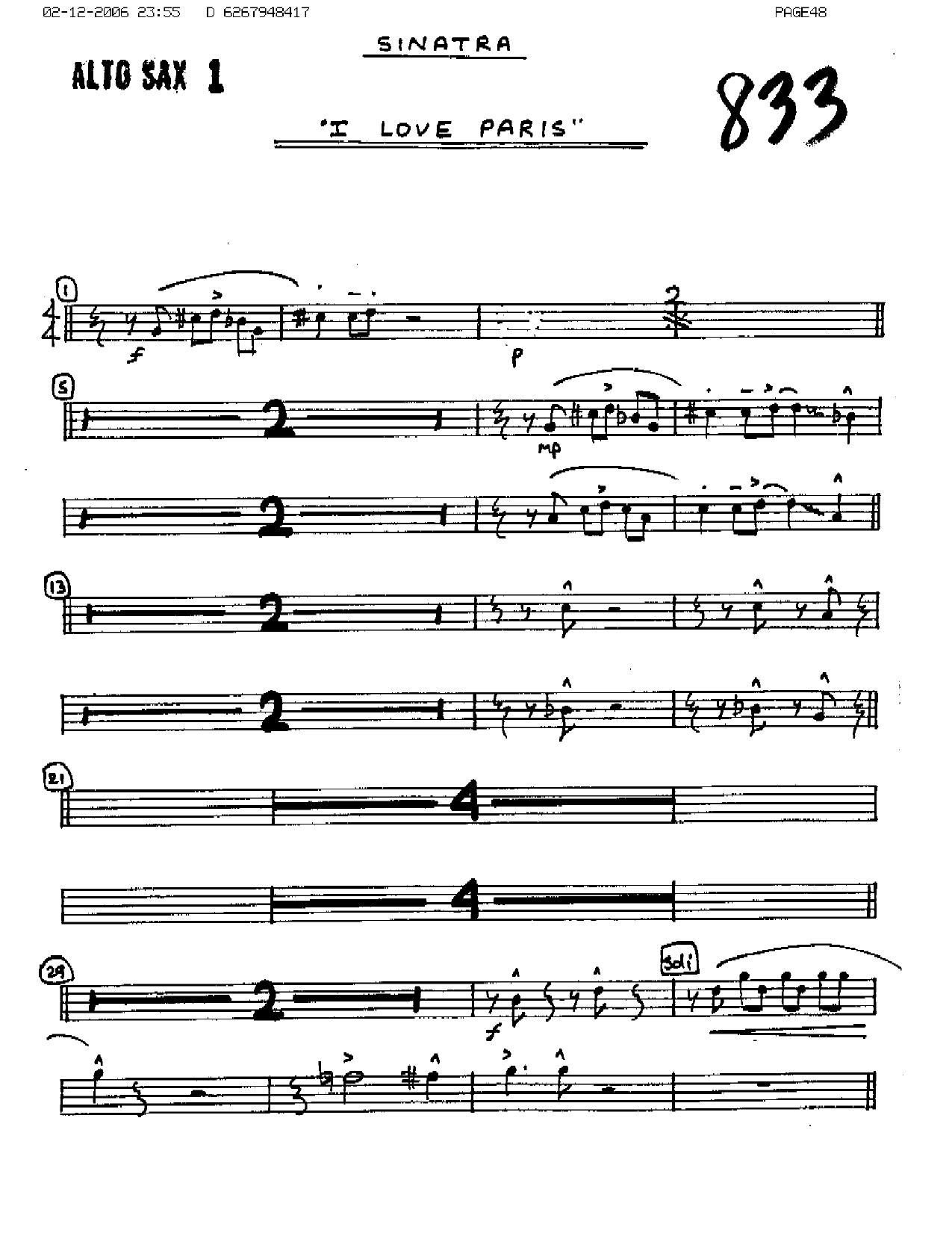
I Love Paris (N.Riddle)
Composed by Cole Porter
Arranged by Frank Sinatra & Nelson Riddle
- Ensemble: Big Band
- Pages: 35
- Instruments (18): Alto Sax 1, Alto Sax 2, Tenor Sax 1, Tenor Sax 2, Bari Sax, Trumpet 1, Trumpet 2 & 3, Trumpet 4, Trombone 1 & 2, Trombone 3 & Bass Trombone, Piano, Bass, Guitar, Drums, Violin 1, Violin 2, Viola, Cello
- Difficulty: medium
- Content: Individual Parts
- Format: PDF Download (Instant)
- Price: $24.99
Cole Porter’s timeless ode to the French capital received its definitive mid-century vocal jazz treatment when Frank Sinatra recorded it for his landmark 1960 Capitol Records release, *Nice ’N’ Easy*. Nelson Riddle’s sophisticated orchestration elevates Porter’s buoyant, cyclical melody into a masterclass of mid-century swinging elegance, capturing both the romantic allure of Paris and the swaggering, high-tailored sophistication of the Capitol Sinatra era. Originally written for Porter’s 1953 Broadway musical *Can-Can*, the song quickly transcended its theatrical origins to become a staple of the Great American Songbook, interpreted by virtually every major jazz vocal stylist. However, it is the symbiotic creative partnership between Sinatra and Riddle that permanently etched this specific version into jazz history, balancing European romanticism with driving American swing. Propelled by an infectious, medium-up swing groove in 4/4 time, this chart exudes a vibrant, urbane energy that shifts seamlessly between driving rhythmic momentum and lush, impressionistic textures. Riddle’s arrangement opens with a playful, teasing vamp before settling into a confident pocket driven by the rhythm section. The emotional landscape is buoyant, sophisticated, and effortlessly cool, evoking the atmosphere of a brisk stroll down the Champs-Élysées at dusk. The harmonic language utilizes extended chord structures, signature Riddle-esque chromatic movements in the woodwinds, and clever modal shifts that keep the listener perpetually engaged, avoiding predictable harmonic resolutions in favor of unexpected, refreshing detours. Riddle’s scoring approach for this ten-instrument ensemble relies heavily on transparent, highly colored voicings rather than dense, wall-of-sound block writing. The woodwinds—featuring crisp doubling across alto, tenor, and baritone saxophones—weave counter-melodies around the vocal line, utilizing breathy subtones and agile scalar runs that mimic the effervescent spirit of Parisian nightlife. The brass section, comprising trumpet and trombone, injects punchy, muted interjections and warm, foundational pads that anchor the sophisticated harmonic framework. Rather than a traditional full-band shout chorus, Riddle builds tension through interlocking horn solis and rhythmic displacement, allowing the ensemble to converse dynamically with the lead voice. The arrangement features designated solo space that invites the featured instrumentalist to adopt Sinatra's phrasing approach: conversational, blues-infused, and rhythmically elastic. Executing this chart successfully requires a polished, lightweight swing feel where eighth notes are played with an understated, forward-leaning pulse rather than a heavy, triplet-heavy drag. The primary technical challenges lie in the dynamic control of the ensemble, ensuring that the background figures complement rather than obscure the melodic focal points. Clean articulation, precise intonation within the close-voiced woodwind passages, and an acute awareness of balance are paramount. Advanced high school, collegiate, and professional jazz ensembles will find this arrangement immensely rewarding, as it provides a masterclass in dynamic subtlety, stylistic restraint, and swing-era orchestration. Achieving the authentic Nelson Riddle sound requires strict attention to dynamic contrast and articulation. The tempo should sit comfortably at a medium-up swing (approximately 144 BPM), ensuring the groove feels conversational rather than rushed. Horn players must master a dry, clipped articulation on short notes, while maintaining a smooth, legato air stream on the lyrical lines. Pay close attention to the balance between the saxophone section's delicate woodwind counter-lines and the brass background figures; the brass should use cup or straight mutes where indicated to blend transparently into the texture. Conductors should rehearse the rhythm section first to establish a rock-solid, feather-light ride cymbal pattern and an understated walking bass line before layering in the horns. Encourage the ensemble to listen across sections to match vibrato widths and phrasing nuances, capturing the effortless, swinging sophistication that defined the golden age of Capitol records. Q: What instruments and parts are included in this arrangement? A: This chart is scored for a 10-instrument ensemble, featuring parts for Alto Saxophone, Tenor Saxophone, Baritone Saxophone, Trumpet, Trombone, and a full rhythm section (piano, guitar, bass, drums), along with a vocal lead sheet. Q: What is the difficulty level of this arrangement? A: It is graded as advanced intermediate to advanced, primarily due to the demand for subtle dynamic control, precise ensemble intonation, and sophisticated swing phrasing rather than extreme technical speed. Q: What is the style and historical context of this chart? A: This arrangement captures the quintessential Capitol Records sound of the 1960s, adapting Nelson Riddle’s iconic orchestration for Frank Sinatra’s recording of Cole Porter’s classic Broadway tune into a swinging, sophisticated jazz standard. Q: What makes this specific arrangement unique? A: Unlike dense, heavy big band charts, Riddle’s 10-piece scoring relies on transparent, impressionistic woodwind voicings, clever chromatic counter-melodies, and dynamic interplay that evokes both European romanticism and American swing. Q: What is the performance duration and recommended tempo? A: The arrangement runs approximately 3 minutes in duration when performed at the recommended medium-up swing tempo of around 144 beats per minute.
Questions and answers
- What is included in the I Love Paris (N.Riddle) PDF?
- The verified current file contains individual parts across 35 pages.
- How many instruments or parts are listed for I Love Paris (N.Riddle)?
- The verified instrumentation list contains 18 entries for this Big Band arrangement.
- Who is credited for I Love Paris (N.Riddle)?
- Composer: Cole Porter. Arranger: Frank Sinatra & Nelson Riddle.
- What difficulty is listed for I Love Paris (N.Riddle)?
- The verified difficulty level is medium.
- Can I preview I Love Paris (N.Riddle) before buying?
- Yes. The product page provides a preview generated from the current PDF file.
- How is I Love Paris (N.Riddle) delivered?
- After successful payment, the digital PDF is made available for download. The displayed price is $24.99.
Musicians Also Search For
I Love Paris Frank Sinatra & Nelson Riddle PDF • I Love Paris Frank Sinatra & Nelson Riddle sheet music • I Love Paris arranged by Frank Sinatra & Nelson Riddle • Frank Sinatra & Nelson Riddle big band charts • Frank Sinatra & Nelson Riddle jazz arrangements PDF • I Love Paris Cole Porter sheet music • I Love Paris Cole Porter big band arrangements • Cole Porter big band charts • I Love Paris big band arrangements • I Love Paris big band PDF download • I Love Paris jazz sheet music • big band sheet music download • I Love Paris individual parts download • I Love Paris sheet music PDF • buy I Love Paris sheet music • download I Love Paris PDF • I Love Paris jazz charts • best Frank Sinatra & Nelson Riddle big band arrangements • Cole Porter arranged by Frank Sinatra & Nelson Riddle • I Love Paris printable sheet music • big band repertoire PDF