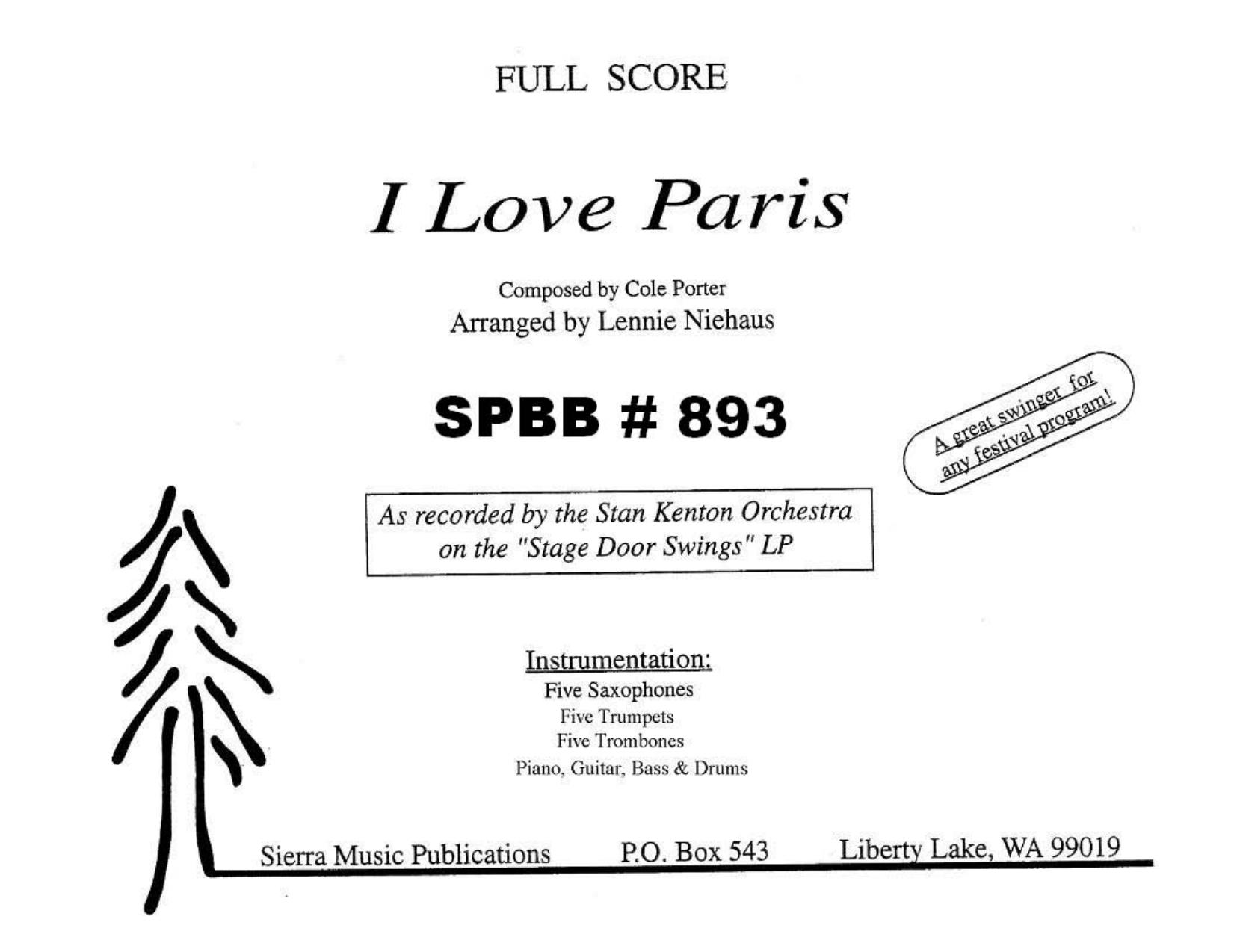
I Love Paris (L.Niehaus) sheet music preview

I Love Paris (L.Niehaus)

Composed by Cole Porter

Arranged by Lennie Niehaus

  • Ensemble: Big Band
  • Pages: 80
  • Instruments (19): Alto Saxophone 1, Alto Saxophone 2, Tenor Saxophone 1, Tenor Saxophone 2, Baritone Saxophone, Trumpet 1, Trumpet 2, Trumpet 3, Trumpet 4, Trumpet 5 (Opt.), Trombone 1 (Solo), Trombone 2, Trombone 3, Bass Trombone 4, Bass Trombone 5, Piano, Rh. Guitar, Bass, Drums
  • Difficulty: advanced
  • Content: Individual Parts
  • Format: PDF Download (Instant)
  • Price: $24.99

Cole Porter’s timeless 1953 standard "I Love Paris," originally introduced in the Broadway musical *Can-Can*, has long captured the romantic imagination of the American Songbook. While Maurice Chevalier and Frank Sinatra cemented its status as a vocal masterpiece in the mid-century popular consciousness, jazz instrumentalists quickly gravitated toward its infectious melody and sophisticated harmonic architecture. The tune bridges the gap between classic Broadway theatricality and sophisticated post-bop harmonic exploration, offering a resilient framework that yields exceptional results when re-imagined for ensemble performance. Lennie Niehaus’s masterwork for big band brings a crisp, West Coast cool-jazz aesthetic to Porter’s melodic blueprint. Moving at a bright, buoyant medium-up swing tempo in 4/4 time, the arrangement radiates sophisticated urban energy and joyful optimism. Niehaus avoids dense, congested orchestrations in favor of clean, transparent voicings, linear counterpoint, and clever rhythmic syncopation. The mood balances breezy sophistication with driving momentum, evoking the effortless charm of a sunlit Parisian boulevard propelled by an underlying West Coast modern jazz pulse. Niehaus applies his signature compositional brilliance—honed through his years as an alto saxophonist and arranger for Stan Kenton—to give the horns crisp, interlocking lines that breathe naturally. The chart features brilliantly constructed soli passages where the saxophones and brass weave intricate counter-melodies against the main theme, utilizing close-interval modern harmonies without ever sacrificing clarity. The rhythm section acts as a vital architectural pillar, utilizing lightly articulated walking basslines and subtle cymbal work to maintain a driving, conversational swing feel. Solo opportunities are thoughtfully integrated to highlight improvisational expression, while a dynamic shout chorus builds tension through clever chromatic shifts and rhythmic displacement before resolving into a triumphant, high-energy climax. Performing this 80-page, 8-instrument arrangement requires precision, stylistic agility, and clean articulation from every player. The melody is shared fluidly across sections, demanding strong sectional balance and intonation, particularly when navigating Niehaus’s characteristic contrapuntal lines. While the technical demands are accessible to advancing ensembles, the subtle phrasing requirements make it a deeply rewarding challenge that exposes the nuances of a band's articulation and groove. Advanced high school ensembles, collegiate big bands, and professional community groups will find this arrangement an ideal vehicle for developing stylistic versatility and ensemble cohesion. It provides an exceptional contrast on any concert program, offering audiences a brilliant synthesis of Cole Porter’s unforgettable melodic genius and Lennie Niehaus’s refined, West Coast big band artistry. Achieving the authentic West Coast cool-jazz aesthetic of this arrangement begins with a crisp, light, and forward-moving swing feel. Avoid heavy accents on beats one and three; instead, place a natural, subtle emphasis on the backbeat (beats two and four) with shortened, articulate eighth notes. The tempo should remain steady and buoyant—do not allow the ensemble to drag during dynamic transitions or rush the shout chorus. Key technical challenges lie in the intricate, linear counter-melodies and tight sectional voicings. Horn players must prioritize flawless blend and intonation, especially during chromatic passages and harmonically rich soli sections. The rhythm section should approach the chart with a conversational, uncluttered mindset: the drummer should utilize crisp hi-hat chicks and understated ride cymbal patterns, while the bassist keeps the walking line driving yet transparent. Rehearsal should initially focus on sectional balance at slower tempos to ensure that inner-voice counterlines are heard clearly beneath the primary melodic statements. Q: What instruments and parts are included in this arrangement? A: This arrangement is scored for an 8-instrument ensemble, specifically featuring parts for Trumpet, Trombone, Alto Saxophone, Tenor Saxophone, Baritone Saxophone, and a complete rhythm section. Q: What is the difficulty level of this Lennie Niehaus chart? A: It is ideally suited for advanced high school, collegiate, and professional community big bands that possess solid reading skills and stylistic versatility in swing articulation. Q: What is the historical context and musical style of "I Love Paris"? A: Originally composed by Cole Porter for the 1953 Broadway musical *Can-Can*, this arrangement transforms the iconic standard into a bright, West Coast cool-jazz swinger. Q: What makes this specific arrangement by Lennie Niehaus unique? A: Niehaus brings his signature Stan Kenton-era arranging style, featuring transparent voicings, linear counterpoint, clever rhythmic syncopation, and a sophisticated shout chorus. Q: What is the performance duration and tempo feel of the piece? A: The arrangement is performed at a bright, buoyant medium-up swing tempo in 4/4 time, typically lasting around 3 to 4 minutes depending on the length of the improvised solos.

Questions and answers

What is included in the I Love Paris (L.Niehaus) PDF?
The verified current file contains a conductor score and individual parts across 80 pages.
How many instruments or parts are listed for I Love Paris (L.Niehaus)?
The verified instrumentation list contains 19 entries for this Big Band arrangement.
Who is credited for I Love Paris (L.Niehaus)?
Composer: Cole Porter. Arranger: Lennie Niehaus.
What difficulty is listed for I Love Paris (L.Niehaus)?
The verified difficulty level is advanced.
Can I preview I Love Paris (L.Niehaus) before buying?
Yes. The product page provides a preview generated from the current PDF file.
How is I Love Paris (L.Niehaus) delivered?
After successful payment, the digital PDF is made available for download. The displayed price is $24.99.

Musicians Also Search For

I Love Paris Lennie Niehaus PDFI Love Paris Lennie Niehaus sheet musicI Love Paris arranged by Lennie NiehausLennie Niehaus big band chartsLennie Niehaus jazz arrangements PDFI Love Paris Cole Porter sheet musicI Love Paris Cole Porter big band arrangementsCole Porter big band chartsI Love Paris big band arrangementsI Love Paris big band PDF downloadI Love Paris jazz sheet musicbig band sheet music downloadI Love Paris conductor score PDFI Love Paris individual parts downloadI Love Paris sheet music PDFbuy I Love Paris sheet musicdownload I Love Paris PDFI Love Paris jazz chartsbest Lennie Niehaus big band arrangementsCole Porter arranged by Lennie NiehausI Love Paris printable sheet musicbig band repertoire PDF

All arrangements by Lennie Niehaus All Cole Porter sheet music