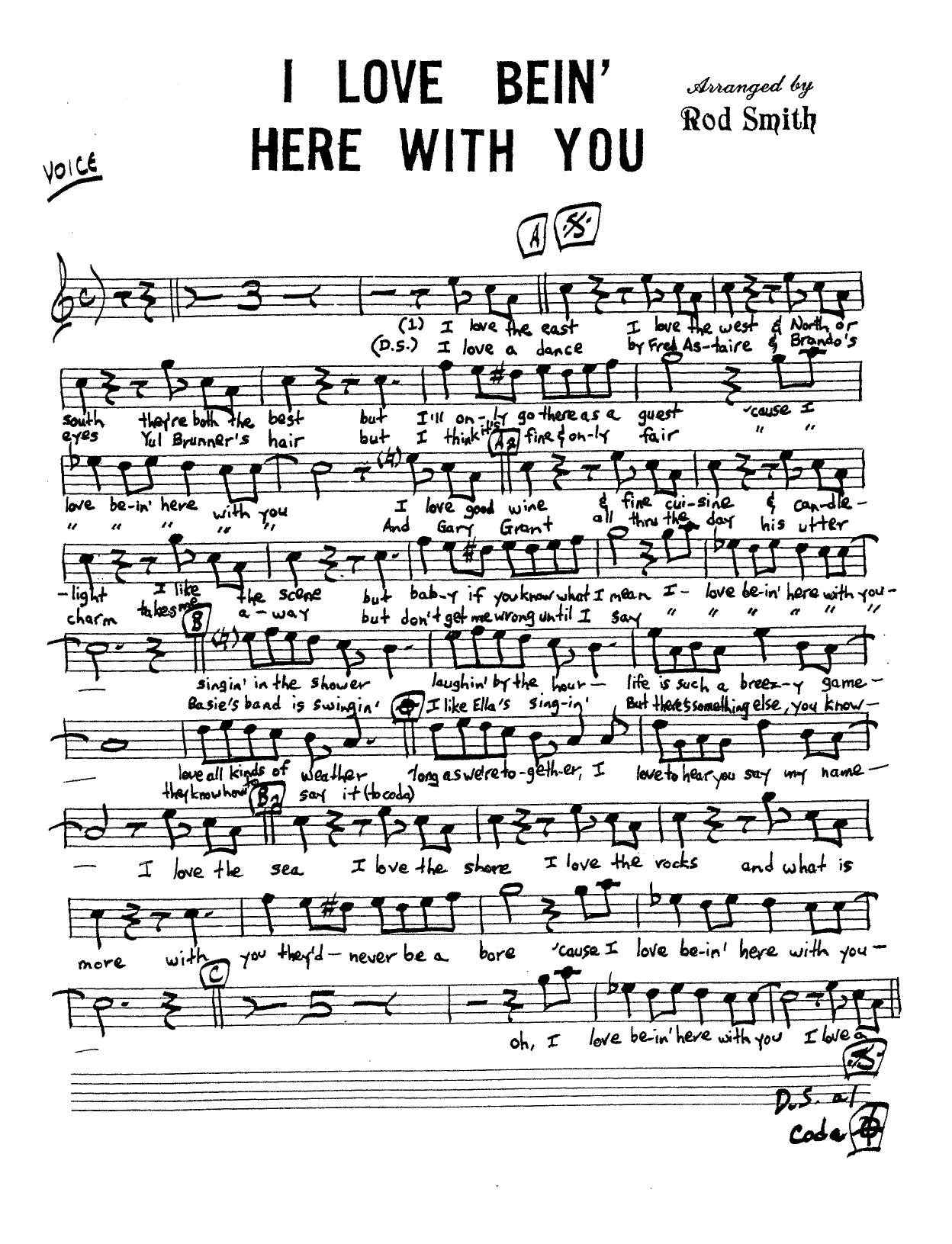
I Love Being Here With You (R.Smith) sheet music preview

I Love Being Here With You (R.Smith)

Composed by Robert W. Smith

Arranged by R.Smith

  • Ensemble: Big Band
  • Style: Jazz Standard
  • Pages: 34
  • Instruments (17): Voice, Alto I, Alto II, Tenor I, Tenor II, Bari, Tpt I, Tpt II, Tpt III, Tpt IV, Tbn I, Tbn II, Tbn III, Tbn IV, Piano, Bass, Drums
  • Difficulty: medium
  • Content: Individual Parts
  • Format: PDF Download (Instant)
  • Price: $24.99

"I Love Being Here With You," a timeless jazz standard originally penned by Robert W. Smith, emerged from the vibrant post-bop era, a period characterized by its sophisticated harmonic language and rhythmic ingenuity. While the original composer is Robert W. Smith, the tune gained widespread recognition through its association with iconic vocalists like Peggy Lee, who imbued it with her signature blend of warmth and wit. It stands as a testament to the enduring appeal of the classic jazz standard, a staple in the repertoire of countless jazz ensembles for its memorable melody and inviting harmonic structure. This piece captures the essence of a relaxed yet engaging musical conversation, embodying the joy and camaraderie inherent in live jazz performance. R.Smith's big band arrangement of "I Love Being Here With You" is a masterclass in crafting an accessible yet sophisticated chart for the modern jazz ensemble. Maintaining a comfortable medium-swing feel in 4/4, the arrangement is set in the key of F Major, providing a bright and inviting sonic landscape. The mood is one of sophisticated cheerfulness, evoking the ambiance of a classic supper club or a lively, intimate concert hall. R.Smith's distinctive approach is evident in the artful voicings, which provide lush harmonic support for the featured vocalist while allowing individual sections to shine. Expect carefully constructed soli sections that showcase the saxophone and brass choirs, demonstrating R.Smith's knack for creating intricate yet playable ensemble passages. The arrangement builds dynamically, culminating in a powerful, yet never overwhelming, shout chorus that provides an exhilarating climax before returning to a more subdued, reflective closing. The melody is primarily carried by the vocalist, whose part is thoughtfully integrated into the ensemble texture, allowing for both prominence and seamless blending. Following the vocal exposition, there are ample opportunities for featured solos, typically allocated to the tenor saxophone and trumpet, offering improvisers a solid harmonic framework over which to explore. Technical challenges for the ensemble include maintaining precise rhythmic articulation in the swing feel, achieving balanced voicings in the soli sections, and executing clean brass fall-offs and saxophone scoops. The rewarding aspect lies in the arrangement's ability to make a big band sound cohesive and polished, allowing musicians to truly groove together and deliver a performance that is both musically satisfying and emotionally resonant. This arrangement is ideally suited for college-level jazz ensembles, advanced high school bands, and community big bands seeking a sophisticated yet approachable chart. Its blend of classic jazz sensibility with contemporary arranging techniques offers a valuable learning experience in ensemble dynamics, stylistic interpretation, and improvisational support. The detailed scoring and clear articulation markings make it an excellent choice for developing bands aiming to refine their swing feel and ensemble precision, while still offering enough depth for more experienced groups to explore nuanced musicality. Conductors should emphasize a relaxed, yet driving medium-swing feel from the outset, ensuring the rhythm section lays down a solid, unhurried foundation. The brass section will need to focus on precise articulation for the short, punchy figures, particularly in the shout chorus, while the trombones should aim for a warm, blended sound in their sustained chords. Saxophone soli sections require careful attention to balance and blend, ensuring the lines are clear and unified. Encourage the rhythm section to interact dynamically with the soloist, providing supportive yet engaging accompaniment. Specific techniques include controlled brass falls at the ends of phrases and subtle saxophone scoops leading into sustained notes, all contributing to the authentic jazz aesthetic. Rehearsal time should be dedicated to finessing the vocal-ensemble interplay, ensuring the band provides a supportive cushion without overpowering the soloist, and practicing the dynamic swells leading into and out of the shout chorus for maximum impact. Q: What instruments and parts are included in this arrangement? A: This arrangement includes parts for Vocal, Alto Saxophone 1, Alto Saxophone 2, Tenor Saxophone 1, Tenor Saxophone 2, Baritone Saxophone, Trumpet 1, Trumpet 2, Trumpet 3, Trumpet 4, Trombone 1, Trombone 2, Trombone 3, Trombone 4, Guitar, Piano, Bass, and Drums, totaling 17 instruments. Q: What is the difficulty level of this arrangement? A: This arrangement is rated as medium-advanced, suitable for college-level jazz ensembles, advanced high school bands, and community big bands. It requires solid rhythmic precision and an understanding of jazz articulation. Q: What is the musical style and historical context of "I Love Being Here With You"? A: "I Love Being Here With You" is a classic jazz standard from the post-bop era, known for its sophisticated harmonic language and engaging melody. It embodies the relaxed yet swinging feel characteristic of mid-20th century vocal jazz. Q: What makes R.Smith's arrangement of this piece unique? A: R.Smith's arrangement is distinguished by its artful voicings, well-crafted soli sections, and a dynamically building shout chorus, all while maintaining a classic medium-swing feel. It balances ensemble sophistication with playability. Q: What is the typical performance duration and tempo for this arrangement? A: The typical performance duration for this arrangement is approximately 3-4 minutes, depending on the length of improvised solos. It is designed to be performed at a comfortable medium-swing tempo, around 120-140 beats per minute.

Questions and answers

What is included in the I Love Being Here With You (R.Smith) PDF?
The verified current file contains individual parts across 34 pages.
How many instruments or parts are listed for I Love Being Here With You (R.Smith)?
The verified instrumentation list contains 17 entries for this Big Band arrangement.
Who is credited for I Love Being Here With You (R.Smith)?
Composer: Robert W. Smith. Arranger: R.Smith.
What difficulty is listed for I Love Being Here With You (R.Smith)?
The verified difficulty level is medium.
What style is listed for I Love Being Here With You (R.Smith)?
The catalog lists the style as Jazz Standard.
Can I preview I Love Being Here With You (R.Smith) before buying?
Yes. The product page provides a preview generated from the current PDF file.
How is I Love Being Here With You (R.Smith) delivered?
After successful payment, the digital PDF is made available for download. The displayed price is $24.99.

Musicians Also Search For

I Love Being Here With You R.Smith PDFI Love Being Here With You R.Smith sheet musicI Love Being Here With You arranged by R.SmithR.Smith big band chartsR.Smith jazz arrangements PDFI Love Being Here With You Robert W. Smith sheet musicI Love Being Here With You Robert W. Smith big band arrangementsRobert W. Smith big band chartsI Love Being Here With You big band arrangementsI Love Being Here With You big band PDF downloadI Love Being Here With You jazz sheet musicbig band sheet music downloadI Love Being Here With You individual parts downloadI Love Being Here With You sheet music PDFI Love Being Here With You Jazz Standard chartsJazz Standard big band arrangementsbuy I Love Being Here With You sheet musicdownload I Love Being Here With You PDFI Love Being Here With You jazz chartsbest R.Smith big band arrangementsRobert W. Smith arranged by R.SmithI Love Being Here With You printable sheet musicbig band repertoire PDF

All arrangements by R.Smith All Robert W. Smith sheet music