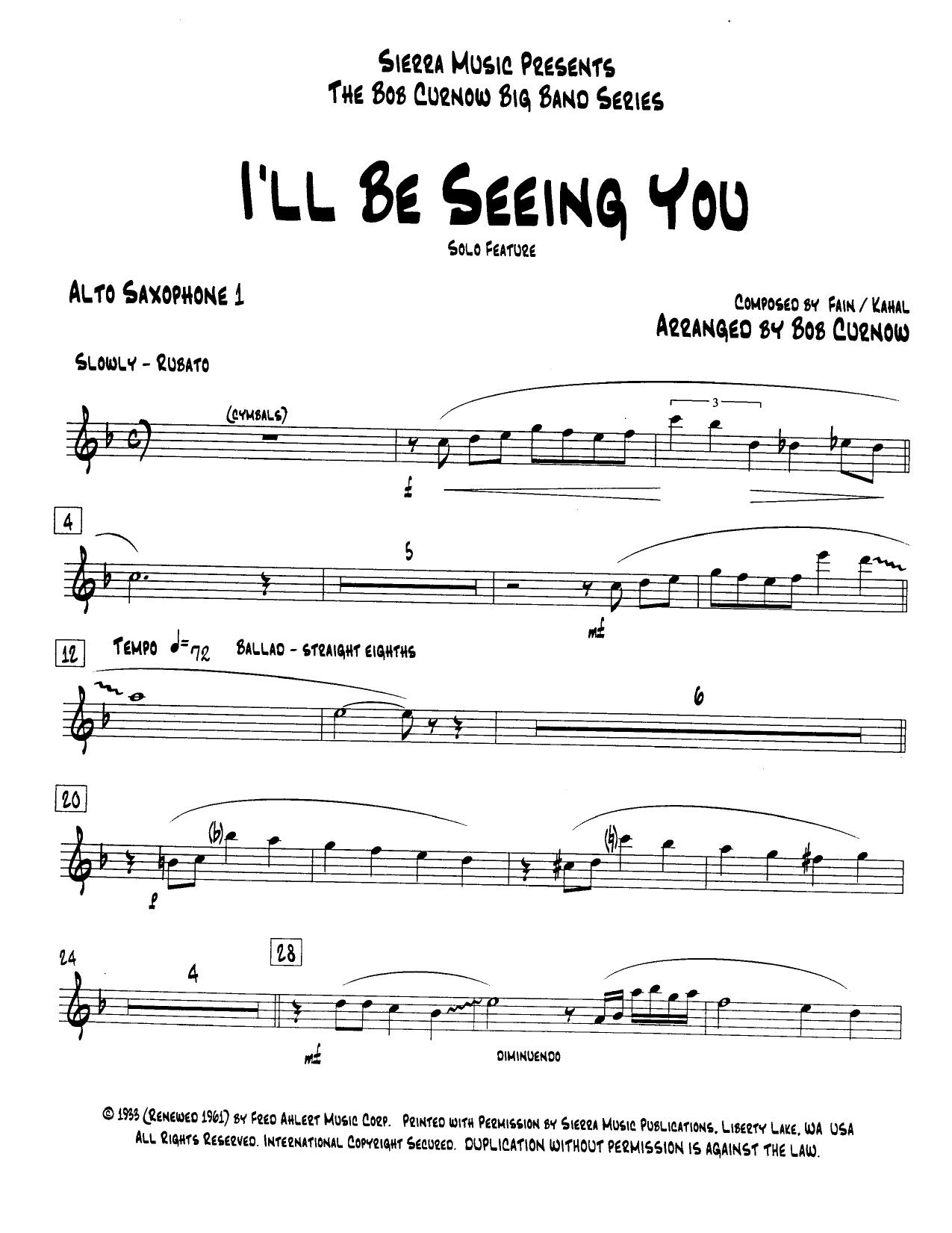
I'll Be Seeing You (B.Curnow) vocal
Composed by Fain / Kahal
Arranged by Bob Curnow
- Ensemble: Big Band Vocal
- Style: Ballad
- Pages: 50
- Instruments (22): Alto Saxophone 1, Alto Saxophone 2, Tenor Saxophone 1, Tenor Saxophone 2, Baritone Saxophone, Flugelhorn / Trumpet 1, Flugelhorn / Trumpet 2, Flugelhorn / Trumpet 3, Flugelhorn / Trumpet 4 (Solo), Trombone 1, Trombone 2, Trombone 3, Bass Trombone 4, Bass, Drums, Guitar, Piano, Soloist in C, Soloist in Eb, Solo Trombone, Solo Trumpet, Vocal
- Difficulty: medium
- Content: Individual Parts
- Format: PDF Download (Instant)
- Price: $24.99
"I'll Be Seeing You," originally composed by Sammy Fain with lyrics by Irving Kahal in 1938, emerged as a poignant ballad during a tumultuous era, becoming an anthem of longing and remembrance for those separated by war. Its melancholic yet hopeful melody resonated deeply, particularly during World War II, making it an enduring standard in the Great American Songbook. The song was famously recorded by Bing Crosby in 1944, whose rendition became a massive hit, and later by numerous jazz and pop vocalists, including Frank Sinatra, Billie Holiday, and Jo Stafford. Its timeless appeal lies in its evocative lyrics and a melody that perfectly captures the bittersweet essence of memory and anticipation, cementing its place as a quintessential jazz ballad. Bob Curnow's arrangement of "I'll Be Seeing You" for big band and vocal soloist masterfully reinterprets this classic, infusing it with his signature harmonic richness and sophisticated orchestration. Curnow approaches this piece as a slow ballad, maintaining a tender and reflective mood throughout. The arrangement opens with a delicate, rubato introduction, immediately setting a contemplative tone before settling into a gentle 4/4 swing feel. Curnow's voicings are characteristically lush and expansive, featuring dense, often suspended harmonies in the brass and saxophones that provide a warm, supportive bed for the vocalist. Expect intricate counter-melodies and interwoven lines that add depth without ever overshadowing the vocal lead. This arrangement avoids flashy, high-energy sections, instead focusing on sustained beauty and emotional resonance, making it a perfect vehicle for a vocalist to convey profound sentiment. The vocal melody is carried by the soloist for the majority of the arrangement, allowing for expressive interpretation. Curnow provides a beautifully crafted, understated ensemble accompaniment that evolves subtly, building tension and release through dynamic shifts and harmonic color. While there isn't a dedicated instrumental solo section, the ensemble writing itself is highly melodic, with brief, lyrical fills from the saxophone section and brass adding texture. The technical challenges lie less in blistering tempos or extreme ranges and more in achieving precise balance, impeccable intonation, and a unified, sensitive ensemble sound that supports the vocalist without being intrusive. The brass sections require careful control of dynamics and blend, particularly in sustained chords, while the saxophones need to execute Curnow's often intricate inner lines with clarity and warmth. This arrangement is ideally suited for college-level jazz ensembles, advanced community big bands, or professional groups seeking a sophisticated and emotionally rich ballad for their repertoire. Its demands on ensemble blend, dynamic control, and harmonic understanding make it a rewarding piece for musicians ready to delve into nuanced musicality. The satisfaction comes from crafting a truly beautiful and moving performance, where every note contributes to the overall expressive power of this beloved standard. The arrangement's 50 pages reflect its detailed orchestration and the care taken to provide a complete and compelling musical statement. This arrangement of "I'll Be Seeing You" requires a sensitive and cohesive approach to truly shine. The primary technical challenge lies in maintaining a consistent, delicate slow ballad swing feel while supporting the vocalist with impeccable blend and intonation. Conductors should emphasize breath control and sustained tone quality, particularly in the brass and saxophone sections, where Curnow's rich, often suspended harmonies demand precise pitch. The tempo should be around quarter note = 60-70 BPM, allowing ample space for the melody to breathe and for the ensemble's textures to unfold. Dynamic contrast is crucial, ranging from very soft (pp) accompaniment to moderate (mf) ensemble swells, always ensuring the vocalist remains paramount. Rehearsal should focus on balancing the intricate inner voices within the saxophone and brass sections, ensuring no single line protrudes inappropriately. Pay close attention to the rubato sections, allowing the vocalist and rhythm section to lead, with the ensemble following sensitively. No special techniques like plungers or falls are explicitly notated, emphasizing a clean, legato articulation throughout. Encourage musicians to listen across sections to achieve a unified, warm, and expressive sound. Q: What instruments are included in this arrangement? A: This arrangement is for a standard big band instrumentation, typically including 5 saxophones (AATTB), 4 trumpets, 4 trombones, piano, bass, drums, and a dedicated vocal soloist part. Q: What is the difficulty level of this arrangement? A: This arrangement is rated as advanced intermediate to advanced. While not technically demanding in terms of speed, it requires excellent ensemble blend, precise intonation, sophisticated harmonic understanding, and mature musicality from all sections and the vocalist. Q: What musical style and historical context does this arrangement represent? A: This is a slow ballad arrangement of a classic Great American Songbook standard from 1938, famously associated with the WWII era. Bob Curnow's treatment maintains the original's romantic and nostalgic character, presented in a lush, contemporary big band jazz style. Q: What makes Bob Curnow's arrangement of "I'll Be Seeing You" unique? A: Curnow's signature lies in his rich, expansive harmonic voicings, intricate counter-melodies, and sophisticated orchestration that provides a deeply supportive yet never overwhelming backdrop for the vocal soloist. It emphasizes emotional depth and nuanced musicality over overt technical display. Q: What is the approximate duration and tempo of this piece? A: As a slow ballad, the performance duration typically ranges from 4 to 5 minutes, depending on the vocalist's interpretation and optional repeats. The tempo should be a gentle, reflective 4/4 swing, around quarter note = 60-70 BPM.
Questions and answers
- What is included in the I'll Be Seeing You (B.Curnow) vocal PDF?
- The verified current file contains individual parts across 50 pages.
- How many instruments or parts are listed for I'll Be Seeing You (B.Curnow) vocal?
- The verified instrumentation list contains 22 entries for this Big Band Vocal arrangement.
- Who is credited for I'll Be Seeing You (B.Curnow) vocal?
- Composer: Fain / Kahal. Arranger: Bob Curnow.
- What difficulty is listed for I'll Be Seeing You (B.Curnow) vocal?
- The verified difficulty level is medium.
- What style is listed for I'll Be Seeing You (B.Curnow) vocal?
- The catalog lists the style as Ballad.
- Can I preview I'll Be Seeing You (B.Curnow) vocal before buying?
- Yes. The product page provides a preview generated from the current PDF file.
- How is I'll Be Seeing You (B.Curnow) vocal delivered?
- After successful payment, the digital PDF is made available for download. The displayed price is $24.99.
Musicians Also Search For
I'll Be Seeing You Bob Curnow PDF • I'll Be Seeing You Bob Curnow sheet music • I'll Be Seeing You arranged by Bob Curnow • Bob Curnow big band vocal charts • Bob Curnow jazz arrangements PDF • I'll Be Seeing You Fain / Kahal sheet music • I'll Be Seeing You Fain / Kahal big band vocal arrangements • Fain / Kahal big band vocal charts • I'll Be Seeing You big band vocal arrangements • I'll Be Seeing You big band vocal PDF download • I'll Be Seeing You jazz sheet music • big band vocal sheet music download • I'll Be Seeing You individual parts download • I'll Be Seeing You sheet music PDF • I'll Be Seeing You Ballad charts • Ballad big band vocal arrangements • buy I'll Be Seeing You sheet music • download I'll Be Seeing You PDF • I'll Be Seeing You jazz charts • best Bob Curnow big band vocal arrangements • Fain / Kahal arranged by Bob Curnow • I'll Be Seeing You printable sheet music • big band vocal repertoire PDF