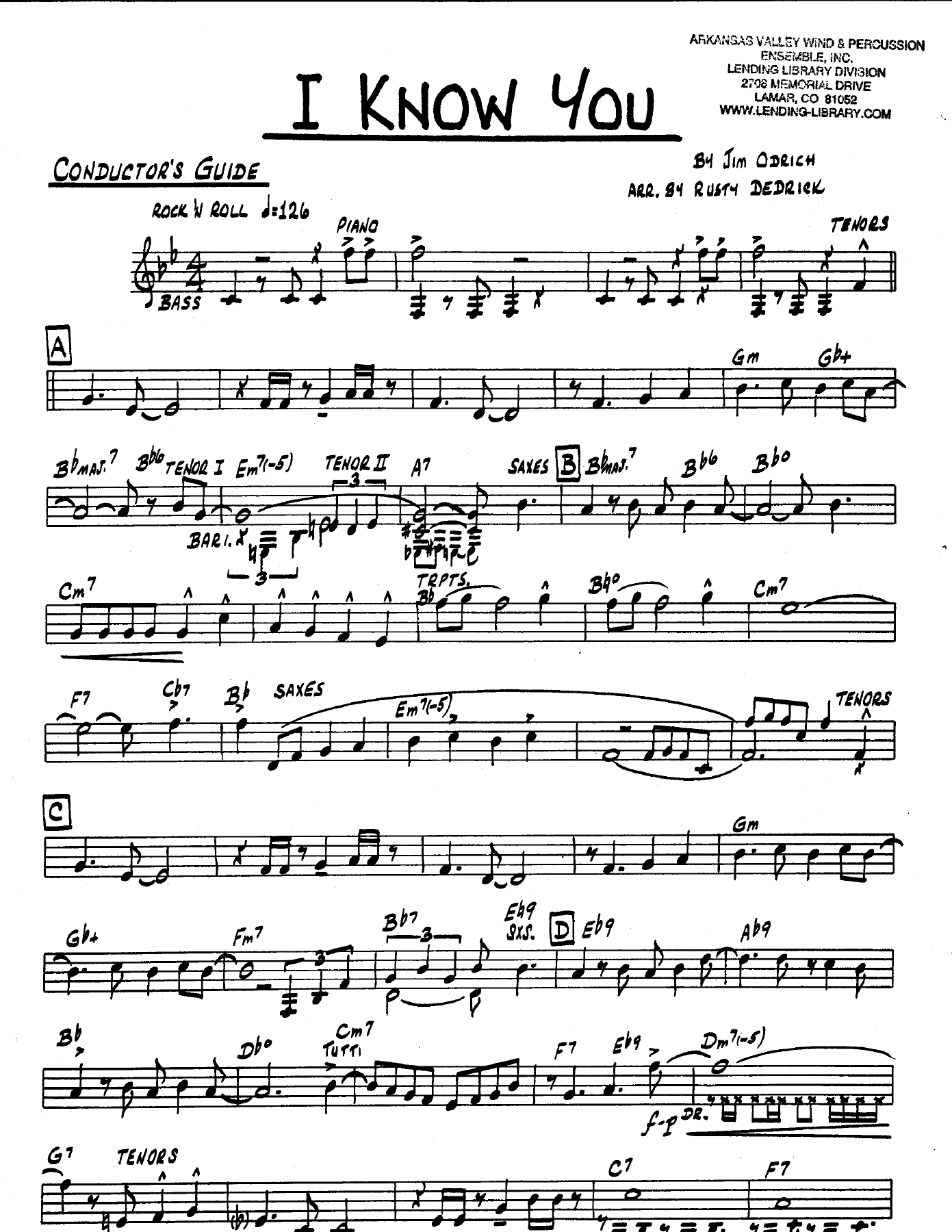
I Know You ( (R.Dedrick) Missing Piano
Composed by Rusty Dedrick
Arranged by Rusty Dedrick
- Ensemble: Big Band Vocal
- Style: Jazz Standard
- Pages: 23
- Difficulty: medium
- Content: Sheet Music
- Format: PDF Download (Instant)
- Price: $24.99
"I Know You," originally composed by Rusty Dedrick, stands as a testament to the enduring appeal and sophisticated craftsmanship of the mid-20th-century jazz standard. While the exact composition date of "I Know You" is not readily available, Dedrick's prolific career as a trumpeter, composer, and arranger flourished from the late 1930s through several decades, placing this piece firmly within the vibrant swing and bebop eras of jazz. Dedrick himself was a prominent figure, having played with legendary big bands such as Red Norvo and Claude Thornhill, and later becoming the director of jazz studies at the Manhattan School of Music. His deep immersion in these styles ensures that "I Know You" embodies the harmonic richness and melodic ingenuity characteristic of a true jazz standard, inviting comparison to works popularized by iconic vocalists and instrumentalists of the period. This arrangement of "I Know You" is conceived as a medium swing ballad, offering a lyrical and expressive vehicle for a featured vocalist. The musical character is one of poignant reflection, balanced by an underlying rhythmic drive that prevents it from becoming overly sentimental. The harmonic language is sophisticated yet accessible, employing extended harmonies and tasteful voice leading that are hallmarks of quality big band writing. The mood is contemplative and warm, evoking the classic soundscapes of a bygone era while remaining fresh and engaging. The arrangement is in a comfortable key for vocal performance, allowing the singer to truly inhabit the melody and lyrics. Rusty Dedrick's approach to this arrangement showcases his mastery of big band orchestration and his deep understanding of the vocalist's role. Known for his technical precision and thoughtful arrangements, Dedrick crafts voicings that are both lush and transparent, supporting the vocal line without overshadowing it. Expect carefully constructed soli sections that highlight the saxophone and brass sections, demonstrating Dedrick's ability to create compelling countermelodies and harmonic interest. The arrangement features a prominent vocal melody throughout the A sections, with instrumental interludes and a well-placed instrumental solo (likely for tenor saxophone or trumpet) offering contrasting textures and improvisational opportunities. A signature Dedrick touch might include subtle rhythmic interplay and dynamic shifts that build and release tension, making for a rewarding performance experience. This arrangement is ideally suited for college, community, and professional big bands seeking a sophisticated and engaging vocal feature. The technical demands are moderate to advanced, requiring solid ensemble playing, good intonation, and a nuanced understanding of swing articulation. While the "missing piano" detail indicates the piano part may need to be reconstructed or improvised from a lead sheet, this offers an opportunity for a skilled pianist to contribute creatively. The rewarding aspects lie in the arrangement's inherent musicality, the opportunity for expressive vocal interpretation, and the chance for the ensemble to demonstrate its blend, balance, and stylistic authenticity in a classic jazz setting. The 23 pages suggest a substantial and fully realized arrangement, providing ample material for a captivating performance. Conductors should establish a relaxed yet consistent medium swing tempo, emphasizing a smooth, legato vocal line supported by a light, driving rhythm section. Attention to dynamic contrasts is crucial, particularly in the interplay between the vocalist and the ensemble. Brass players should focus on warm, blended tones in the sustained chords and crisp, articulate attacks in the soli passages. Saxophones should strive for a unified sound, paying close attention to blend and intonation, especially in the harmonized melody sections. The "missing piano" notation implies the pianist will need to interpret chord symbols and create an accompaniment that complements the ensemble, potentially requiring a lead sheet or a strong understanding of jazz piano voicings. Rehearsal time should be dedicated to shaping the vocal phrasing and ensuring seamless transitions between vocal and instrumental sections, allowing soloists ample space to develop their improvisations. **Q: What instruments are included in this arrangement?** A: This arrangement is for a standard big band with a vocal soloist. It typically includes 5 saxophones (2 alto, 2 tenor, 1 baritone), 4 trumpets, 4 trombones, and a rhythm section (bass, drums, and a part for guitar). The piano part is noted as "missing," suggesting it may need to be improvised or created from a lead sheet. **Q: What is the difficulty level of this arrangement?** A: This arrangement is considered moderate to advanced. It requires a solid understanding of big band ensemble playing, good intonation, and a nuanced grasp of swing articulation, making it suitable for college, community, and professional jazz ensembles. **Q: What is the musical style and historical context of "I Know You"?** A: "I Know You" is a jazz standard composed by Rusty Dedrick, reflecting the sophisticated swing and bebop styles prevalent during his active career from the late 1930s onwards. It embodies the melodic and harmonic characteristics of mid-20th-century jazz. **Q: What makes this particular arrangement unique?** A: This arrangement by Rusty Dedrick features his signature approach to big band writing, including lush voicings, well-crafted soli sections, and dynamic interplay between the ensemble and the featured vocalist. His background as a trumpeter and arranger ensures an authentic and engaging treatment of the jazz standard. **Q: What is the approximate performance duration or tempo of this piece?** A: "I Know You" is arranged as a medium swing ballad. While the exact duration will vary based on tempo choices and solo lengths, a medium swing ballad typically ranges from 4 to 6 minutes in performance.
Musicians Also Search For
I Know You Rusty Dedrick PDF • I Know You Rusty Dedrick sheet music • I Know You arranged by Rusty Dedrick • Rusty Dedrick big band vocal charts • Rusty Dedrick jazz arrangements PDF • I Know You Rusty Dedrick big band vocal arrangement • I Know You big band vocal arrangement • I Know You big band vocal PDF download • I Know You jazz ensemble sheet music • big band vocal sheet music instant download • I Know You sheet music with parts • I Know You Jazz Standard chart • Jazz Standard big band vocal arrangements • buy I Know You sheet music online • download I Know You PDF • I Know You jazz chart • best Rusty Dedrick big band vocal arrangements • I Know You printable sheet music • big band vocal repertoire PDF