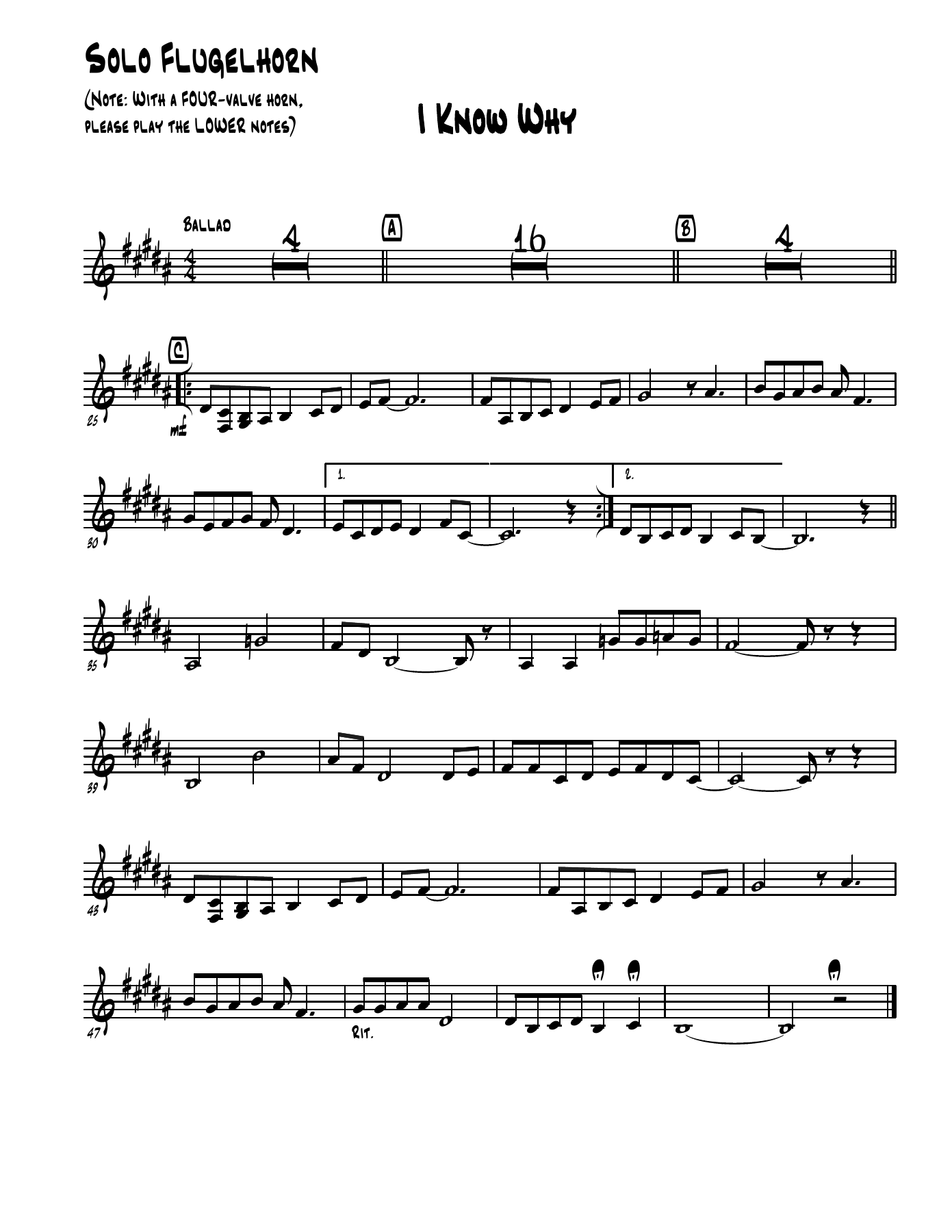
I Know Why (B.Eberhart)
Composed by Harry Warren
Arranged by Bob Eberhart
- Ensemble: Big Band
- Style: Jazz Standard
- Pages: 18
- Instruments (17): Solo Flugelhorn, 1st Alto Saxophone, 2nd Alto Saxophone, 1st Tenor Saxophone, 2nd Tenor Saxophone, Clarinet, 1st Trumpet, 2nd Trumpet, 3rd Trumpet, 1st Trombone, 2nd Trombone, 3rd Trombone, 4th Trombone, Piano, Guitar, Bass, Drums
- Difficulty: easy
- Content: Individual Parts
- Format: PDF Download (Instant)
- Price: $24.99
"I Know Why (And So Do You)," originally composed by the prolific Harry Warren, emerged from the golden age of American songwriting, specifically for the 1941 film "Sun Valley Serenade." This iconic tune is indelibly linked with the Glenn Miller Orchestra and their vocalist Paula Kelly, whose rendition became a massive hit and solidified its place in the Great American Songbook. The piece encapsulates the romantic sentimentality and lush orchestral sound characteristic of the early 1940s big band era, a time when swing music dominated the airwaves and dance halls. Its enduring melodic charm and harmonic sophistication have ensured its status as a beloved jazz standard, frequently revisited by vocalists and instrumentalists alike for its inherent beauty and expressive potential. Bob Eberhart's masterful big band arrangement of "I Know Why (B.Eberhart)" reimagines this classic, infusing it with a medium-swing feel that balances tradition with a fresh, contemporary energy. The arrangement is set in the key of F major, providing a bright yet warm sonic landscape that perfectly complements the song's optimistic mood. Eberhart's signature approach is evident in his sophisticated voicings, which create rich, full textures throughout the ensemble, particularly in the brass and saxophone sections. Expect carefully crafted soli passages that allow the various sections to shine, showcasing both their individual prowess and their ability to blend seamlessly. While honoring the original's melodic integrity, Eberhart introduces subtle harmonic extensions and dynamic contrasts that elevate the piece beyond a mere transcription, making it a compelling and engaging experience for both performers and audience. The arrangement opens with a lyrical Flugelhorn melody, establishing an intimate and expressive tone before the full ensemble enters with a beautifully voiced harmonization. Eberhart strategically deploys the melody across different sections, featuring the saxophone section in a lush soli, followed by a powerful brass statement that builds excitement. While there are no extended open solos, the arrangement offers ample opportunity for individual expression within the ensemble, particularly in the nuanced phrasing required from lead players. Technical challenges lie in achieving precise articulation, maintaining a consistent medium-swing groove, and navigating the dynamic shifts that are crucial to the arrangement's emotional arc. The rewarding aspect comes from performing a timeless melody through a vibrant, expertly crafted big band lens, culminating in a powerful, uplifting shout chorus that leaves a lasting impression. This arrangement is ideally suited for college-level jazz ensembles, advanced community bands, and professional big bands seeking a sophisticated yet accessible chart. Its detailed scoring and thoughtful orchestration provide an excellent platform for developing ensemble blend, dynamic control, and stylistic authenticity. The piece offers enough complexity to engage seasoned musicians while remaining within reach for a well-rehearsed college or community group, making it a valuable addition to any big band library. Conductors should emphasize a consistent, relaxed medium-swing feel from the outset, ensuring the rhythm section lays down a solid foundation without rushing. The opening Flugelhorn solo requires a warm, sustained tone and expressive phrasing to set the mood effectively. Pay close attention to dynamic contrasts, particularly in the soli sections where crescendos and decrescendos are integral to the arrangement's emotional flow. Brass players should focus on clear articulation and controlled attacks, especially in the punchier figures, while saxophones need to prioritize blend and intonation in their soli passages. Rehearsal tips include isolating the interwoven melodic lines to ensure clarity and balance, and practicing the shout chorus at a slightly slower tempo to nail the rhythmic precision and dynamic impact before bringing it up to speed. No special techniques like plunger mutes or extreme falls are required, allowing the focus to remain on musicality and ensemble cohesion. Q: What instruments and parts are included in this arrangement? A: This big band arrangement is scored for 17 instruments, including Flugelhorn, Alto Saxophone 1, Alto Saxophone 2, Tenor Saxophone 1, Tenor Saxophone 2, Baritone Saxophone, 4 Trumpets, 4 Trombones, Piano, Bass, and Drums. Q: What is the difficulty level of "I Know Why (B.Eberhart)"? A: This arrangement is rated as medium-advanced, making it suitable for college-level jazz ensembles, advanced community bands, and professional big bands. It requires good ensemble blend, dynamic control, and solid instrumental technique. Q: What is the musical style and historical context of this piece? A: This is a jazz standard arrangement of "I Know Why (And So Do You)," a romantic tune from the 1941 big band era, originally made famous by the Glenn Miller Orchestra. It embodies the classic swing sound of that period. Q: What makes Bob Eberhart's arrangement of "I Know Why" unique? A: Eberhart's treatment features sophisticated voicings, a consistent medium-swing feel, and dynamic contrasts that elevate the original melody. It includes carefully crafted soli sections and a powerful shout chorus, showcasing his distinctive arranging style. Q: What is the approximate performance duration and tempo of this arrangement? A: The arrangement is designed for a medium-swing tempo, typically around 120-130 beats per minute. The approximate performance duration is between 3 to 4 minutes, depending on the chosen tempo and any optional repeats.
Questions and answers
- What is included in the I Know Why (B.Eberhart) PDF?
- The verified current file contains individual parts across 18 pages.
- How many instruments or parts are listed for I Know Why (B.Eberhart)?
- The verified instrumentation list contains 17 entries for this Big Band arrangement.
- Who is credited for I Know Why (B.Eberhart)?
- Composer: Harry Warren. Arranger: Bob Eberhart.
- What difficulty is listed for I Know Why (B.Eberhart)?
- The verified difficulty level is easy.
- What style is listed for I Know Why (B.Eberhart)?
- The catalog lists the style as Jazz Standard.
- Can I preview I Know Why (B.Eberhart) before buying?
- Yes. The product page provides a preview generated from the current PDF file.
- How is I Know Why (B.Eberhart) delivered?
- After successful payment, the digital PDF is made available for download. The displayed price is $24.99.
Musicians Also Search For
I Know Why Bob Eberhart PDF • I Know Why Bob Eberhart sheet music • I Know Why arranged by Bob Eberhart • Bob Eberhart big band charts • Bob Eberhart jazz arrangements PDF • I Know Why Harry Warren sheet music • I Know Why Harry Warren big band arrangements • Harry Warren big band charts • I Know Why big band arrangements • I Know Why big band PDF download • I Know Why jazz sheet music • big band sheet music download • I Know Why individual parts download • I Know Why sheet music PDF • I Know Why Jazz Standard charts • Jazz Standard big band arrangements • buy I Know Why sheet music • download I Know Why PDF • I Know Why jazz charts • best Bob Eberhart big band arrangements • Harry Warren arranged by Bob Eberhart • I Know Why printable sheet music • big band repertoire PDF