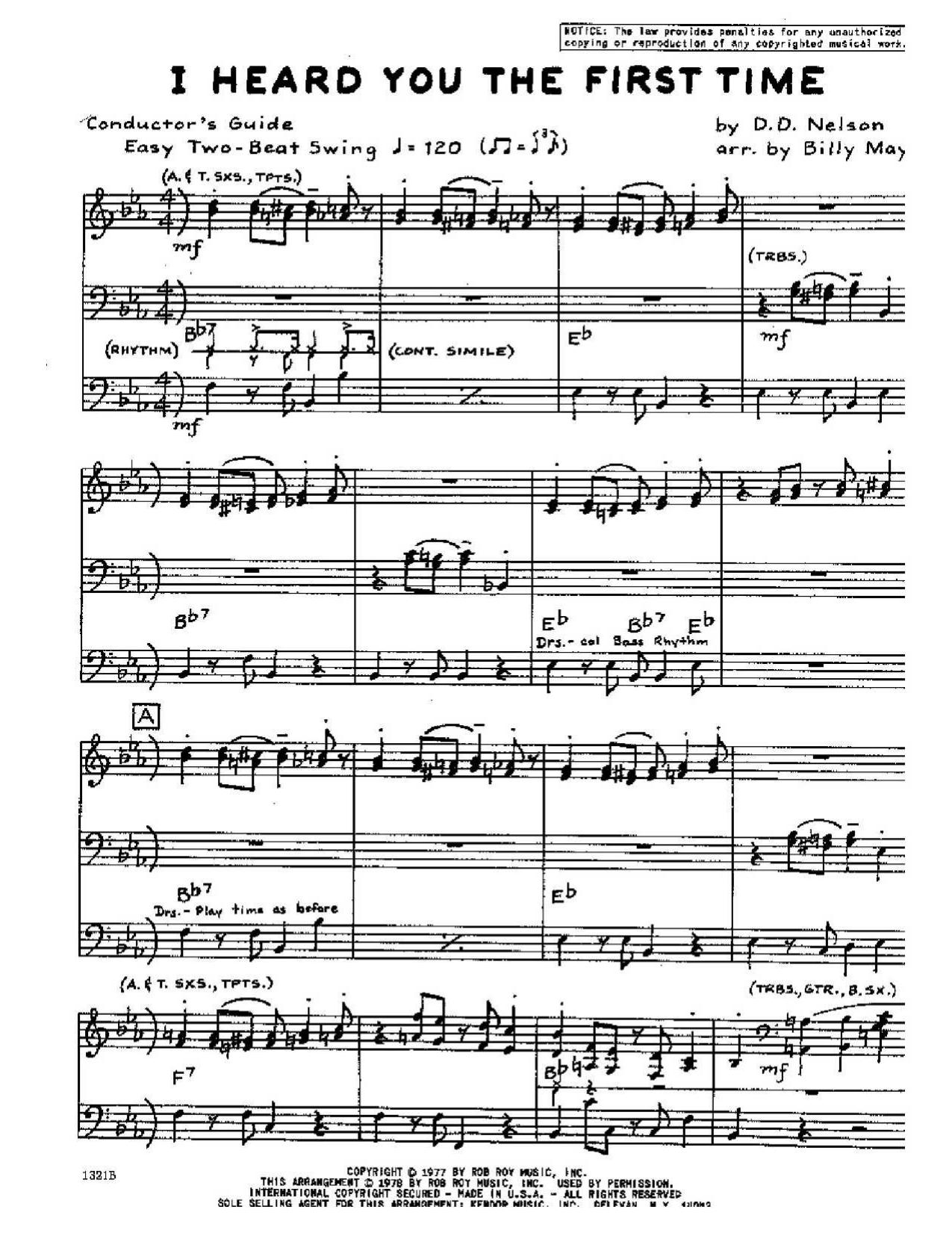
I Heard You The First Time (B.May) sheet music preview

I Heard You The First Time (B.May)

Composed by Billy May

Arranged by Billy May

  • Ensemble: Big Band
  • Pages: 28
  • Instruments (17): 1st Eb Alto Sax, 2nd Eb Alto Sax, 1st Bb Tenor Sax, 2nd Bb Tenor Sax, Eb Baritone Sax, 1st Bb Trumpet, 2nd Bb Trumpet, 3rd Bb Trumpet, 4th Bb Trumpet, 1st Trombone, 2nd Trombone, 3rd Trombone, 4th Trombone, Guitar, Piano, Bass, Drums
  • Difficulty: medium
  • Content: Individual Parts
  • Format: PDF Download (Instant)
  • Price: $24.99

Mid-century American big band jazz reached its most theatrical and swinging zenith through the inimitable pen of Billy May, whose iconic writing style defined the sound of Capitol Records' premier recording sessions in the 1950s. "I Heard You The First Time" captures the swagger, wit, and sheer kinetic drive that made May one of the most sought-after arrangers and orchestrators of the golden age of swing and easy-listening jazz. Written during a period when May was crafting high-energy charts for artists like Frank Sinatra, Nat King Cole, and his own studio orchestras, this composition embodies the buoyant optimism and sophisticated harmonic language of post-war studio jazz. It stands as a brilliant example of mid-century commercial big band writing that treats the ensemble not just as a backing unit, but as a dynamic, wisecracking character in its own right. Driving forward with a infectious, punchy medium-up swing feel in 4/4 time, the chart immediately establishes an atmosphere of playful tension and release. The mood is irrepressibly upbeat, characterized by crisp dynamic contrasts, driving walking basslines, and a brass section that bites into every syncopated figure with authority. May's harmonic palette relies heavily on rich, extended jazz chords—frequently utilizing major sevenths, ninths, and sharp-elevenths—paired with a buoyant rhythmic momentum that evokes the bustling energy of a late-night Hollywood soundstage. The emotional trajectory shifts seamlessly from cheeky, muted counter-melodies to roaring, full-ensemble climaxes that never fail to captivate an audience through sheer rhythmic vitality and sophisticated orchestration. The structural genius of this arrangement lies in Billy May’s signature writing techniques, most notably his famous "scoop" or slurred brass figures and his genius for dense, saxophone-heavy block voicings. The 8-instrument configuration (featuring a tight horn line of Alto Saxophone, Tenor Saxophone, Baritone Saxophone, Trumpet, and Trombone, complemented by rhythm section support) is utilized with maximum economy and punch, sounding vastly larger than the player count implies. The woodwinds frequently carry sparkling, bebop-infused lines that weave around brass stabs, leading into tightly knit soli sections that demand absolute rhythmic precision. Solos are integrated organically into the arrangement, allowing individual players to stretch out over changes that mirror the blues-infused sophistication of the era, while the ensemble functions as a razor-sharp reactive unit behind them. Advanced high school, collegiate, and professional jazz ensembles will find this chart to be an exhilarating centerpiece for a concert program. Because the 8-part instrumentation places individual responsibility squarely on each player—with very little duplication of parts—every musician must possess a strong command of swing articulation, dynamic control, and stylistic phrasing. The technical challenges lie primarily in the stylistic execution of May's unique phrasing markings, demanding that the ensemble breathe and swing as a single organism. Delivering this chart successfully rewards the band with an authentic taste of 1950s studio sophistication, making it an unforgettable experience for both performers and jazz aficionados alike. Conductors approaching "I Heard You The First Time" should establish a confident, driving medium-swing tempo that feels relaxed yet relentlessly propulsive—avoid rushing the quarter note, as the groove relies heavily on the backbeat. Articulation is the single most critical element of this chart; all eighth notes must be performed with traditional swing interpretation, treating upbeats with a buoyant, lifted weight while keeping stenciled notes short and accented. Section leaders must ensure uniform execution of Billy May’s signature brass slurs, falls, and plunger-style accents, which require careful tongue-damping and lip flexibility rather than excessive force. Rehearsals should initially isolate the rhythm section to lock in the foundational groove before layering in the saxophone and brass counter-lines. Pay close attention to dynamic balance during the transitional ensemble passages; the underlying accompaniment must drop away effortlessly to let featured soloists project naturally without straining their acoustic tone. Q: What instruments and parts are included in this arrangement? A: This arrangement is scored for an 8-instrument ensemble, specifically featuring Alto Saxophone, Tenor Saxophone, Baritone Saxophone, Trumpet, and Trombone parts, alongside a complete rhythm section rhythm framework across 28 pages of music. Q: What is the difficulty level of this chart? A: This piece is best suited for advanced high school, collegiate, and professional jazz ensembles due to its exposed 8-part writing, demanding swing articulation requirements, and the need for individual stylistic independence. Q: What is the musical style and historical context of the piece? A: Composed in the mid-20th century style popularized by arranger Billy May, the piece represents the pinnacle of 1950s Hollywood studio jazz, combining swinging big band drive with witty, sophisticated brass and reed orchestration. Q: What makes this specific Billy May arrangement unique? A: It showcases May's signature arranging hallmarks, including inventive brass slurs, dense saxophone voicings, and an economical 8-instrument texture that sounds remarkably full and driving without requiring a full fifteen-piece big band. Q: What is the performance duration and tempo feel of the arrangement? A: The arrangement is set to a buoyant, driving medium-swing tempo in 4/4 time, making it an ideal 3-to-4-minute dynamic anchor or feature spot for a standard jazz concert set.

Questions and answers

What is included in the I Heard You The First Time (B.May) PDF?
The verified current file contains a conductor score and individual parts across 28 pages.
How many instruments or parts are listed for I Heard You The First Time (B.May)?
The verified instrumentation list contains 17 entries for this Big Band arrangement.
Who is credited for I Heard You The First Time (B.May)?
Composer: Billy May. Arranger: Billy May.
What difficulty is listed for I Heard You The First Time (B.May)?
The verified difficulty level is medium.
Can I preview I Heard You The First Time (B.May) before buying?
Yes. The product page provides a preview generated from the current PDF file.
How is I Heard You The First Time (B.May) delivered?
After successful payment, the digital PDF is made available for download. The displayed price is $24.99.

Musicians Also Search For

I Heard You The First Time Billy May PDFI Heard You The First Time Billy May sheet musicI Heard You The First Time arranged by Billy MayBilly May big band chartsBilly May jazz arrangements PDFI Heard You The First Time Billy May big band arrangementsI Heard You The First Time big band arrangementsI Heard You The First Time big band PDF downloadI Heard You The First Time jazz sheet musicbig band sheet music downloadI Heard You The First Time conductor score PDFI Heard You The First Time individual parts downloadI Heard You The First Time sheet music PDFbuy I Heard You The First Time sheet musicdownload I Heard You The First Time PDFI Heard You The First Time jazz chartsbest Billy May big band arrangementsI Heard You The First Time printable sheet musicbig band repertoire PDF

All arrangements by Billy May All Billy May sheet music