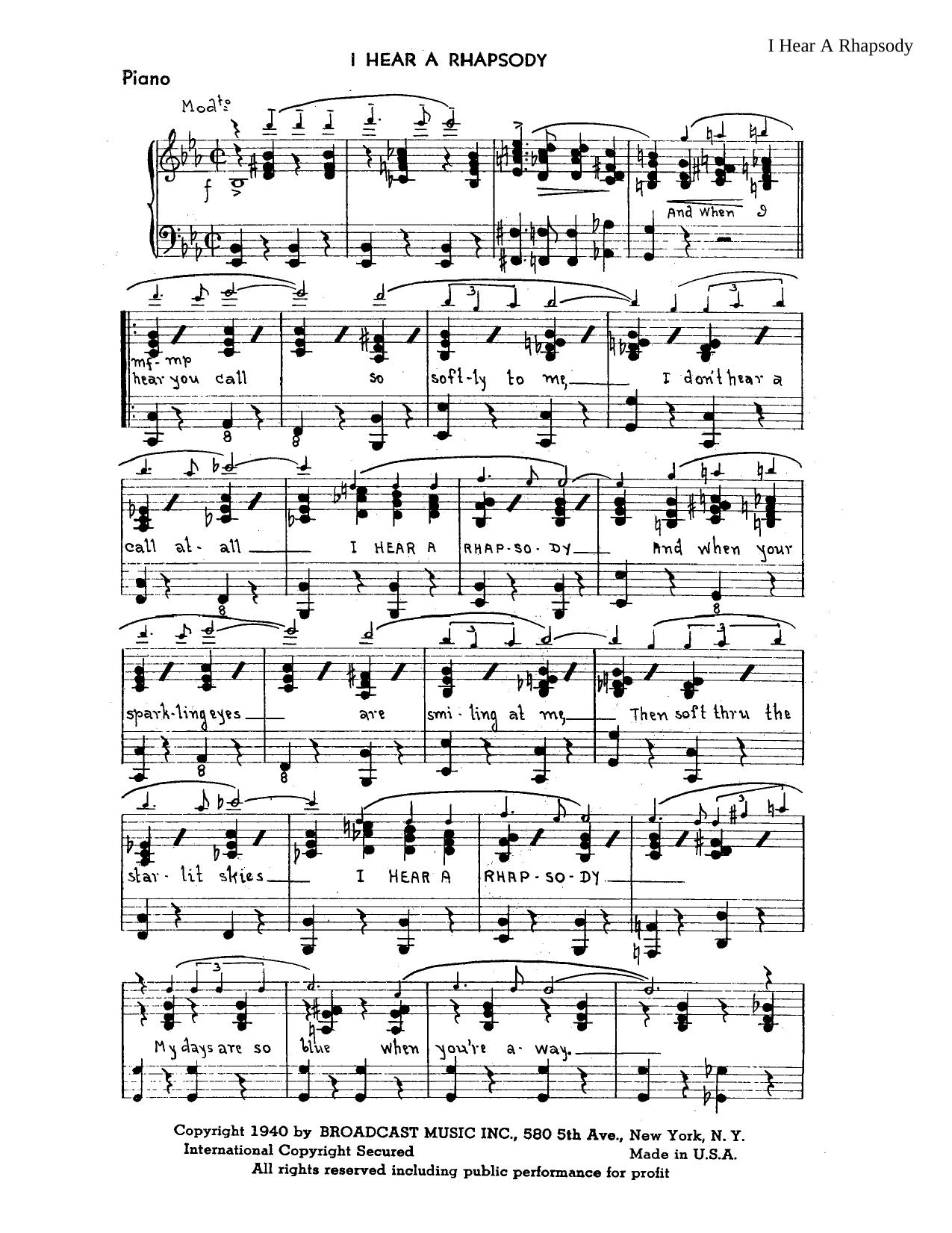
I Hear A Rhapsody (W.Paul) sheet music preview

I Hear A Rhapsody (W.Paul)

Composed by George Fragos

Arranged by W.Paul

  • Ensemble: Big Band
  • Style: Jazz Standard
  • Pages: 28
  • Instruments (16): Piano, 1st Tenor (Vocal), 2nd Tenor (Vocal), Baritone (Vocal), Guitar, 1st Trombone, 2nd Trombone, 1st Saxophone Eb Alto, 2nd Saxophone Bb Tenor, 3rd Saxophone Eb Alto, 4th Saxophone Bb Tenor, 1st Trumpet, 2nd Trumpet in Bb, 3rd Trumpet in Bb, Drums, Bass
  • Difficulty: medium
  • Content: Individual Parts
  • Format: PDF Download (Instant)
  • Price: $24.99

"I Hear A Rhapsody," originally composed by George Fragos, Dick Gasparre, and Jack Baker, emerged during the golden age of American popular song, specifically in 1941. This timeless melody quickly became a beloved jazz standard, embraced by countless vocalists and instrumentalists for its lyrical beauty and harmonic richness. Its enduring popularity stems from its evocative title and the inherent romanticism woven into its melodic lines, making it a staple in the Great American Songbook and a perennial favorite for improvisation. The piece embodies the sophisticated yet accessible aesthetic of the early 1940s, a period when swing music dominated the airwaves and dance halls, and intricate melodies were paired with lush harmonies. W.Paul's arrangement of "I Hear A Rhapsody" for big band transforms this classic into a captivating medium swing experience, set in the key of C major. The arrangement immediately establishes a relaxed, flowing groove, perfect for showcasing the vocal trio. The mood is one of elegant romance and sophisticated nostalgia, evoking the classic big band sound without sacrificing contemporary appeal. The energy builds organically, transitioning from tender vocal passages to robust instrumental sections, maintaining a consistent, engaging pulse throughout. The arrangement is carefully crafted to highlight the interplay between the vocalists and the ensemble, creating a rich tapestry of sound that is both warm and dynamic. W.Paul's distinctive approach to this standard is evident in several key elements. The arrangement features intricate voicings for the vocal trio, providing lush harmonies that complement the original melody. The instrumental sections are characterized by smooth, flowing lines and carefully balanced ensemble writing, ensuring clarity and depth. Expect a signature W.Paul touch in the brass soli sections, which are both challenging and rewarding, showcasing the full power and precision of the ensemble. There are no abrupt modulations, allowing the piece to unfold naturally, building intensity through dynamic shifts and textural changes rather than key changes. The arrangement also includes a beautifully written guitar feature, offering a moment of intimate expression before the full ensemble returns. The melody is primarily carried by the vocal trio, with instrumental sections providing counterpoint and harmonic support. This arrangement features a prominent tenor saxophone solo, offering ample space for improvisation over the classic chord changes. Technical challenges include precise articulation in the brass soli, maintaining a consistent medium swing feel, and achieving a seamless blend within the vocal trio. The rewarding aspects lie in the opportunity to perform a beloved standard with a fresh, sophisticated interpretation, the interplay between the vocalists and the band, and the sheer joy of executing W.Paul's meticulously crafted ensemble passages. This arrangement is particularly well-suited for college and community big bands seeking to expand their repertoire with a classic standard presented in a fresh, engaging manner, as well as professional ensembles looking for a polished, vocal-centric chart. Conductors should emphasize a relaxed, medium swing feel from the outset, ensuring the rhythm section establishes a solid, unhurried groove. The key technical challenge lies in achieving a balanced blend and precise intonation within the vocal trio, which carries significant melodic and harmonic weight; careful rehearsal of these sections is crucial. Brass players should focus on smooth legato lines in the ensemble passages and crisp, unified articulation during the soli sections, paying close attention to dynamics to support the vocalists without overpowering them. The tenor saxophone soloist should be encouraged to embrace the lyrical nature of the piece, crafting a melodic improvisation that complements the arrangement's romantic mood. Rehearsal tips include isolating the vocal trio and brass soli sections for dedicated practice, and then integrating them gradually with the full ensemble to ensure seamless transitions and dynamic control. No special techniques like plunger mutes or falls are explicitly required, allowing the focus to remain on blend, balance, and musicality. Q: What instruments and parts are included in this arrangement? A: This arrangement is scored for a 13-instrument big band, including Piano, Vocal Trio, Guitar, 1st Trombone, 2nd Trombone, and a standard saxophone and trumpet section. Q: What is the difficulty level of "I Hear A Rhapsody (W.Paul)"? A: This arrangement is rated as medium difficulty, suitable for college, advanced community, and professional big bands due to its intricate vocal harmonies, demanding brass soli sections, and the need for a mature understanding of swing feel. Q: What musical style and historical context does this arrangement represent? A: This is a jazz standard arranged in a medium swing style, reflecting the sophisticated and romantic big band sound of the early 1940s, a pivotal era for American popular song and jazz. Q: What makes W.Paul's arrangement of "I Hear A Rhapsody" unique? A: W.Paul's treatment is distinguished by its lush vocal trio voicings, elegant brass soli sections, a featured guitar part, and a focus on a warm, flowing medium swing feel that honors the original while providing a fresh, engaging interpretation. Q: What is the typical performance duration and tempo for this piece? A: The arrangement is designed for a medium swing tempo, typically around 120-130 BPM, resulting in a performance duration of approximately 3 to 4 minutes, depending on the soloist's improvisation length.

Questions and answers

What is included in the I Hear A Rhapsody (W.Paul) PDF?
The verified current file contains individual parts across 28 pages.
How many instruments or parts are listed for I Hear A Rhapsody (W.Paul)?
The verified instrumentation list contains 16 entries for this Big Band arrangement.
Who is credited for I Hear A Rhapsody (W.Paul)?
Composer: George Fragos. Arranger: W.Paul.
What difficulty is listed for I Hear A Rhapsody (W.Paul)?
The verified difficulty level is medium.
What style is listed for I Hear A Rhapsody (W.Paul)?
The catalog lists the style as Jazz Standard.
Can I preview I Hear A Rhapsody (W.Paul) before buying?
Yes. The product page provides a preview generated from the current PDF file.
How is I Hear A Rhapsody (W.Paul) delivered?
After successful payment, the digital PDF is made available for download. The displayed price is $24.99.

Musicians Also Search For

I Hear A Rhapsody W.Paul PDFI Hear A Rhapsody W.Paul sheet musicI Hear A Rhapsody arranged by W.PaulW.Paul big band chartsW.Paul jazz arrangements PDFI Hear A Rhapsody George Fragos sheet musicI Hear A Rhapsody George Fragos big band arrangementsGeorge Fragos big band chartsI Hear A Rhapsody big band arrangementsI Hear A Rhapsody big band PDF downloadI Hear A Rhapsody jazz sheet musicbig band sheet music downloadI Hear A Rhapsody individual parts downloadI Hear A Rhapsody sheet music PDFI Hear A Rhapsody Jazz Standard chartsJazz Standard big band arrangementsbuy I Hear A Rhapsody sheet musicdownload I Hear A Rhapsody PDFI Hear A Rhapsody jazz chartsbest W.Paul big band arrangementsGeorge Fragos arranged by W.PaulI Hear A Rhapsody printable sheet musicbig band repertoire PDF

All arrangements by W.Paul All George Fragos sheet music