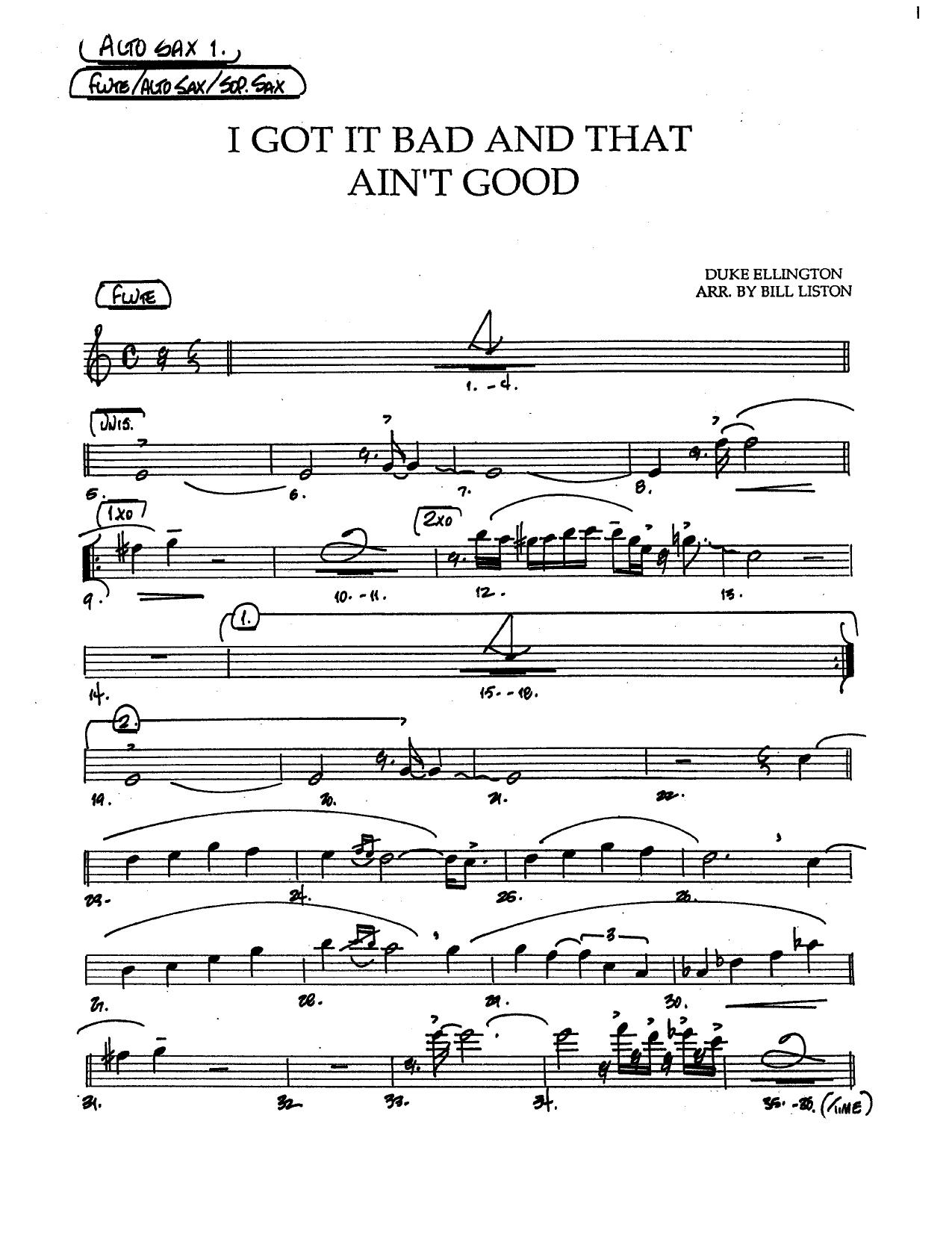
I Got It Bad And That Ain't Good (B.Liston)
Composed by Duke Ellington
Arranged by Bill Liston
- Ensemble: Big Band
- Pages: 51
- Instruments (17): Alto Sax 1 (doubling Flute, Soprano Sax), Alto Sax 2 (doubling Flute), Tenor Sax 1, Tenor Sax 2 (doubling Flute), Baritone Sax (doubling Bass Clarinet), Trumpet 1, Trumpet 2, Trumpet 3, Trumpet 4 (doubling Flugelhorn), Trombone 1, Trombone 2, Trombone 3, Trombone 4, Piano, Bass, Drums, Guitar
- Difficulty: advanced
- Content: Individual Parts
- Format: PDF Download (Instant)
- Price: $24.99
Duke Ellington and Paul Webster’s timeless masterwork, "I Got It Bad (And That Ain't Good)," stands as one of the crown jewels of the American Songbook and a definitive pillar of the classic big band era. Originally introduced in 1941 and famously immortalized by Ivie Anderson with the Duke Ellington Orchestra, this poignant ballad captures the bittersweet ache of unrequited love through sophisticated minor-mode harmony and a deeply blues-infused sensibility. The composition represents the height of Ellington’s collaborative genius with Billy Strayhorn and his compositional focus on tailoring material to the unique tonal personalities of his ensemble members, most notably alto saxophonist Johnny Hodges. Bill Liston’s sophisticated big band interpretation honors the smoky, midnight atmosphere of the original while expanding the palette with lush, contemporary harmonic extensions and rich modern voicings. Set in a smoldering, slow-to-medium groove, the arrangement unfolds with an exquisite blend of Ellingtonian warmth and refined contemporary orchestration. The emotional landscape is heavy yet tender, evoking a late-night club ambiance defined by sultry woodwind textures, sighing suspension-heavy chord structures, and a profound sense of restrained blues tension. Liston utilizes the expanded 20-piece instrumentation to create gorgeous vertical sonorities where brass and saxophones interlock seamlessly, generating a dense, velvety cushion of sound that breathes organically with every phrase. The melody is primarily introduced by the lead alto saxophone—utilizing doubling on soprano saxophone and flute across the expanded reed section to create shimmering, modern timbral colors that nod to Hodges' historic association with the tune. Featured solo space allows a mature soloist to stretch out over sophisticated changes that invite deep emotional expression and melodic phrasing. Technical demands center less on raw velocity and much more on blend, intonation, ultra-slow ballad sub-division, and dynamic control. The brass section must master subtle color changes, utilizing warm, open tones contrasted with delicate muted passages, while the rhythm section anchors the piece with an unhurried, laying-back-in-the-pocket feel that maintains forward momentum without rushing the tempo. Advanced high school ensembles with strong section leaders, collegiate jazz orchestras, and professional big bands will find this chart to be a masterclass in ensemble balance and stylistic maturity. While the technical note-reading is accessible, the interpretive maturity required to pull off the subtle rubato-like elasticity within a strict time feel makes it a rewarding centerpiece for festival performances or sophisticated concert sets. Liston’s masterful pacing guides the ensemble through gorgeous harmonic swells and hushed, intimate interludes, ensuring that both performers and audiences remain utterly captivated from the first downbeat to the final lingering chord. Conductors approaching Bill Liston’s arrangement of "I Got It Bad" must prioritize blend, balance, and microscopic control over dynamic extremes. The primary technical challenge lies in maintaining a luxurious, fat sound at very soft dynamics (mezzo-piano to pianissimo), particularly in the saxophones and muted brass. The tempo should feel languid and blues-soaked; avoid dragging by ensuring the rhythm section maintains an internal, pulsing subdivision, especially during the sparse accompaniment figures. Saxophone doublings (alto to soprano and flute) require meticulous attention to intonation and immediate acoustic adjustment upon switching instruments. Brass players should employ warm, velvety plunger or cup mutes where indicated, ensuring that muted lines project without pinching the tone quality. Rehearsal should begin by isolating the chordal voicings in the saxophones and brass chorir separately to lock in the complex harmonic upper structures before integrating the rhythm section. Emphasize the natural rise and fall of the phrasing, treating each melodic line as a vocal narrative. Q: What instruments and parts are included in this 20-instrument arrangement? A: The instrumentation features a 20-piece expanded lineup including Alto Saxophone 1 (with Flute and Soprano Saxophone doubles), Alto Saxophone 2, Tenor Saxophone 1, and full standard big band sections with expanded woodwind and brass capabilities. Q: What is the difficulty level of this chart? A: This arrangement is graded as advanced, best suited for collegiate jazz orchestras, professional big bands, and high school ensembles with exceptionally mature section players and an advanced lead alto. Q: What is the historical context and musical style of this piece? A: Based on Duke Ellington’s 1941 classic standard, this arrangement retains the smoky, blues-inflected ballad style of the big band era while incorporating modern harmonic coloration and rich contemporary voicing techniques by arranger Bill Liston. Q: What makes Bill Liston’s arrangement unique compared to the original? A: While staying true to the emotional core of the Ellington/Ivie Anderson original, Liston introduces contemporary harmonic extensions, unique woodwind doubling options across the reed section, and lush vertical voicings that expand the sonic possibilities of a 20-piece ensemble. Q: What is the suggested tempo and performance duration? A: The piece is set in a slow-to-medium, smoldering ballad swing feel, typically clocking in around a performance duration of 4 to 5 minutes depending on the length of the featured improvised solo.
Questions and answers
- What is included in the I Got It Bad And That Ain't Good (B.Liston) PDF?
- The verified current file contains individual parts across 51 pages.
- How many instruments or parts are listed for I Got It Bad And That Ain't Good (B.Liston)?
- The verified instrumentation list contains 17 entries for this Big Band arrangement.
- Who is credited for I Got It Bad And That Ain't Good (B.Liston)?
- Composer: Duke Ellington. Arranger: Bill Liston.
- What difficulty is listed for I Got It Bad And That Ain't Good (B.Liston)?
- The verified difficulty level is advanced.
- Can I preview I Got It Bad And That Ain't Good (B.Liston) before buying?
- Yes. The product page provides a preview generated from the current PDF file.
- How is I Got It Bad And That Ain't Good (B.Liston) delivered?
- After successful payment, the digital PDF is made available for download. The displayed price is $24.99.
Musicians Also Search For
I Got It Bad And That Ain't Good Bill Liston PDF • I Got It Bad And That Ain't Good Bill Liston sheet music • I Got It Bad And That Ain't Good arranged by Bill Liston • Bill Liston big band charts • Bill Liston jazz arrangements PDF • I Got It Bad And That Ain't Good Duke Ellington sheet music • I Got It Bad And That Ain't Good Duke Ellington big band arrangements • Duke Ellington big band charts • I Got It Bad And That Ain't Good big band arrangements • I Got It Bad And That Ain't Good big band PDF download • I Got It Bad And That Ain't Good jazz sheet music • big band sheet music download • I Got It Bad And That Ain't Good individual parts download • I Got It Bad And That Ain't Good sheet music PDF • buy I Got It Bad And That Ain't Good sheet music • download I Got It Bad And That Ain't Good PDF • I Got It Bad And That Ain't Good jazz charts • best Bill Liston big band arrangements • Duke Ellington arranged by Bill Liston • I Got It Bad And That Ain't Good printable sheet music • big band repertoire PDF