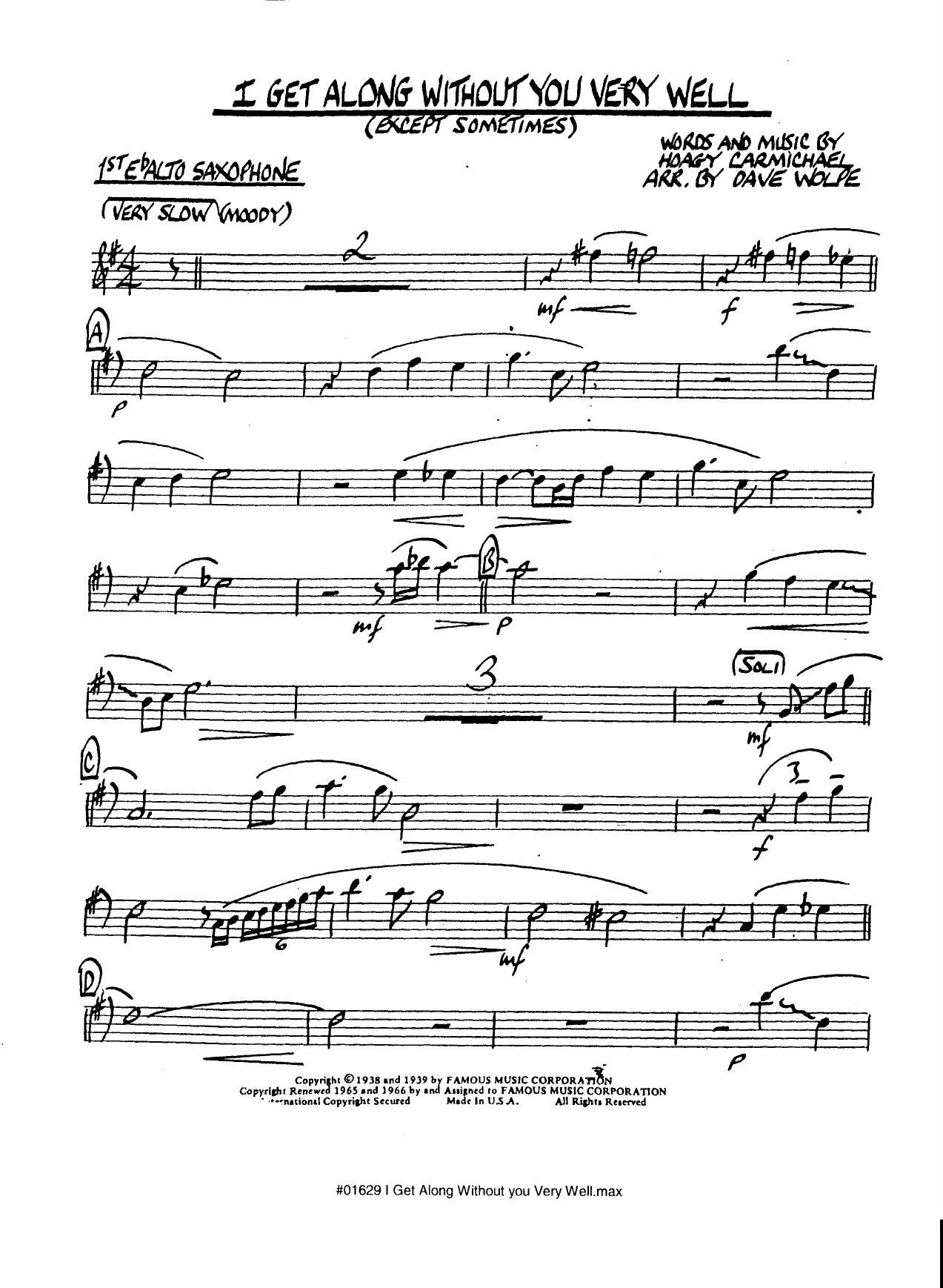
I Get Along Without You Very Well (D.Wolpe) sheet music preview

I Get Along Without You Very Well (D.Wolpe)

Composed by Frank Loesser

Arranged by Dave Wolpe

  • Ensemble: Big Band
  • Pages: 35
  • Instruments (17): 1st Eb Alto Saxophone, 2nd Eb Alto Saxophone, 1st Bb Tenor Saxophone, 2nd Bb Tenor Saxophone, Eb Baritone Saxophone, Solo Bb Trumpet, 1st Bb Trumpet, 2nd Bb Trumpet, 3rd Bb Trumpet, 1st Trombone, 2nd Trombone, 3rd Trombone, Bass Trombone, Piano, Guitar, Bass, Drums
  • Difficulty: medium
  • Content: Individual Parts
  • Format: PDF Download (Instant)
  • Price: $24.99

Written by Hoagy Carmichael and first published in 1938 with lyrics attributed to Jane Brown Thompson (though famously associated with a clever radio hoax involving Walter Winchell and Frank Loesser), "I Get Along Without You Very Well" stands as one of the most poignant torch ballads in the Great American Songbook. This timeless standard captures the bittersweet agony of heartbreak and forced resilience, embodying the sophisticated harmonic language of the late 1930s pop and jazz landscape. Over the decades, it has been interpreted by vocal and instrumental jazz legends alike, transitioning seamlessly from a smoky cabaret lament into a vehicle for expressive, expansive jazz ensemble writing. Dave Wolpe’s masterful big band adaptation reimagines this classic standard as a lush, expressive ballad centered around a relaxed, flowing 12/8 or slow 4/4 swing feel. The arrangement radiates an atmosphere of introspective melancholy, utilizing rich, extended chord voicings in the brass and subtle textural shifts to evoke a late-night, cinematic mood. Wolpe masterfully exploits the dynamic range of the full 16-piece big band, contrasting fragile, exposed woodwind textures with warm, swelling brass chorales that capture the profound emotional weight of Carmichael’s original melody. Known for his idiomatic, player-friendly writing that bridges traditional swing with contemporary big band accessibility, Wolpe constructs this chart with meticulous attention to color and balance. The arrangement opens with a tender, harmonically rich introduction that immediately establishes the reflective mood, before handing the primary melody over to the lead alto saxophone and muted brass. A tasteful, featuring solo space allows a soloist—ideally on tenor saxophone or flugelhorn—to improvise over lush, changing backgrounds that never overpower the lead voice. The chart avoids aggressive shout choruses in favor of a soaring, emotional climax that showcases the ensemble's collective tone control, intonation, and phrasing sensitivity. Advanced high school ensembles, collegiate jazz orchestras, and professional community big bands will find this arrangement an exceptional vehicle for developing ballad-playing maturity. While the individual technical demands on range and rhythm are moderate, the true challenge lies in the stylistic nuances: maintaining a steady, unhurried pulse, achieving seamless blend across sections, and infusing every phrase with genuine lyrical expression. It serves as an ideal centerpiece for a concert program seeking to balance high-energy burners with profound, emotionally resonant storytelling. Mastering this Dave Wolpe arrangement requires acute attention to breath support, intonation, and subtle dynamic shading. Conductor and band alike must approach the tempo with a patient, unhurried pulse, ensuring that the ballad feel never drags nor rushes. The primary technical challenge rests in the long, sustained phrases; horn players must practice circular breathing or staggered breathing where appropriate to maintain a continuous, seamless tone without breaking the melodic line. Saxophones should focus on a warm, sub-tone sound, particularly in the lower registers, while the brass section must keep their muted passages rich and centered, avoiding any pinched or bright timbre. Balance is paramount during the background figures behind the featured soloist; accompanists should dynamically drop to a whispering piano or mezzo-piano to keep the soloist front and center. Rehearsals should initially be conducted without meter constraints, focusing purely on chordal balance and unified phrasing, before locking in the subtle rubato-like elasticity that makes this chart resonate deeply with an audience. Q: What instruments and parts are included in this big band arrangement? A: This chart is scored for a standard 16-piece big band instrumentation, featuring Alto Saxophone 1 & 2, Tenor Saxophone 1 & 2, Baritone Saxophone, 4 Trumpets, 4 Trombones, and a standard four-piece rhythm section consisting of piano, bass, drums, and guitar. Q: What is the difficulty level of this Dave Wolpe arrangement? A: It is graded as medium difficulty, making it well-suited for advanced high school, collegiate, and community jazz ensembles looking to develop mature ballad-playing skills and sectional blend. Q: What is the musical style and historical context of this piece? A: Originally penned in 1938 by Hoagy Carmichael, this arrangement translates the iconic torch ballad into a lush, expressive slow swing/ballad format that honors the tradition of the golden era of big bands. Q: What makes this specific arrangement by Dave Wolpe unique? A: Wolpe avoids heavy-handed shout choruses, instead utilizing sophisticated harmonic voicings, delicate woodwind-brass interplay, and an emotionally soaring dynamic arc to highlight the poignant narrative of the melody. Q: What is the approximate performance duration and tempo guidance? A: The arrangement runs approximately 4 to 5 minutes in duration and is performed at a relaxed, unhurried ballad tempo with a flowing, expressive 4/4 or 12/8 feel.

Questions and answers

What is included in the I Get Along Without You Very Well (D.Wolpe) PDF?
The verified current file contains individual parts across 35 pages.
How many instruments or parts are listed for I Get Along Without You Very Well (D.Wolpe)?
The verified instrumentation list contains 17 entries for this Big Band arrangement.
Who is credited for I Get Along Without You Very Well (D.Wolpe)?
Composer: Frank Loesser. Arranger: Dave Wolpe.
What difficulty is listed for I Get Along Without You Very Well (D.Wolpe)?
The verified difficulty level is medium.
Can I preview I Get Along Without You Very Well (D.Wolpe) before buying?
Yes. The product page provides a preview generated from the current PDF file.
How is I Get Along Without You Very Well (D.Wolpe) delivered?
After successful payment, the digital PDF is made available for download. The displayed price is $24.99.

Musicians Also Search For

I Get Along Without You Very Well Dave Wolpe PDFI Get Along Without You Very Well Dave Wolpe sheet musicI Get Along Without You Very Well arranged by Dave WolpeDave Wolpe big band chartsDave Wolpe jazz arrangements PDFI Get Along Without You Very Well Frank Loesser sheet musicI Get Along Without You Very Well Frank Loesser big band arrangementsFrank Loesser big band chartsI Get Along Without You Very Well big band arrangementsI Get Along Without You Very Well big band PDF downloadI Get Along Without You Very Well jazz sheet musicbig band sheet music downloadI Get Along Without You Very Well individual parts downloadI Get Along Without You Very Well sheet music PDFbuy I Get Along Without You Very Well sheet musicdownload I Get Along Without You Very Well PDFI Get Along Without You Very Well jazz chartsbest Dave Wolpe big band arrangementsFrank Loesser arranged by Dave WolpeI Get Along Without You Very Well printable sheet musicbig band repertoire PDF

All arrangements by Dave Wolpe All Frank Loesser sheet music