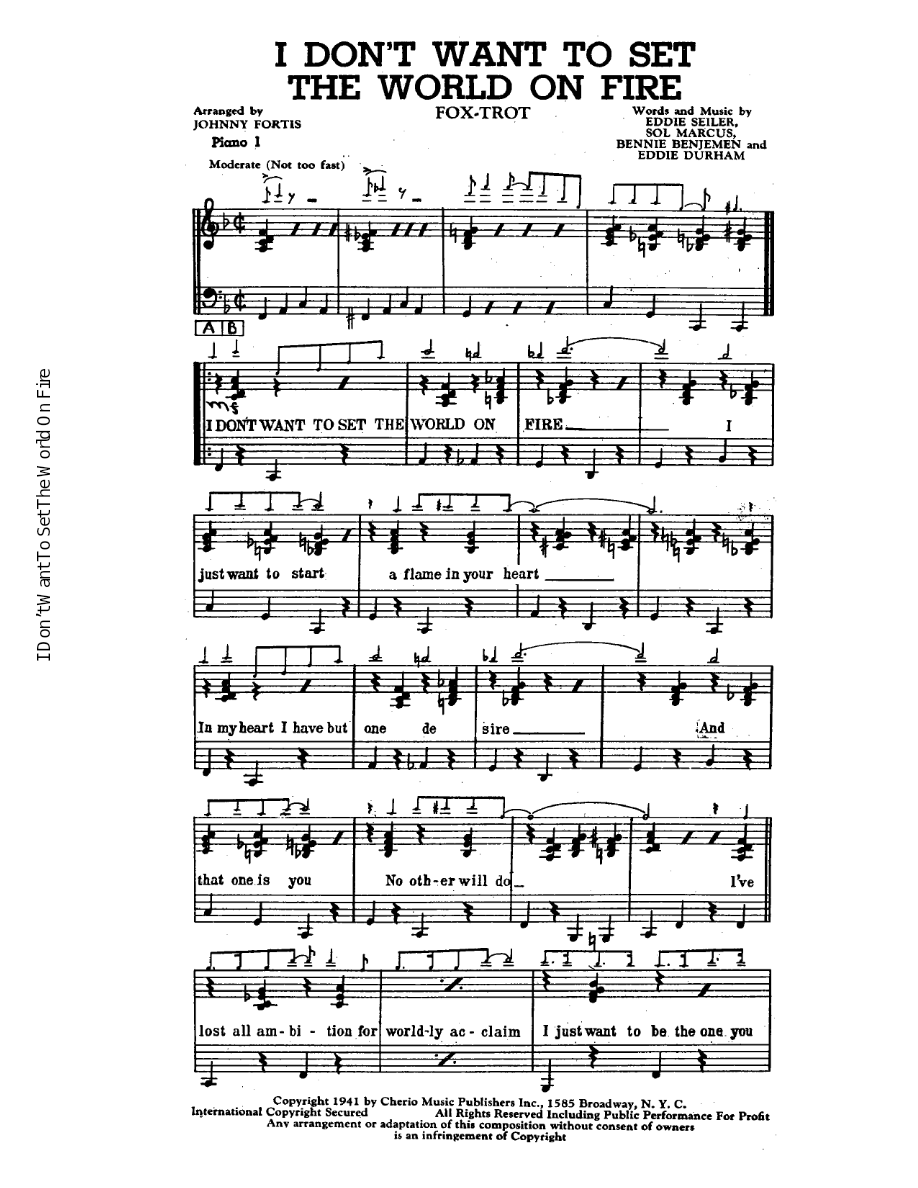
I Don't Want To Set The World On Fire (J.Fortis)
Composed by Eddie Seiler, Sol Marcus, Bennie Benjamin, George Weiss
Arranged by J. Fortis
- Ensemble: Big Band
- Style: Foxtrot
- Pages: 24
- Instruments (13): Piano, Guitar, Bass, Drum Set, 3rd Alto Saxophone, 2nd Tenor Saxophone, 1st Alto Saxophone, 2nd Trombone, 1st Trombone, 3rd Trumpet, 1st Trumpet, 2nd Trumpet, 4th Tenor Saxophone
- Difficulty: medium
- Content: Individual Parts
- Format: PDF Download (Instant)
- Price: $24.99
First popularized by The Ink Spots in 1941, "I Don't Want To Set The World On Fire" emerged as a poignant ballad during the tumultuous pre-World War II era. Its melancholic melody and romantic lyrics resonated deeply with audiences, capturing a sense of longing and devotion amidst global uncertainty. While not strictly a jazz standard in the improvisational sense, its enduring popularity and evocative melody have made it a beloved classic, frequently reinterpreted across various genres and famously featured in period-setting media. This J. Fortis arrangement reimagines the song's timeless appeal within the vibrant, full-bodied sound of a classic big band foxtrot, transporting listeners to an era of sophisticated dance halls and lush orchestral arrangements. J. Fortis's treatment of this iconic tune is a masterclass in blending nostalgic charm with contemporary big band sensibilities. Set in a comfortable medium foxtrot tempo, the arrangement maintains the original's tender emotional core while infusing it with a gentle, swaying rhythm in 4/4 time. The primary key of F Major is employed, offering a bright yet warm sound palette. Fortis's signature approach is evident in the rich, carefully crafted voicings, particularly in the saxophone section, which delivers the initial melody with a smooth, blended legato that evokes the original's vocal harmonies. The arrangement avoids overly complex rhythmic figures, focusing instead on melodic clarity and harmonic richness, making it accessible while still offering substantial musical depth. The arrangement unfolds with a captivating narrative arc. The melody is initially presented by the saxophone section, establishing the song's familiar theme with warmth and precision. This is followed by a beautifully orchestrated brass soli, showcasing Fortis's ability to create intricate yet flowing lines within the ensemble. A featured solo for Tenor Saxophone 1 provides an opportunity for expressive improvisation over a lush harmonic backdrop, allowing the soloist to interpret the song's romantic essence. The arrangement builds to a classic big band shout chorus, where the full ensemble articulates powerful, harmonized figures, culminating in a satisfying, full-band statement before returning to a more subdued, reflective closing. Technical challenges include maintaining precise ensemble balance, particularly in the dense brass voicings, and achieving a unified legato feel across all sections. The reward lies in performing a piece that is both historically resonant and musically gratifying, offering a band the chance to explore nuanced dynamics and rich tonal colors. This arrangement is ideally suited for college-level jazz ensembles, advanced community bands, and professional big bands seeking a sophisticated yet accessible foxtrot. Its blend of melodic beauty, harmonic interest, and classic big band orchestration provides an excellent vehicle for developing ensemble blend, dynamic control, and stylistic authenticity. While high school bands with strong lead players and a solid understanding of big band phrasing could tackle it, the nuanced voicings and sustained legato lines will truly shine with more experienced musicians who can bring out the arrangement's inherent elegance and emotional depth. Conductors should emphasize a consistent, relaxed medium foxtrot feel, avoiding any tendency to rush or drag. The tempo should be steady, around quarter note = 120-128 BPM, maintaining a smooth, connected pulse. Pay close attention to dynamic contrasts; the arrangement features several swells and diminuendos that are crucial for conveying its romantic character. The saxophone section's initial melody requires a unified legato articulation and precise intonation, especially in the inner voices. Brass players should focus on warm, sustained tones in the soli sections, ensuring clean attacks and releases. The Tenor Saxophone 1 solo should be played with lyrical phrasing and a warm tone, allowing for expressive interpretation. Ensure the rhythm section lays down a solid, unwavering foundation, with the bass providing a clear walking line and the drums offering a tasteful, understated brush or stick pattern that supports the foxtrot feel without overpowering the ensemble. Q: What instruments and parts are included in this arrangement? A: This big band arrangement is scored for 17 instruments: Alto Saxophone 1 & 2, Tenor Saxophone 1 & 2, Baritone Saxophone, Trumpet 1-4, Trombone 1-4, Piano, Guitar, Bass, and Drums. Q: What is the difficulty level of "I Don't Want To Set The World On Fire (J. Fortis)"? A: This arrangement is rated as Medium-Advanced. It is suitable for college-level jazz ensembles, advanced community big bands, and professional groups, requiring solid ensemble playing, good intonation, and expressive interpretation. Q: What musical style and historical context does this arrangement represent? A: This arrangement is a classic big band foxtrot, reimagining a popular ballad from 1941, famously recorded by The Ink Spots. It evokes the sophisticated dance hall sounds of the early 1940s. Q: What makes J. Fortis's arrangement of this piece unique? A: Fortis's treatment is distinctive for its lush, carefully crafted voicings, particularly in the saxophone and brass soli sections, and its ability to maintain the original song's romantic essence within a swinging big band context, featuring a lyrical tenor solo and a powerful shout chorus. Q: What is the approximate performance duration and recommended tempo for this piece? A: The approximate performance duration is 3:00-3:30 minutes. The recommended tempo is a medium foxtrot, around quarter note = 120-128 BPM, with a smooth, connected feel.
Musicians Also Search For
I Don't Want To Set The World On Fire J. Fortis PDF • I Don't Want To Set The World On Fire J. Fortis sheet music • I Don't Want To Set The World On Fire arranged by J. Fortis • J. Fortis big band charts • J. Fortis jazz arrangements PDF • I Don't Want To Set The World On Fire Eddie Seiler, Sol Marcus, Bennie Benjamin, George Weiss sheet music • I Don't Want To Set The World On Fire Eddie Seiler, Sol Marcus, Bennie Benjamin, George Weiss big band arrangement • Eddie Seiler, Sol Marcus, Bennie Benjamin, George Weiss big band charts • I Don't Want To Set The World On Fire big band arrangement • I Don't Want To Set The World On Fire big band PDF download • I Don't Want To Set The World On Fire jazz ensemble sheet music • big band sheet music instant download • I Don't Want To Set The World On Fire individual parts download • I Don't Want To Set The World On Fire sheet music with parts • I Don't Want To Set The World On Fire Foxtrot chart • Foxtrot big band arrangements • buy I Don't Want To Set The World On Fire sheet music online • download I Don't Want To Set The World On Fire PDF • I Don't Want To Set The World On Fire jazz chart • best J. Fortis big band arrangements • Eddie Seiler, Sol Marcus, Bennie Benjamin, George Weiss songs arranged by J. Fortis • I Don't Want To Set The World On Fire printable sheet music • big band repertoire PDF