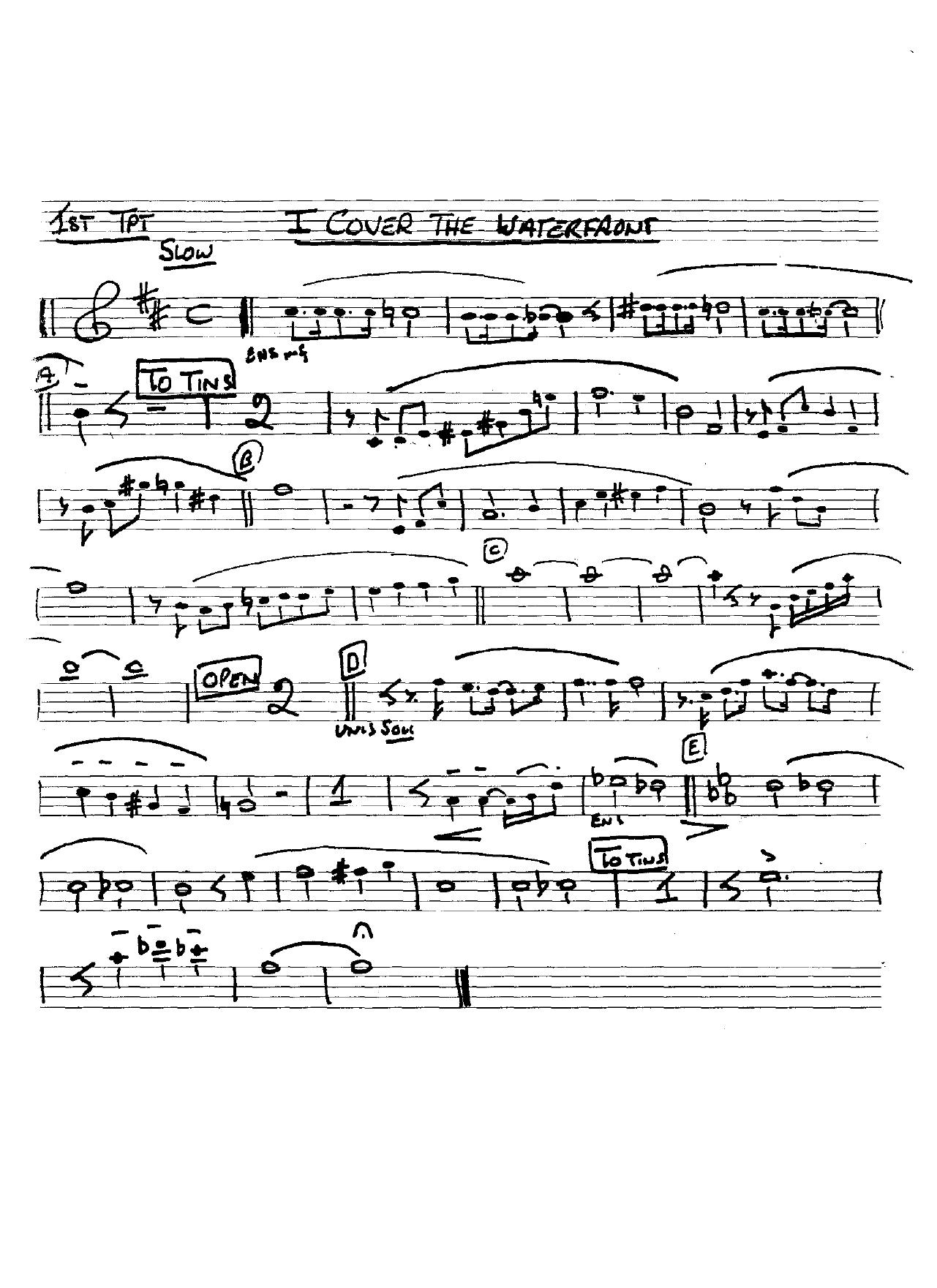
I Cover The Waterfront (J.Farley)
Composed by Johnny Green
Arranged by John Farley
- Ensemble: Big Band
- Pages: 18
- Instruments (17): 1st Trumpet, 2nd Trumpet, 3rd Trumpet, 4th Trumpet, 1st Trombone, 2nd Trombone, 3rd Trombone, 4th Trombone, 1st Alto Saxophone, 2nd Alto Saxophone, 1st Tenor Saxophone, 2nd Tenor Saxophone, Baritone Saxophone, Double Bass, Drums, Piano, Guitar
- Difficulty: easy
- Content: Individual Parts
- Format: PDF Download (Instant)
- Price: $24.99
Written by Johnny Green with lyrics by Edward Heyman, "I Cover the Waterfront" emerged in 1933 as a poignant musical response to Max Miller’s bestselling novel of the same name. Quickly embraced by the luminaries of the early swing era—most notably through landmark recordings by Louis Armstrong, Billie Holiday, and Art Tatum—the composition evolved into a quintessential torch ballad and an indispensable vehicle for jazz improvisation. Its timeless appeal lies in its melancholic, yearning melody and sophisticated harmonic architecture, which naturally invites rich, expressive reharmonization while retaining an underlying blues-infused bluescape. John Farley’s masterwork for standard big band transforms this classic standard into a deeply atmospheric, late-night ballad featuring a smoldering, rubato-leaning medium-slow swing feel (approx. quarter note = 68-72 BPM). The arrangement opens with a haunting, ambient muted-brass introduction before settling into a lush, spacious groove driven by a subtle ride-cymbal pulse and walking bassline. Farley utilizes dense, modern-traditional voicings in the saxophone and trombone sections to evoke the classic Capitol-era Nelson Riddle aesthetic, juxtaposing warm, stacked fourths with biting, sophisticated upper extensions. The emotional arc transitions from quiet introspection to a powerful, emotionally charged shout chorus that swells dynamically before receding into a delicate, whispering coda. Throughout the chart, melodic duties are shared thoughtfully between a featured trumpet or alto saxophone soloist and rich ensemble solis that showcase section blend and intonation. The primary technical challenges do not stem from breakneck velocity, but rather from the rigorous demands of sustained breath control, precise intonation within tight chord clusters, and the delicate art of rubato phrasing over strict time. Performers must navigate subtle dynamic shifts and lush harmonic movement, making it an exquisite showcase for expressive musicianship. The arrangement includes an open solo section over the standard AABA form, allowing a featured instrumentalist to stretch out lyrically against a shifting backdrop of rich background figures. Advanced high school ensembles, collegiate jazz orchestras, and professional community big bands will find this arrangement an ideal centerpiece for formal concert programs, festivals, or sophisticated club settings. Because it demands high levels of maturity, dynamic control, and ensemble listening rather than sheer technical virtuosity, it serves as an exceptional pedagogical tool for developing a band’s collective concept of time, balance, and emotional resonance. Conductors should approach John Farley’s arrangement of "I Cover the Waterfront" with a focus on deep stylistic cohesion and textural balance. The tempo must remain fluid yet grounded; resist the temptation to drag, ensuring the underlying subdivision drives the slow swing feel forward even during rubato-esque passages. The primary technical hurdle lies in the sustained, exposed horn writing in the opening and closing sections, which requires immaculate breath support, pristine intonation, and seamless blend across all four trumpet and four trombone parts. Brass players should utilize cup or harmon mutes where indicated to achieve the desired nocturnal timbre, ensuring that muted lines never pinch the pitch. Rehearsals should initially isolate the chordal voicings in the saxophones and trombones to lock in the rich upper extensions before adding the rhythm section. Emphasize dynamic contrast: the transition from the subdued, intimate opening to the soaring climactic shout chorus must feel organic and earned, requiring the ensemble to reserve their maximum dynamic ceiling until the peak of the chart. Q: What instruments and parts are included in the 18-page score and parts set? A: The arrangement is scored for a standard 17-instrument big band, consisting of 4 trumpets, 4 trombones (3 tenors, 1 bass), 5 saxophones (2 altos, 2 tenors, 1 baritone), and a full four-piece rhythm section (piano, bass, drums, and optional guitar), distributed across 18 comprehensive pages. Q: What is the designated difficulty level of this big band arrangement? A: This chart is pitched at an advanced-intermediate to advanced level (Grade 4/5), making it exceptionally well-suited for accomplished high school jazz ensembles, collegiate bands, and professional community big bands seeking a sophisticated ballad. Q: What is the historical style and mood of this specific arrangement? A: The chart captures the quintessential mood of a late-night torch ballad, blending the classic 1933 Johnny Green Tin Pan Alley aesthetic with modern, lush voicings reminiscent of the classic Capitol swing era. Q: What makes John Farley’s treatment of this standard unique? A: Farley’s arrangement stands out through its masterclass use of atmospheric, dense harmonic voicings, an evocative interplay between muted brass and rich sax solis, and a carefully paced emotional arc that builds from intimate chamber-like textures to a soaring, dramatic shout chorus. Q: What is the performance duration and recommended tempo for this piece? A: The performance duration is approximately 4 to 5 minutes, depending on the length allotted for the open solo section, and is anchored by a relaxed, expressive medium-slow swing tempo around 68-72 BPM.
Questions and answers
- What is included in the I Cover The Waterfront (J.Farley) PDF?
- The verified current file contains individual parts across 18 pages.
- How many instruments or parts are listed for I Cover The Waterfront (J.Farley)?
- The verified instrumentation list contains 17 entries for this Big Band arrangement.
- Who is credited for I Cover The Waterfront (J.Farley)?
- Composer: Johnny Green. Arranger: John Farley.
- What difficulty is listed for I Cover The Waterfront (J.Farley)?
- The verified difficulty level is easy.
- Can I preview I Cover The Waterfront (J.Farley) before buying?
- Yes. The product page provides a preview generated from the current PDF file.
- How is I Cover The Waterfront (J.Farley) delivered?
- After successful payment, the digital PDF is made available for download. The displayed price is $24.99.
Musicians Also Search For
I Cover The Waterfront John Farley PDF • I Cover The Waterfront John Farley sheet music • I Cover The Waterfront arranged by John Farley • John Farley big band charts • John Farley jazz arrangements PDF • I Cover The Waterfront Johnny Green sheet music • I Cover The Waterfront Johnny Green big band arrangements • Johnny Green big band charts • I Cover The Waterfront big band arrangements • I Cover The Waterfront big band PDF download • I Cover The Waterfront jazz sheet music • big band sheet music download • I Cover The Waterfront individual parts download • I Cover The Waterfront sheet music PDF • buy I Cover The Waterfront sheet music • download I Cover The Waterfront PDF • I Cover The Waterfront jazz charts • best John Farley big band arrangements • Johnny Green arranged by John Farley • I Cover The Waterfront printable sheet music • big band repertoire PDF