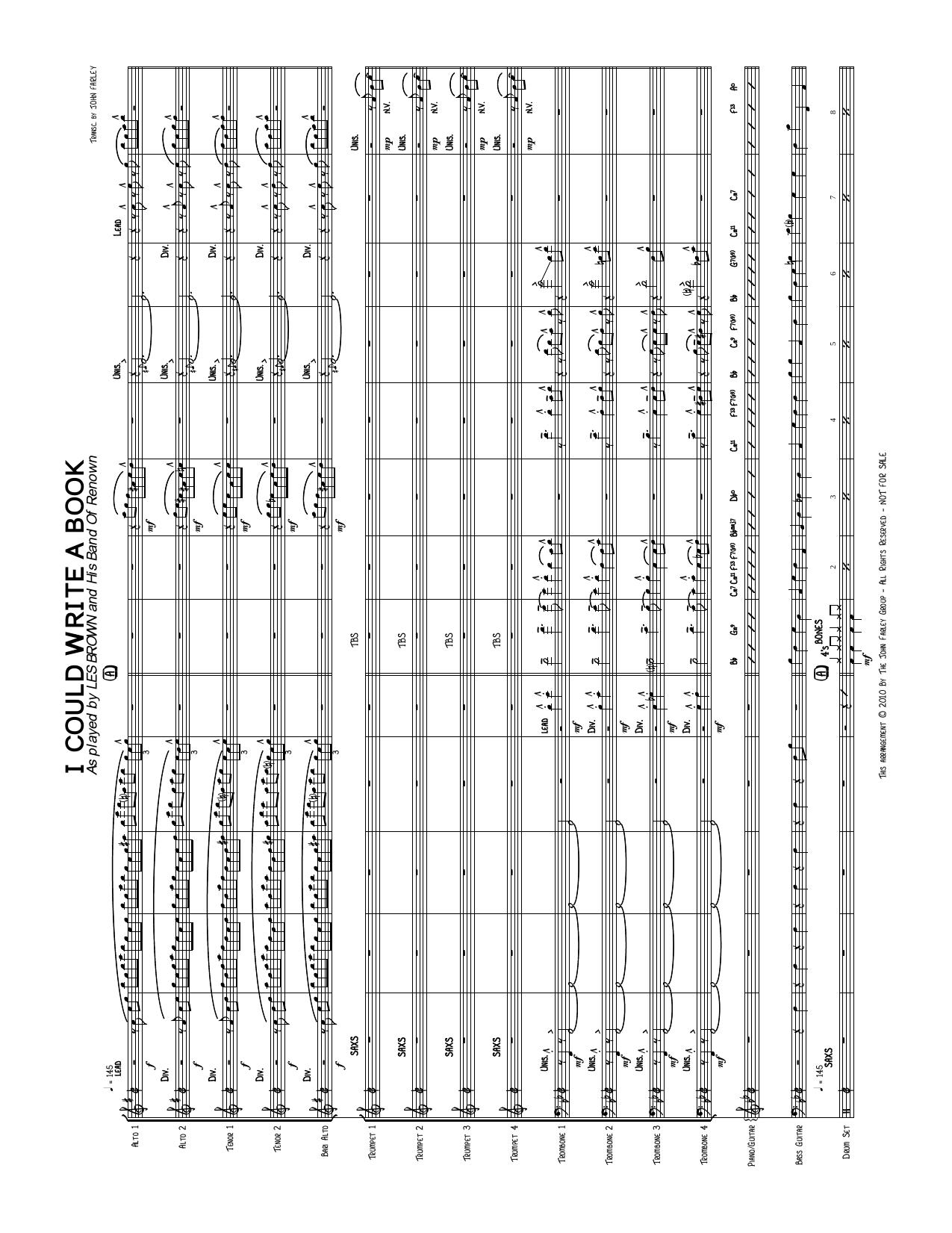
I Could Write A Book (J.Farley)
Composed by Richard Rodgers
Arranged by John Farley
- Ensemble: Big Band
- Pages: 45
- Instruments (16): Alto Saxophone 1, Alto Saxophone 2, Tenor Saxophone 1, Tenor Saxophone 2, Baritone Saxophone, Trumpet 1, Trumpet 2, Trumpet 3, Trumpet 4, Trombone 1, Trombone 2, Trombone 3, Trombone 4, Piano/Guitar, Bass Guitar, Drum Set
- Difficulty: medium
- Content: Individual Parts
- Format: PDF Download (Instant)
- Price: $24.99
Rodgers and Hart’s timeless masterpiece "I Could Write A Book," introduced to the world in the 1940 Broadway musical *Pal Joey* and later immortalized by Miles Davis on his classic 1956 Prestige album *Cookin’ with the Miles Davis Quintet*, remains one of the most sophisticated vehicles in the Great American Songbook. Richard Rodgers' characteristically graceful, symmetrical melody paired with Lorenz Hart’s witty, conversational lyric provides an ideal framework for jazz interpretation. Over decades, it has transitioned from a Broadway showtune into an essential jazz standard, revered by improvisers for its deceptively simple harmonic progression that invites both lyrical exploration and harmonic reharmonization. John Farley’s masterful big band adaptation reimagines the standard as a sophisticated, medium-swing groover that balances traditional big band warmth with contemporary harmonic color. The arrangement opens with an atmospheric, rubato preamble before settling into a crisp, infectious pocket driven by the rhythm section. Farley’s chart is characterized by lush, impressionistic reed voicings, subtle chromatic inner-line movements, and a sophisticated use of open-horn counterpoint. The mood shifts effortlessly from intimate, smoky ballad-esque textures during the initial melody statements to high-energy, brass-heavy interludes that evoke the golden era of mid-century arranging while keeping a fresh, modern ear for chord extensions and dynamic contrast. Throughout the 45-page score, the melodic weight is distributed judiciously across the ensemble. The saxophones—featuring dual alto, dual tenor, and baritone voicing—carry the primary thematic weight in lush solis, while the brass section provides warm, muted cushions and occasional punctuation that highlights the harmonic sophistication of the changes. A dedicated, spacious solo section allows featured performers (traditionally tenor saxophone or trumpet) to stretch out over standard changes backed by crisp horn-background figures that build organically in intensity. The arrangement culminates in a brilliantly crafted shout chorus that reinterprets the main motif with dense cluster voicings and driving syncopation, ultimately resolving into a shimmering, sophisticated final chord that lingers in the room. Advanced high school ensembles, collegiate jazz orchestras, and professional community big bands will find this chart to be a rewarding centerpiece for concert programs and festival sets. While the technical demands require solid reading skills and precise sectional blend—particularly in balancing the delicate counterlines of the saxes against warm trombone pads—the payoff is immense. Farley has constructed an arrangement that respects the listener's ear through gorgeous melodic clarity while giving advanced players plenty of sophisticated harmonic meat to sink their teeth into. Conductors should approach John Farley’s arrangement with a focus on relaxed, driving medium swing (approx. quarter note = 116–120 BPM). The primary technical challenge lies in maintaining a feather-light articulation during the exposed saxophone soli sections; players must execute eighth-note lines with a consistent, horizontal legato tongue rather than a heavy, accented attack. The rhythm section is the engine here: the pianist should utilize sparse, modal-leaning rootless voicings, while the drummer keeps a buoyant ride-cymbal sizzle with feathered bass drum on all four beats. Brass players should utilize cup or bucket mutes where indicated in the score to achieve that authentic, intimate mid-century jazz club timbre. During rehearsal, isolate the dynamic swells in the bridge of the shout chorus, ensuring the ensemble doesn't overblow the peak; balance is key to letting Farley's sophisticated chordal suspensions ring clearly across the bandstand. Q: What instruments and parts are included in this big band arrangement? A: The 45-page score and parts package is scored for a standard 16-instrument big band, comprising 5 saxophones (Alto Saxophone 1, Alto Saxophone 2, Tenor Saxophone 1, Tenor Saxophone 2, Baritone Saxophone), 4 trumpets, 4 trombones, and a full rhythm section including piano, bass, and drums. Q: What is the difficulty level of John Farley’s "I Could Write A Book"? A: This arrangement is graded as advanced-intermediate to advanced, making it best suited for capable high school jazz ensembles, collegiate bands, and professional community big bands that possess strong sectional blend and reading skills. Q: What is the musical style and historical context of this piece? A: Styled as a sophisticated medium swing, this chart honors the timeless Rodgers and Hart showtune tradition while drawing inspiration from classic mid-century jazz interpretations, notably the modal and hard-bop sensibilities popularized by Miles Davis in the 1950s. Q: What makes this specific big band arrangement unique? A: John Farley’s distinct approach stands out through its lush, impressionistic reed voicings, open-horn counterpoint, and a brilliantly crafted shout chorus that injects modern harmonic extensions into a classic standard framework. Q: What is the performance duration and recommended tempo for this arrangement? A: The piece runs approximately 4 to 5 minutes in length and is best performed at a relaxed, swinging medium tempo of around quarter note = 116 to 120 BPM.
Questions and answers
- What is included in the I Could Write A Book (J.Farley) PDF?
- The verified current file contains a conductor score and individual parts across 45 pages.
- How many instruments or parts are listed for I Could Write A Book (J.Farley)?
- The verified instrumentation list contains 16 entries for this Big Band arrangement.
- Who is credited for I Could Write A Book (J.Farley)?
- Composer: Richard Rodgers. Arranger: John Farley.
- What difficulty is listed for I Could Write A Book (J.Farley)?
- The verified difficulty level is medium.
- Can I preview I Could Write A Book (J.Farley) before buying?
- Yes. The product page provides a preview generated from the current PDF file.
- How is I Could Write A Book (J.Farley) delivered?
- After successful payment, the digital PDF is made available for download. The displayed price is $24.99.
Musicians Also Search For
I Could Write A Book John Farley PDF • I Could Write A Book John Farley sheet music • I Could Write A Book arranged by John Farley • John Farley big band charts • John Farley jazz arrangements PDF • I Could Write A Book Richard Rodgers sheet music • I Could Write A Book Richard Rodgers big band arrangements • Richard Rodgers big band charts • I Could Write A Book big band arrangements • I Could Write A Book big band PDF download • I Could Write A Book jazz sheet music • big band sheet music download • I Could Write A Book conductor score PDF • I Could Write A Book individual parts download • I Could Write A Book sheet music PDF • buy I Could Write A Book sheet music • download I Could Write A Book PDF • I Could Write A Book jazz charts • best John Farley big band arrangements • Richard Rodgers arranged by John Farley • I Could Write A Book printable sheet music • big band repertoire PDF