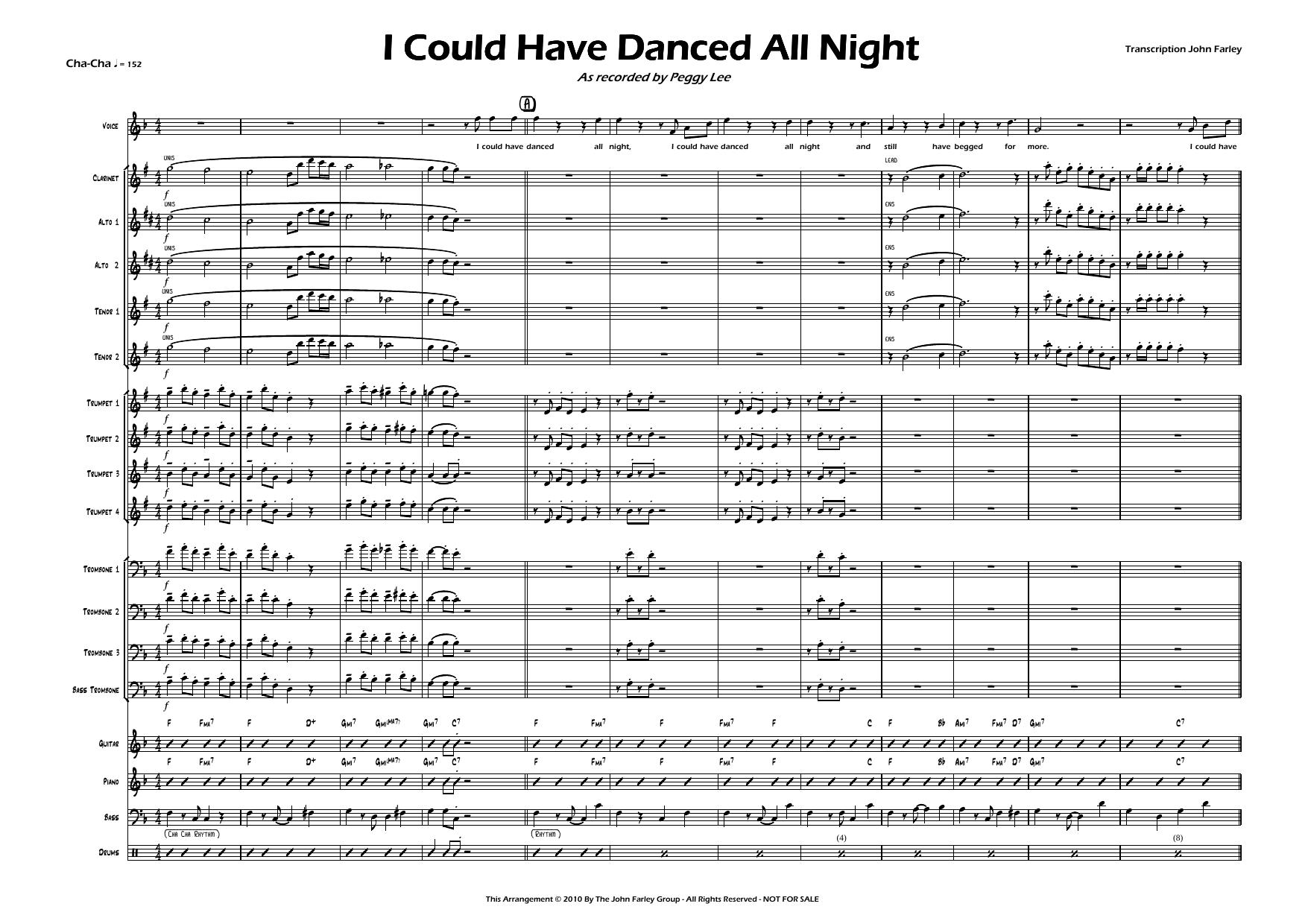
I Could Have Danced All Night (J.Farley-Peggy Lee)
Composed by Frederick Loewe
Arranged by J.Farley-Peggy Lee
- Ensemble: Big Band Vocal
- Style: Musical Theatre
- Pages: 28
- Instruments (19): Voice, Clarinet, Alto Saxophone 1, Alto Saxophone 2, Tenor Saxophone 1, Flute, Tenor Saxophone 2, Trumpet 1, Trumpet 2, Trumpet 3, Trumpet 4, Trombone 1, Trombone 2, Trombone 3, Bass Trombone, Guitar, Piano, Bass, Drums
- Difficulty: medium
- Content: Individual Parts
- Format: PDF Download (Instant)
- Price: $24.99
First introduced to the world in 1956 as a show-stopping number in Lerner and Loewe's iconic musical *My Fair Lady*, "I Could Have Danced All Night" quickly transcended its Broadway origins to become a beloved standard. Immortalized by Julie Andrews' captivating performance as Eliza Doolittle, the song encapsulates the exhilaration and romantic euphoria of new love, cementing its place in the Great American Songbook. Its soaring melodic lines and waltz-like structure, often adapted into various jazz and pop contexts, reflect the golden age of musical theatre and its enduring appeal. While not a traditional jazz standard in its original form, its harmonic richness and memorable melody have made it a fertile ground for jazz interpretation, inviting arrangers to reimagine its inherent joy within a swing framework. This particular big band vocal arrangement by J.Farley-Peggy Lee transforms the classic 3/4 waltz into an ebullient medium-up swing feel in 4/4, maintaining the original key of C Major for the vocalist. The arrangement radiates an infectious, bright, and optimistic energy, perfectly capturing the song's celebratory spirit. The musical character is one of sophisticated exuberance, blending the theatricality of the original with the polished drive of a classic big band. Listeners will be swept up by its dynamic contrasts and the sheer joy it evokes, making it an ideal choice for concerts, dances, or any occasion demanding a touch of elegance and swing. J.Farley-Peggy Lee's distinctive approach to this arrangement is immediately evident in its clever reharmonizations and the seamless integration of the vocal line with the ensemble. The arrangement opens with a driving, rhythmic introduction that establishes the swing feel, leading into the vocalist's entrance. The brass and saxophone sections engage in playful call-and-response figures and tightly voiced soli passages that propel the narrative forward without overshadowing the singer. A notable feature is the arranger's use of layered textures, building from subtle accompaniment to powerful, full-ensemble shout choruses that punctuate key lyrical phrases. The arrangement also includes a well-crafted instrumental interlude, offering a brief moment for the band to shine with a melodic soli before returning to the vocalist for the final, exhilarating chorus. The writing for the rhythm section is particularly supportive, providing a solid foundation while allowing for stylistic nuances. Performing this arrangement is a rewarding experience for both the vocalist and the ensemble. The melody is predominantly carried by the singer, requiring a strong, clear vocal presence capable of navigating the song's wide range and emotional arc. There are no extended instrumental solos, keeping the focus squarely on the vocal performance and the ensemble's collective power. Technical challenges include maintaining the consistent medium-up swing tempo, achieving precise brass attacks and releases, and executing the saxophone soli sections with tight articulation and blend. The dynamic shaping, especially in the build-ups to the shout choruses, is crucial for maximizing impact. This arrangement is well-suited for college and community big bands, as well as semi-professional ensembles looking for a vibrant and engaging vocal feature that balances tradition with a fresh, swinging perspective. Its accessible key and clear structure make it an excellent choice for developing ensembles to tackle sophisticated big band writing. This arrangement demands a consistent medium-up swing tempo, ideally around 144-152 BPM, to maintain its infectious energy. The primary technical challenge lies in achieving unified articulation and precise rhythmic placement, particularly in the brass section's punchy figures and the saxophone soli passages. Conductors should emphasize a light, driving swing feel from the rhythm section, avoiding a heavy or plodding approach. Rehearsal focus should be placed on dynamic contrasts, ensuring the ensemble builds effectively into the shout choruses without overblowing, and that the accompanying figures support rather than overpower the vocalist. Pay close attention to cut-offs and releases, especially in the brass, for a clean and professional sound. No special techniques like plungers or falls are explicitly notated, allowing for a clean, classic big band aesthetic. The vocal line requires attention to breath support and phrasing to navigate its broad melodic contours. Q: What instruments and parts are included in this arrangement? A: This arrangement includes a full big band instrumentation: 5 saxophones (AATTB), 4 trumpets, 4 trombones, guitar, piano, bass, drums, and a dedicated vocal chart. Q: What is the difficulty level of this arrangement? A: This arrangement is rated as Medium-Advanced. It requires solid ensemble playing, good rhythmic precision, and a capable vocalist with a strong range, making it suitable for college, community, and semi-professional big bands. Q: What is the musical style and historical context of this arrangement? A: This is a big band vocal arrangement of "I Could Have Danced All Night" from the 1956 musical *My Fair Lady*. While the original is a musical theatre waltz, this arrangement reinterprets it as an ebullient medium-up swing in 4/4. Q: What makes this specific arrangement unique? A: J.Farley-Peggy Lee's arrangement stands out for its clever transformation of the original 3/4 waltz into a driving 4/4 swing, featuring sophisticated reharmonizations, tightly voiced soli sections, and dynamic shout choruses that perfectly complement the vocal performance. Q: What is the approximate performance duration and recommended tempo? A: The approximate performance duration is 3:00-3:30 minutes, depending on the chosen tempo. A medium-up swing tempo of 144-152 BPM is recommended to capture the intended energetic and joyful feel.
Questions and answers
- What is included in the I Could Have Danced All Night (J.Farley-Peggy Lee) PDF?
- The verified current file contains a conductor score and individual parts across 28 pages.
- How many instruments or parts are listed for I Could Have Danced All Night (J.Farley-Peggy Lee)?
- The verified instrumentation list contains 19 entries for this Big Band Vocal arrangement.
- Who is credited for I Could Have Danced All Night (J.Farley-Peggy Lee)?
- Composer: Frederick Loewe. Arranger: J.Farley-Peggy Lee.
- What difficulty is listed for I Could Have Danced All Night (J.Farley-Peggy Lee)?
- The verified difficulty level is medium.
- What style is listed for I Could Have Danced All Night (J.Farley-Peggy Lee)?
- The catalog lists the style as Musical Theatre.
- Can I preview I Could Have Danced All Night (J.Farley-Peggy Lee) before buying?
- Yes. The product page provides a preview generated from the current PDF file.
- How is I Could Have Danced All Night (J.Farley-Peggy Lee) delivered?
- After successful payment, the digital PDF is made available for download. The displayed price is $24.99.
Musicians Also Search For
I Could Have Danced All Night J.Farley-Peggy Lee PDF • I Could Have Danced All Night J.Farley-Peggy Lee sheet music • I Could Have Danced All Night arranged by J.Farley-Peggy Lee • J.Farley-Peggy Lee big band vocal charts • J.Farley-Peggy Lee jazz arrangements PDF • I Could Have Danced All Night Frederick Loewe sheet music • I Could Have Danced All Night Frederick Loewe big band vocal arrangements • Frederick Loewe big band vocal charts • I Could Have Danced All Night big band vocal arrangements • I Could Have Danced All Night big band vocal PDF download • I Could Have Danced All Night jazz sheet music • big band vocal sheet music download • I Could Have Danced All Night conductor score PDF • I Could Have Danced All Night individual parts download • I Could Have Danced All Night sheet music PDF • I Could Have Danced All Night Musical Theatre charts • Musical Theatre big band vocal arrangements • buy I Could Have Danced All Night sheet music • download I Could Have Danced All Night PDF • I Could Have Danced All Night jazz charts • best J.Farley-Peggy Lee big band vocal arrangements • Frederick Loewe arranged by J.Farley-Peggy Lee • I Could Have Danced All Night printable sheet music • big band vocal repertoire PDF