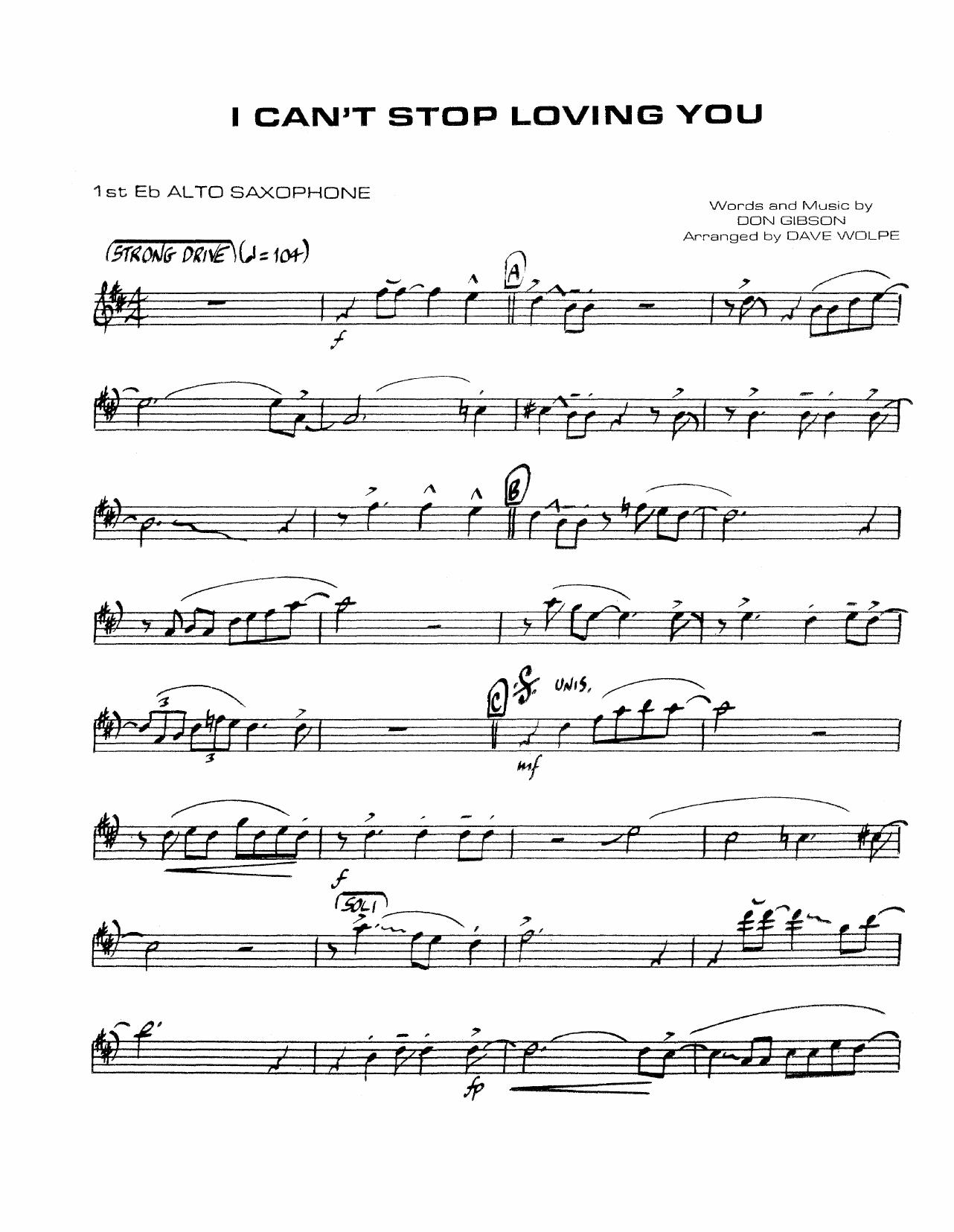
I Can't Stop Loving You (D.Wolpe)
Composed by Don Gibson
Arranged by Dave Wolpe
- Ensemble: Big Band
- Pages: 44
- Instruments (17): 1st Eb Alto Saxophone, 2nd Eb Alto Saxophone, 1st Bb Tenor Saxophone, 2nd Bb Tenor Saxophone, Eb Baritone Saxophone, 1st Bb Trumpet, 2nd Bb Trumpet, 3rd Bb Trumpet, 4th Bb Trumpet, 1st Trombone, 2nd Trombone, 3rd Trombone, Bass Trombone, Drums, Bass, Guitar, Piano
- Difficulty: medium
- Content: Individual Parts
- Format: PDF Download (Instant)
- Price: $24.99
Originally penned by country-soul pioneer Don Gibson in 1957 and catapulted into global crossover prominence by Ray Charles on his landmark 1962 album *Modern Sounds in Country and Western Music*, "I Can't Stop Loving You" stands as a monumental bridge between American roots music and timeless popular song craft. While born from the idioms of country and rhythm and blues, the melody possesses a sweeping, inherently lyrical contour that has made it an irresistible vehicle for jazz interpretation. This crossover appeal allows big bands to tap into a deeply emotional vein that standard Tin Pan Alley material sometimes misses, blending soulful vocal-like phrasing with rich, sophisticated harmonic motion. Dave Wolpe’s masterful big band adaptation recasts this beloved standard as a lush, expressive ballad with an underlying, gentle slow-swing groove. The arrangement opens with a warm, inviting harmonic palette that immediately establishes a reflective, tender mood. Wolpe expertly balances rich, contemporary jazz voicings in the brass with flowing, contrapuntal movement in the reeds, evoking the sophisticated studio stylings of mid-century West Coast arranging while retaining the raw emotional honesty of the original composition. As the chart unfolds, the dynamic swells and falls cultivate a sense of sweeping cinematic romance, shifting fluidly from intimate, exposed quartet textures to full-ensemble swells that feel both powerful and restrained. The melodic weight is shared gracefully across the ensemble, giving sections ample opportunity to shine with a singing, legato approach. A featured solo space—tailored ideally for an expressive alto saxophone or trumpet—serves as the emotional epicenter of the chart, allowing a soloist to lean into the blues-infused changes. Wolpe weaves intricate background figures behind the soloist that build organic tension without ever cluttering the texture. The arrangement culminates in a rich, warm shout chorus that relies on dynamic control and precise blend rather than sheer volume, providing a deeply satisfying emotional release before winding down into a serene, lingering coda. Advanced high school, collegiate, and community jazz orchestras will find this chart an exceptional vehicle for developing stylistic maturity, blend, and phrasing. Because the primary technical demands center on intonation, balance, and sustained breath support rather than breakneck velocity, it serves as a brilliant masterclass in musicality. Directors will appreciate how naturally the chart sits under the fingers of the players, making it an ideal choice for festival ballad slots, formal concert programs, or sophisticated club dates where connecting with the audience on an emotional level is paramount. Success with this Dave Wolpe chart hinges on the ensemble's mastery of tone quality, intonation, and subtle time-feel. Conceived around a relaxed, laid-back slow-swing tempo, the rhythm section must lock in a deep, unhurried pocket that avoids rushing the eighth-note subdivisions. Drummers should utilize a sparse, tasteful ride cymbal pattern with light hi-hat chokes on beats two and four, keeping brush work in mind for more intimate acoustic settings. The primary technical challenge lies in sustaining long, lyrical phrases without letting the dynamic level drop or pitch sag. Horn players must pay meticulous attention to balance within their sections, ensuring that internal chord voicings are tuned precisely, particularly during chromatic passing tones. Articulation should be soft and connected (rounded tongue), avoiding harsh accents unless specifically noted by Wolpe. Rehearsal should begin by having the rhythm section establish the harmonic and rhythmic foundation alone, followed by the saxophones playing their chorales strictly in tune. When integrating the brass, emphasize smooth voice-leading and dynamic shading; the emotional impact of this arrangement relies entirely on seamless crescendos and decrescendos rather than sudden volume spikes. Q: What instruments and parts are included in this big band arrangement? A: The instrumentation comprises a standard 17-piece big band setup: 2 alto saxophones, 2 tenor saxophones, 1 baritone saxophone, 4 trumpets, 4 trombones, piano, guitar, bass, and drums, alongside a comprehensive conductor score spanning 44 pages. Q: What is the difficulty level of this Dave Wolpe chart? A: This arrangement is graded as medium-easy to medium, making it highly accessible for advanced high school ensembles, college developmental bands, and community jazz orchestras looking for a rewarding ballad challenge. Q: What musical style and historical era does this piece represent? A: It is arranged in a lush jazz ballad and slow-swing style, drawing inspiration from the golden era of big band arranging and Ray Charles's legendary 1962 rhythm-and-blues interpretation of Don Gibson's country classic. Q: What makes this specific arrangement by Dave Wolpe unique? A: Wolpe expertly balances rich, sophisticated harmonic voicings with a deeply emotional, vocal-like melodic treatment, featuring lush reed-and-brass interplay and a tasteful solo vehicle without overcomplicating the foundational structure. Q: What is the performance duration and recommended tempo feel? A: While performance time varies slightly based on the length of the improvised solo and chosen rubato sections, the piece typically runs around 3.5 to 4 minutes at a relaxed, flowing slow-swing tempo.
Questions and answers
- What is included in the I Can't Stop Loving You (D.Wolpe) PDF?
- The verified current file contains a conductor score and individual parts across 44 pages.
- How many instruments or parts are listed for I Can't Stop Loving You (D.Wolpe)?
- The verified instrumentation list contains 17 entries for this Big Band arrangement.
- Who is credited for I Can't Stop Loving You (D.Wolpe)?
- Composer: Don Gibson. Arranger: Dave Wolpe.
- What difficulty is listed for I Can't Stop Loving You (D.Wolpe)?
- The verified difficulty level is medium.
- Can I preview I Can't Stop Loving You (D.Wolpe) before buying?
- Yes. The product page provides a preview generated from the current PDF file.
- How is I Can't Stop Loving You (D.Wolpe) delivered?
- After successful payment, the digital PDF is made available for download. The displayed price is $24.99.
Musicians Also Search For
I Can't Stop Loving You Dave Wolpe PDF • I Can't Stop Loving You Dave Wolpe sheet music • I Can't Stop Loving You arranged by Dave Wolpe • Dave Wolpe big band charts • Dave Wolpe jazz arrangements PDF • I Can't Stop Loving You Don Gibson sheet music • I Can't Stop Loving You Don Gibson big band arrangements • Don Gibson big band charts • I Can't Stop Loving You big band arrangements • I Can't Stop Loving You big band PDF download • I Can't Stop Loving You jazz sheet music • big band sheet music download • I Can't Stop Loving You conductor score PDF • I Can't Stop Loving You individual parts download • I Can't Stop Loving You sheet music PDF • buy I Can't Stop Loving You sheet music • download I Can't Stop Loving You PDF • I Can't Stop Loving You jazz charts • best Dave Wolpe big band arrangements • Don Gibson arranged by Dave Wolpe • I Can't Stop Loving You printable sheet music • big band repertoire PDF