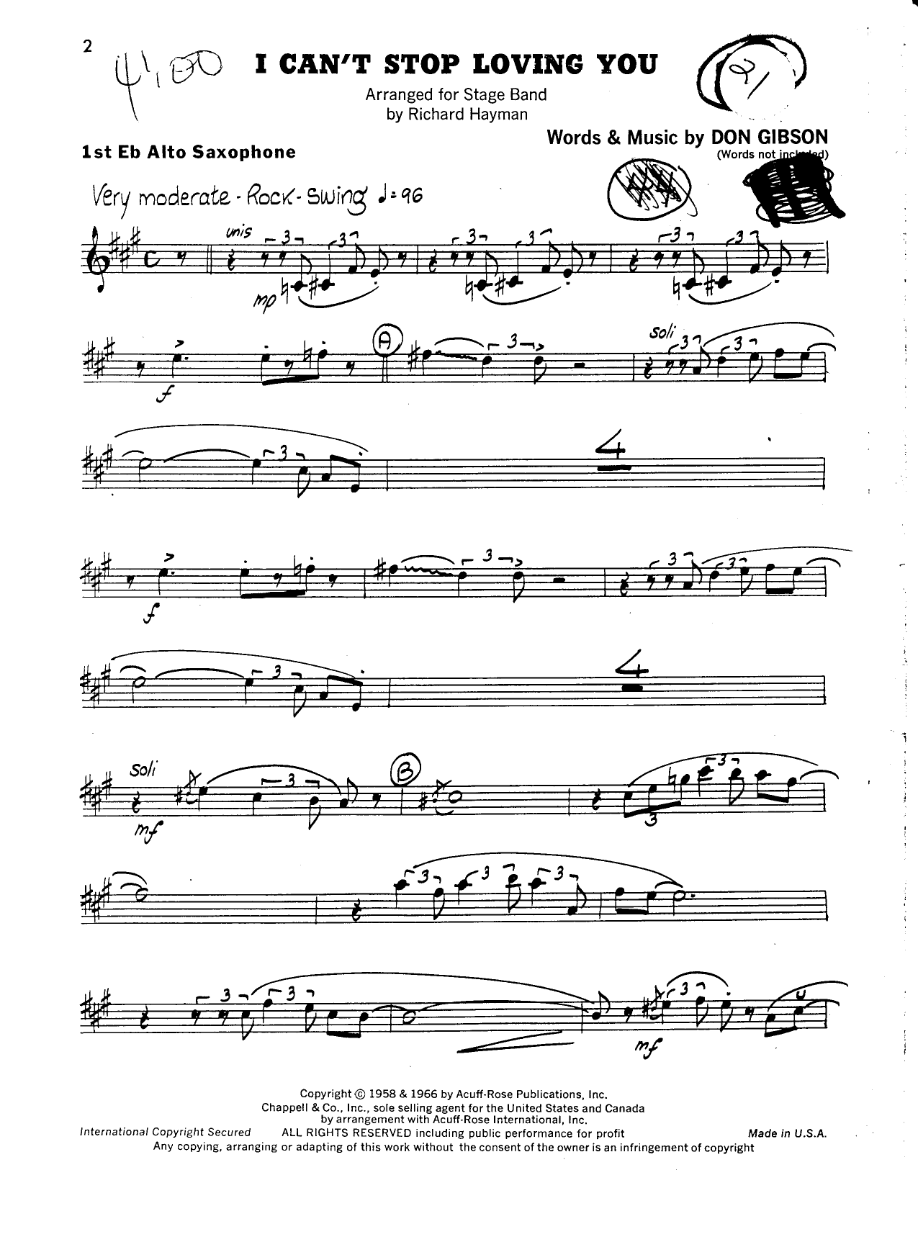
I Can't Stop Loving You (D.Wolpe)
Composed by DON GIBSON
Arranged by Dave Wolpe
- Ensemble: Small Ensemble
- Style: Jazz Standard
- Pages: 32
- Instruments (16): 1st Eb Alto Saxophone, 2nd Eb Alto Saxophone, 1st Bb Tenor Saxophone, 2nd Bb Tenor Saxophone, Eb Baritone Saxophone, 1st Bb Trumpet, 2nd Bb Trumpet, 3rd Bb Trumpet, 4th Bb Trumpet, 1st Trombone, 2nd Trombone, 3rd Trombone, 4th Trombone, Guitar, String Bass, Drums
- Difficulty: easy
- Content: Individual Parts
- Format: PDF Download (Instant)
- Price: $12.99
Originally penned by country-music icon Don Gibson in 1957 and catapulted into global superstardom by Ray Charles in his landmark 1962 album *Modern Sounds in Country and Western Music*, "I Can't Stop Loving You" occupies a fascinating intersection between American country storytelling and rhythm-and-blues sophistication. Ray Charles’s seminal rendition transformed the tune into an immortal crossover standard, fusing soulful vocal phrasing with rich, blues-inflected orchestral backing. Over the decades, the composition has been interpreted by jazz royalty, cementing its status as a versatile vehicle for expressive ballad playing and expressive swing interpretations. In this masterful small-ensemble setting, arranger Dave Wolpe adapts the timeless melody into a deeply engaging medium-swing groove that balances sophisticated harmonic coloring with an accessible, warm-hearted emotional core. Unfolding in a comfortable medium tempo, the arrangement evokes a late-night club atmosphere, blending gentle melancholic undertones with an underlying, resilient pulse. The mood shifts effortlessly from introspective, tender lyricism to rich, full-ensemble warmth, offering a masterclass in how to sustain interest and build emotional resonance within a compact instrumental framework. Dave Wolpe is renowned for his uncanny ability to craft charts that sound remarkably lush despite economical instrumentation, and this 16-page score is a prime example of his craft. Wolpe utilizes classic swing-era voicings, clever counterpoint, and subtle harmonic reharmonizations that breathe new life into Gibson’s familiar chord progression. Rather than relying on bombastic, high-energy shout choruses, Wolpe builds momentum through delicate horn intertwining, well-placed dynamic swells, and sophisticated chordal extensions that give the small ensemble a surprisingly robust, satisfying weight. Throughout the arrangement, the melodic weight is shared thoughtfully across the horns, allowing various timbres to take center stage before opening up into featured solo opportunities that invite improvisers to lean into the blues-soaked harmony. Technically, the chart prioritizes stylistic cohesion, blend, and phrasing over sheer velocity, making it an exceptional educational tool as well as a dependable crowd-pleaser for sophisticated venues. Advanced high school ensembles, collegiate combos, and professional community groups alike will find immense value here; it challenges players to refine their swing subdivision, balance dynamic levels within a tight acoustic space, and deliver a deeply communicative jazz ballad performance. Achieving the authentic feel of this arrangement requires careful attention to the medium-swing groove. The quarter-note pulse should remain steady and relaxed, avoiding any tendency to rush the backbeat. Directors should emphasize an authentic jazz articulation style: eighth notes must be swung gracefully, with articulated accents placed naturally on the offbeats (the "and" of the beat) rather than heavy tongue strokes. Key technical challenges involve blending and intonation during the harmonized horn passages, particularly when navigating Wolpe's extended chords. Players must listen across the ensemble to match vibrato width and tone color. Balance is critical; because the texture is transparent, inner voices must project their counter-melodies without overpowering the primary melodic line. No extended techniques like plunger mutes or extreme altissimo are required, allowing players to focus entirely on tone quality, dynamic control, and expressive phrasing. In rehearsal, isolate the rubato-style intro to ensure a unified collective breath and release before locking into the established tempo. Encourage soloists to reference Ray Charles’s vocal phrasing or traditional blues vocabulary, prioritizing melodic storytelling over technical display. Q: What instruments and parts are included in this small ensemble arrangement? A: Scored for a flexible jazz small-ensemble format, the 16-page publication includes standard horn parts (typically featuring a combination of saxophones, trumpets, and trombones) alongside a complete rhythm section rhythm chart with chord symbols for piano, bass, drums, and guitar. Q: What is the difficulty level of this Dave Wolpe chart? A: This arrangement is graded as medium difficulty, making it exceptionally well-suited for advanced high school jazz bands, collegiate small groups, and professional community ensembles looking for a polished, accessible swing chart. Q: What is the historical and stylistic background of this piece? A: Originally written as a country tune by Don Gibson in 1957, the song was famously reinvented as a soul-inflected crossover masterpiece by Ray Charles in 1962, inspiring this jazz standard interpretation. Q: What makes this specific arrangement by Dave Wolpe unique? A: Wolpe expertly adapts a vocal ballad into a medium-swing small-ensemble chart, utilizing lush harmonic voicings and clever counterpoint that maximize the sonic depth of a smaller horn section without overcomplicating the texture. Q: What is the approximate performance duration and tempo feel? A: The arrangement is set to a comfortable medium-swing tempo (around 108 to 116 BPM) and typically runs between 3.5 and 4.5 minutes depending on the length of the improvised solos.
Questions and answers
- What is included in the I Can't Stop Loving You (D.Wolpe) PDF?
- The verified current file contains individual parts across 32 pages.
- How many instruments or parts are listed for I Can't Stop Loving You (D.Wolpe)?
- The verified instrumentation list contains 16 entries for this Small Ensemble arrangement.
- Who is credited for I Can't Stop Loving You (D.Wolpe)?
- Composer: DON GIBSON. Arranger: Dave Wolpe.
- What difficulty is listed for I Can't Stop Loving You (D.Wolpe)?
- The verified difficulty level is easy.
- What style is listed for I Can't Stop Loving You (D.Wolpe)?
- The catalog lists the style as Jazz Standard.
- Can I preview I Can't Stop Loving You (D.Wolpe) before buying?
- Yes. The product page provides a preview generated from the current PDF file.
- How is I Can't Stop Loving You (D.Wolpe) delivered?
- After successful payment, the digital PDF is made available for download. The displayed price is $12.99.
Musicians Also Search For
I Can't Stop Loving You Dave Wolpe PDF • I Can't Stop Loving You Dave Wolpe sheet music • I Can't Stop Loving You arranged by Dave Wolpe • Dave Wolpe small ensemble charts • Dave Wolpe jazz arrangements PDF • I Can't Stop Loving You DON GIBSON sheet music • I Can't Stop Loving You DON GIBSON small ensemble arrangements • DON GIBSON small ensemble charts • I Can't Stop Loving You small ensemble arrangements • I Can't Stop Loving You small ensemble PDF download • I Can't Stop Loving You jazz sheet music • small ensemble sheet music download • I Can't Stop Loving You individual parts download • I Can't Stop Loving You sheet music PDF • I Can't Stop Loving You Jazz Standard charts • Jazz Standard small ensemble arrangements • buy I Can't Stop Loving You sheet music • download I Can't Stop Loving You PDF • I Can't Stop Loving You jazz charts • best Dave Wolpe small ensemble arrangements • DON GIBSON arranged by Dave Wolpe • I Can't Stop Loving You printable sheet music • small ensemble repertoire PDF