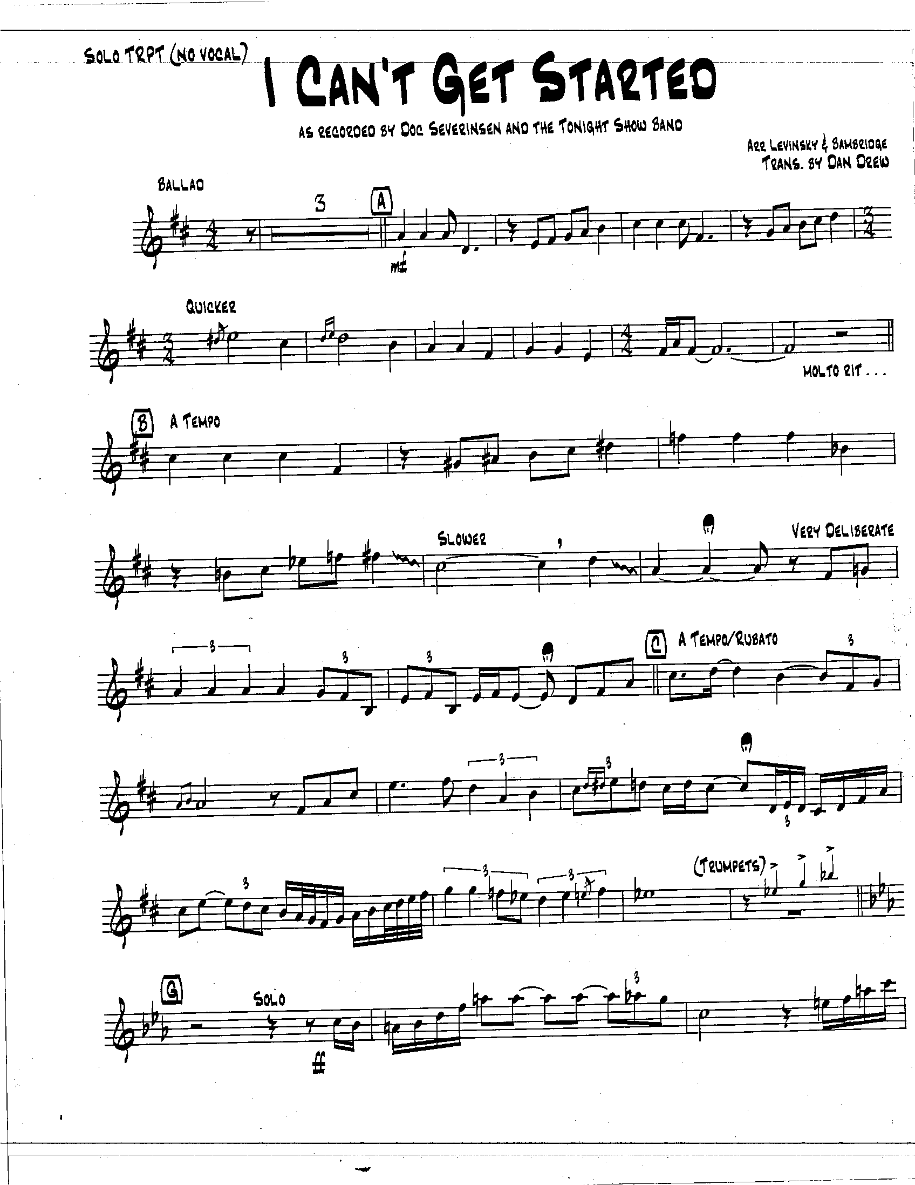
I Can't Get Started (J.Bambridge) sheet music preview

I Can't Get Started (J.Bambridge)

Composed by Vernon Duke

Arranged by Doc Severinsen

  • Ensemble: Big Band
  • Pages: 49
  • Instruments (17): Solo Trumpet, Alto Saxophone 1, Alto Saxophone 2, Tenor Saxophone 1, Tenor Saxophone 2, Baritone Saxophone, Trumpet 1, Trumpet 2, Trumpet 3, Trumpet 4, Trombone 1, Trombone 2, Trombone 3, Trombone 4, Piano, Bass, Drums
  • Difficulty: medium
  • Content: Individual Parts
  • Format: PDF Download (Instant)
  • Price: $24.99

Vernon Duke and Ira Gershwin’s timeless ballad "I Can't Get Started" entered the Great American Songbook following its introduction in the 1936 Broadway revue *Ziegfeld Follies*, quickly cementing itself as a quintessential vehicle for jazz artists. While famously popularized by Bunny Berigan—whose triumphant 1937 trumpet recording established the tune's heroic blueprint—the composition has since been interpreted by virtually every major figure in jazz, from Lester Young to Dizzy Gillespie. It represents the pinnacle of mid-1930s sophisticated songwriting, characterized by a lush harmonic framework and a narrative lyricism that invites deeply expressive, rubato-inflected soloing. Brought to life through the virtuosic lens of legendary trumpet master Doc Severinsen, this distinctive big band setting transforms the familiar standard into a tour de force of brass-led brilliance and rich, cinematic texture. Designed for an 8-instrument core ensemble (featuring Alto Saxophone, Tenor Saxophone, Baritone Saxophone, Trumpet, and Trombone), the arrangement balances intimate, chamber-like voicings with soaring, high-register climaxes. Severinsen’s signature treatment emphasizes sparkling trumpet pyrotechnics and luxurious, extended chord extensions in the lower brass and reeds, evoking the high-gloss glamour of *The Tonight Show Starring Johnny Carson* era while maintaining profound respect for the tune's romantic core. The mood shifts seamlessly from introspective, smoky balladry to brass-heavy majesty, driven by meticulous dynamic contrasts and lush harmonic shifts. At the heart of this chart is a prominent, soaring trumpet feature that demands exceptional breath support, stylistic versatility, and a commanding upper register, making it an ideal showcase for a star soloist. The accompanying horn section weaves dense, harmonically sophisticated countermelodies beneath the lead voice, requiring precise intonation and a refined sense of ensemble blend. Rather than relying on a standard, predictable big band shout chorus, Severinsen utilizes developmental, quasi-improvisational textures across the 49 pages of score and parts, where the saxophones provide warm, cushioned pads while the low brass anchor the subterranean harmonic foundations. Advanced high school groups with exceptional lead players, as well as college, community, and professional jazz ensembles, will find this arrangement an exhilarating addition to their repertoire. Because of its demanding lead trumpet requirements and the subtle interpretive maturity needed to pace the emotional arc of the ballad, it serves as a premier showcase piece for formal concerts, festivals, and gala performances. Ensembles that master its nuanced phrasing and demanding dynamic range will reward audiences with an unforgettable, deeply swinging yet deeply romantic musical experience. Conductors approaching this arrangement should treat the opening as a flexible, expressive ballad style before locking into a steady, languid swing groove where applicable. The primary technical challenge lies in the lead trumpet part, which requires immense endurance, a refined tone in the extreme upper register, and precise control over delicate, sustained pitch centers. Rhythm section players must exercise restraint; the piano and guitar should voice rootless, modern chord structures that leave ample sonic space for the horns, while the bassist utilizes a walking feel that remains deep and unhurried. Drummers should avoid busy fills during the exposed ballad sections, utilizing subtle brushwork and crisp cymbal highlights to frame the soloists. Pay meticulous attention to dynamic markings; Severinsen’s charts achieve their emotional impact through sudden subtones blooming into full-ensemble crescendos. Ensure the saxophones blend their soli passages with a unified, homogeneous tone color, avoiding excessive vibrato so the rich, contemporary voicings cut cleanly through the room without harshness. Q: What instruments and parts are included in this 49-page arrangement? A: This arrangement is scored for an 8-instrument ensemble comprising Alto Saxophone, Tenor Saxophone, Baritone Saxophone, Trumpet, Trombone, and a fully realized rhythm section, with comprehensive score and part sets spanning 49 pages. Q: What is the overall difficulty level of this chart? A: This arrangement is tailored for advanced high school, collegiate, and professional jazz ensembles, with the primary technical hurdle being the demanding, high-register lead trumpet part and the need for mature stylistic interpretation. Q: What is the historical style and background of this specific setting? A: Based on Vernon Duke’s 1936 standard, this chart reflects Doc Severinsen’s signature virtuosic and polished big band approach, bridging classic mid-century ballad traditions with high-gloss television-era brass styling. Q: What makes this Doc Severinsen arrangement unique compared to standard stock charts? A: It features sophisticated extended harmonies, lush developmental scoring across a compact 8-instrument footprint, and a distinctive focus on virtuosic brass features rather than a traditional heavy shout chorus. Q: What is the recommended performance tempo and duration for this piece? A: The arrangement is paced as an expressive ballad with rubato sections transitioning into a relaxed, expressive tempo, typically running between 4 to 5 minutes depending on the length of the improvised solos.

Questions and answers

What is included in the I Can't Get Started (J.Bambridge) PDF?
The verified current file contains individual parts across 49 pages.
How many instruments or parts are listed for I Can't Get Started (J.Bambridge)?
The verified instrumentation list contains 17 entries for this Big Band arrangement.
Who is credited for I Can't Get Started (J.Bambridge)?
Composer: Vernon Duke. Arranger: Doc Severinsen.
What difficulty is listed for I Can't Get Started (J.Bambridge)?
The verified difficulty level is medium.
Can I preview I Can't Get Started (J.Bambridge) before buying?
Yes. The product page provides a preview generated from the current PDF file.
How is I Can't Get Started (J.Bambridge) delivered?
After successful payment, the digital PDF is made available for download. The displayed price is $24.99.

Musicians Also Search For

I Can't Get Started Doc Severinsen PDFI Can't Get Started Doc Severinsen sheet musicI Can't Get Started arranged by Doc SeverinsenDoc Severinsen big band chartsDoc Severinsen jazz arrangements PDFI Can't Get Started Vernon Duke sheet musicI Can't Get Started Vernon Duke big band arrangementsVernon Duke big band chartsI Can't Get Started big band arrangementsI Can't Get Started big band PDF downloadI Can't Get Started jazz sheet musicbig band sheet music downloadI Can't Get Started individual parts downloadI Can't Get Started sheet music PDFbuy I Can't Get Started sheet musicdownload I Can't Get Started PDFI Can't Get Started jazz chartsbest Doc Severinsen big band arrangementsVernon Duke arranged by Doc SeverinsenI Can't Get Started printable sheet musicbig band repertoire PDF

All arrangements by Doc Severinsen All Vernon Duke sheet music