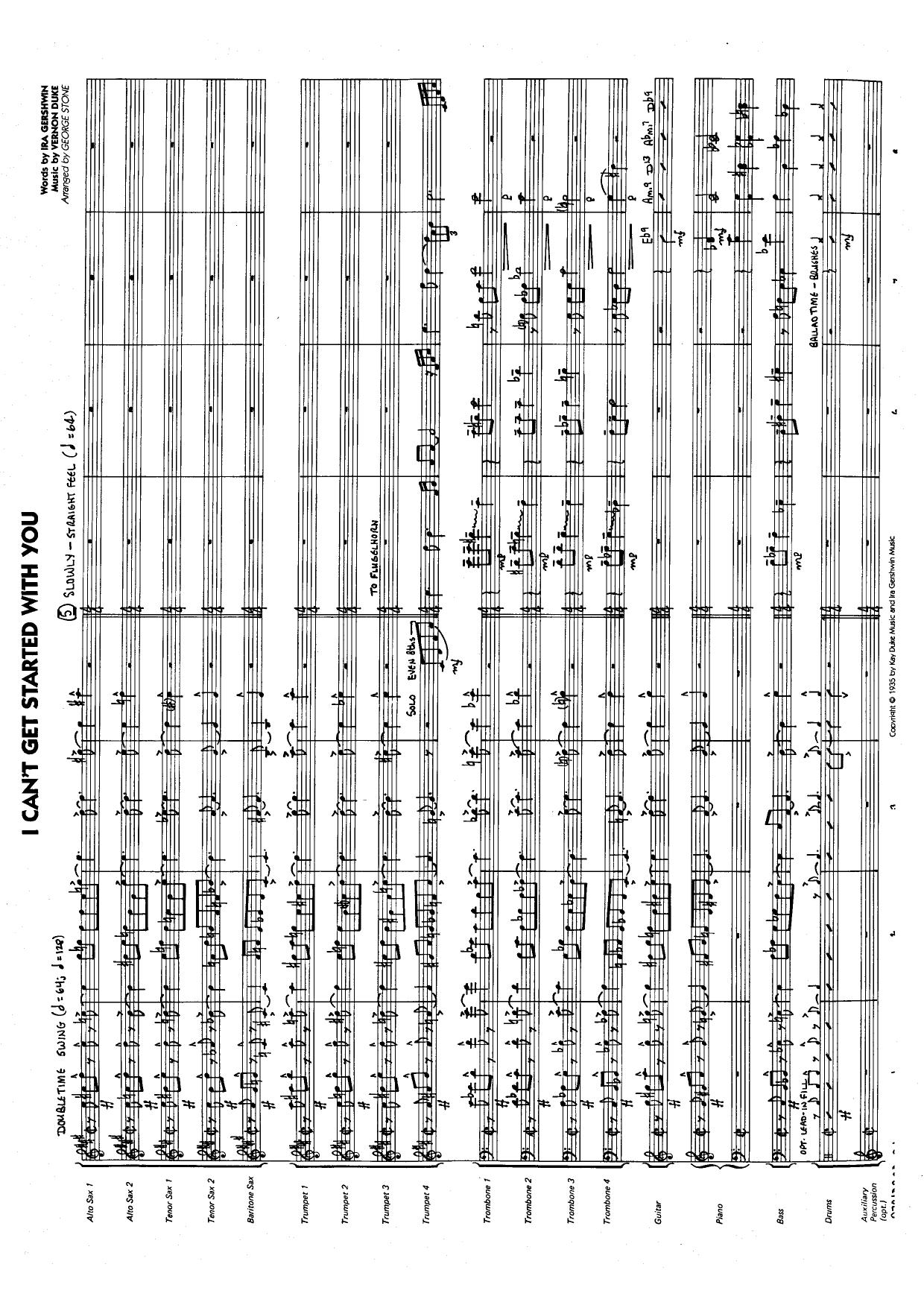
I Can't Get Started (G.Stone)
Composed by Vernon Duke
Arranged by George Stone
- Ensemble: Big Band
- Pages: 49
- Instruments (18): Alto Sax 1, Alto Sax 2, Tenor Sax 1, Tenor Sax 2, Baritone Sax, Trumpet 1, Trumpet 2, Trumpet 3, Trumpet 4, Trombone 1, Trombone 2, Trombone 3, Trombone 4, Guitar, Piano, Bass, Drums, Auxiliary Percussion
- Difficulty: medium
- Content: Individual Parts
- Format: PDF Download (Instant)
- Price: $24.99
Vernon Duke and Ira Gershwin’s immortal 1936 composition "I Can't Get Started" occupies a towering position in the Great American Songbook, forever linked to the legendary 1937 recording by Bunny Berigan that cemented its status as a quintessential jazz trumpet vehicle. Originally introduced in the Broadway revue *Ziegfeld Follies of 1936*, the tune transitioned rapidly into an essential jam-session standard, embraced by generations of jazz royalty for its sophisticated harmonic movement, bittersweet melodic contour, and rich lyrical narrative of unrequited affection. George Stone’s masterful big band adaptation reimagines this timeless classic through a sophisticated, modern compositional lens while preserving the lush, romantic melancholy of the original melody. Unfolding at a luxurious, introspective ballad tempo, the chart explores an expansive harmonic landscape characterized by luminous extended voicings, subtle chromatic inner-voice movement, and sophisticated reharmonizations. The emotional trajectory shifts seamlessly from tender vulnerability to sweeping cinematic grandeur, utilizing the full dynamic and tonal palette of the ensemble to evoke a profound sense of late-night nostalgia and expressive depth. Stone applies his signature contemporary arranging aesthetic to the 7-instrument ensemble configuration, achieving a remarkably rich and transparent texture that sounds vastly larger than the instrumentation suggests. The arrangement brilliantly exploits the unique timbral qualities of the horn section—featuring interlocking woodwind and brass lines, lush block-chord harmonies, and sparse, highly effective counterpoint. Rather than relying on a traditional dense wall of sound, Stone builds tension through meticulous voice-leading and shifting tonal centers, allowing the soloist ample room to breathe while the ensemble provides a shimmering, responsive carpet of sound. The featured soloist takes center stage early, guiding the emotional core of the performance with spacious phrasing and expressive rubato opportunities before the rhythm section locks into a steady, supportive pulse. Technically, the chart demands a high degree of maturity, refined intonation, and stylistic cohesion, making it an ideal showcase for advanced collegiate, community, or professional jazz ensembles looking to highlight a premier lead horn or pianist. The interplay between the rhythm section and the horns requires absolute sensitivity to dynamic shading, ensuring that this sophisticated treatment resonates with profound emotional impact from the opening chord to the final sustained sonority. Bringing George Stone’s sophisticated arrangement of "I Can't Get Started" to life requires meticulous attention to balance, intonation, and emotional restraint. Conceived as an expressive, slow-tempo ballad, the ensemble must avoid rushing the pulse, maintaining an internal subdivision that keeps the rubato sections fluid yet anchored. The primary technical challenge lies in executing the dense, extended-tertian harmonies with pristine intonation; horn players must actively listen across sections to lock in the upper-structure extensions without overblowing. The rhythm section plays a pivotal role in establishing the mood. The pianist should approach the comping with a delicate touch, utilizing sparse, impressionistic voicings that complement rather than crowd the soloist. Drummers should employ brushes with a subtle, heartbeat-like pulse, ensuring cymbal accents remain shimmering and understated. Rehearsals should initially focus on sectional blend and dynamic control, particularly during the transition points between exposed solo passages and full ensemble swells. Encourage the featured soloist to treat the melody with vocal-like inflection, mirroring the bittersweet storytelling inherent in Ira Gershwin's iconic lyric. Q: What specific instruments and parts are included in this arrangement? A: This arrangement is scored for a 7-instrument ensemble configuration consisting of Alto Saxophone, Tenor Saxophone, Trumpet, Trombone, Piano, and rhythm section support, contained within a comprehensive 49-page score and part set. Q: What is the designated difficulty level for this chart? A: This piece is tailored for advanced high school, collegiate, community, and professional jazz ensembles due to its sophisticated extended harmonies, subtle dynamic demands, and requirement for mature stylistic interpretation. Q: What musical style and historical context does this arrangement inhabit? A: Rooted in the Great American Songbook tradition, this chart reimagines Vernon Duke’s 1936 standard through a contemporary jazz lens, balancing traditional ballad pacing with modern compositional voicings. Q: What makes George Stone's treatment of this standard unique? A: Stone achieves an impressively full, cinematic soundscape using a streamlined 7-instrument instrumentation, utilizing transparent textures, luminous reharmonizations, and intricate voice-leading instead of standard dense big band scoring. Q: What is the performance duration and tempo feel of this arrangement? A: The arrangement is structured as a lush, expressive ballad performed at a slow, reflective tempo, allowing approximately 4 to 5 minutes of concert performance time depending on solo extensions.
Questions and answers
- What is included in the I Can't Get Started (G.Stone) PDF?
- The verified current file contains a conductor score and individual parts across 49 pages.
- How many instruments or parts are listed for I Can't Get Started (G.Stone)?
- The verified instrumentation list contains 18 entries for this Big Band arrangement.
- Who is credited for I Can't Get Started (G.Stone)?
- Composer: Vernon Duke. Arranger: George Stone.
- What difficulty is listed for I Can't Get Started (G.Stone)?
- The verified difficulty level is medium.
- Can I preview I Can't Get Started (G.Stone) before buying?
- Yes. The product page provides a preview generated from the current PDF file.
- How is I Can't Get Started (G.Stone) delivered?
- After successful payment, the digital PDF is made available for download. The displayed price is $24.99.
Musicians Also Search For
I Can't Get Started George Stone PDF • I Can't Get Started George Stone sheet music • I Can't Get Started arranged by George Stone • George Stone big band charts • George Stone jazz arrangements PDF • I Can't Get Started Vernon Duke sheet music • I Can't Get Started Vernon Duke big band arrangements • Vernon Duke big band charts • I Can't Get Started big band arrangements • I Can't Get Started big band PDF download • I Can't Get Started jazz sheet music • big band sheet music download • I Can't Get Started conductor score PDF • I Can't Get Started individual parts download • I Can't Get Started sheet music PDF • buy I Can't Get Started sheet music • download I Can't Get Started PDF • I Can't Get Started jazz charts • best George Stone big band arrangements • Vernon Duke arranged by George Stone • I Can't Get Started printable sheet music • big band repertoire PDF