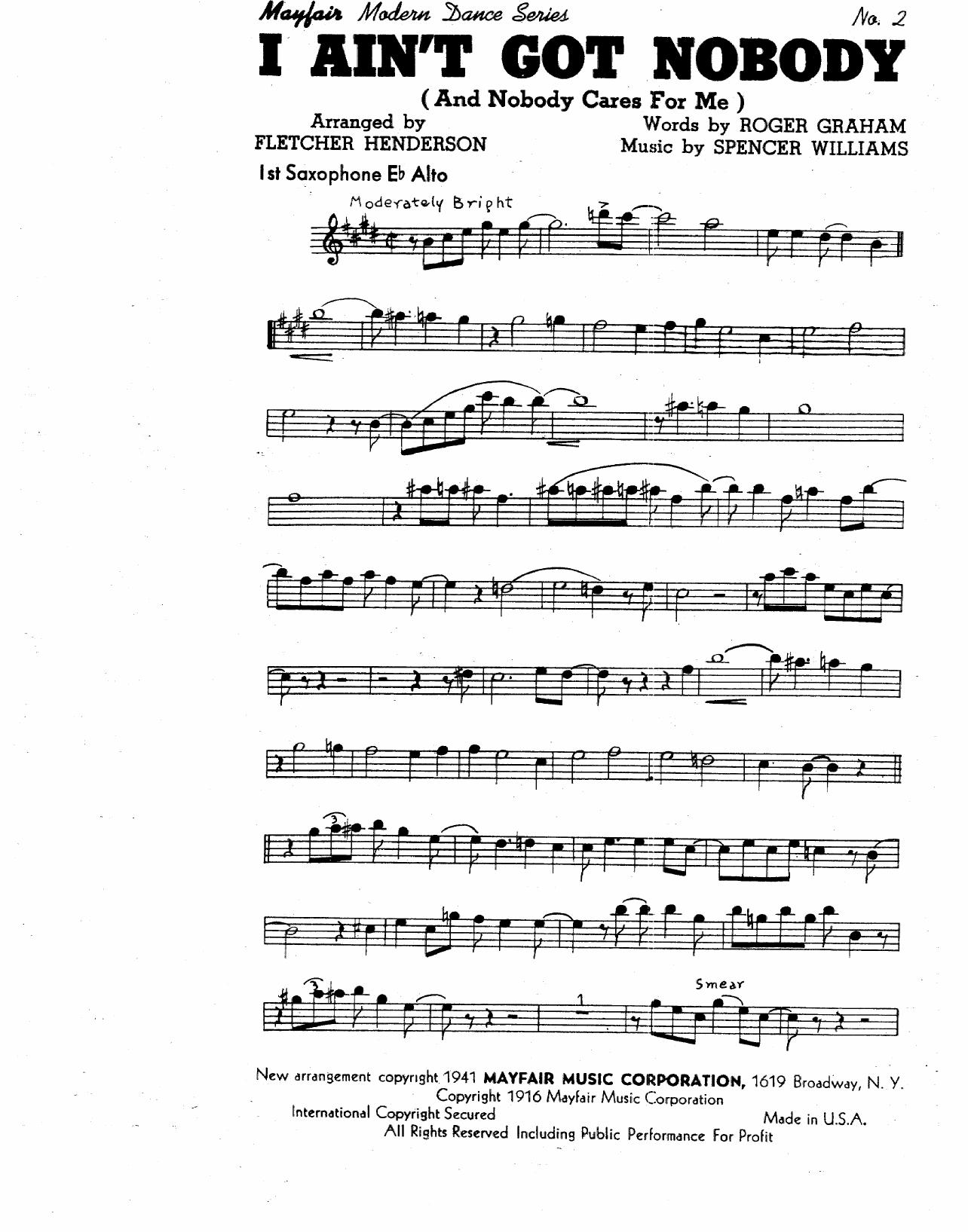
I Ain't Got Nobody (F.Henderson)
Composed by Spencer Williams
Arranged by Fletcher Henderson
- Ensemble: Big Band
- Pages: 31
- Instruments (15): 1st Saxophone Eb Alto, 3rd Saxophone Eb Alto, 2nd Saxophone Bb Tenor, 4th Sax. Bb Tenor, 1st Trumpet in Bb, 2nd Trumpet in Bb, 3rd Trumpet in Bb, 1st Trombone, 2nd Trombone, Drums, Bass, 1st Violins B-C, 1st Violin A, Guitar, Piano
- Difficulty: medium
- Content: Individual Parts
- Format: PDF Download (Instant)
- Price: $24.99
Spencer Williams penned "I Ain't Got Nobody" in 1915, but it was Fletcher Henderson’s revolutionary 1926 Victor recording that permanently cemented the tune as a cornerstone of early jazz and big band literature. Emerging during the height of the Harlem Renaissance, Henderson’s orchestra pioneered the blueprint for swing era arranging, transforming small-group ragtime and blues sensibilities into a sophisticated, section-oriented orchestral art form. This timeless standard balances an underlying melancholic blues yearning with an irrepressible, driving rhythmic momentum that defined the transition from New Orleans polyphony to the birth of the modern big band. Operating at a brisk, buoyant medium-swing tempo in 4/4 time, this arrangement exudes the confident, dance-hall sophistication characteristic of the Roseland Ballroom era. The mood shifts fluidly between sultry, muted brass statements and exuberant, full-ensemble climaxes. Henderson’s scoring relies on call-and-response dynamics, pitting conversational reed lines against biting brass punctuations. The harmonic language stays rooted in classic early swing changes, utilizing rich, tertian extensions, driving walking basslines, and tightly woven chordal clusters that give the ensemble a remarkably dense, driving acoustic footprint despite its historical origins. Henderson approaches the form through masterclass section-writing, masterfully balancing textural variety across the 12-instrument ensemble. The arrangement features hallmark Henderson devices: harmonized reed solis that double the melody at tight intervals, contrasting plunger-muted brass countermelodies, and a tightly coiled shout chorus that builds relentless tension before releasing into a roaring ensemble tutti. Rather than relying on extended, modern modal explorations, the arrangement creates excitement through rhythmic displacement, anticipations, and masterful section interplay, showcasing how Henderson utilized simple thematic material to build architectural grandeur. Carrying the melodic weight is a shared responsibility, passing seamlessly from lead trumpet and clarinets to robust trombone counterlines. Solo opportunities are integrated organically to let individual players shine within the vintage idiom, requiring a strong command of early swing phrasing, ghost notes, and stylistic articulation. Technical challenges lie primarily in stylistic authenticity rather than extreme range; success depends on achieving a unified, lightweight swing eighth-note feel, crisp section articulation, and precise dynamic control. Advanced high school, collegiate, and professional jazz orchestras will find this chart an immensely rewarding study in historical big band architecture, offering audiences an authentic slice of 1920s jazz royalty. Recreating Fletcher Henderson's authentic 1920s aesthetic demands strict attention to articulation and stylistic phrasing. The tempo should remain a steady, driving medium-swing feel—avoid rushing the upbeats, as the rhythmic engine relies entirely on a relaxed, behind-the-beat quarter-note pulse. Brass players should master the use of cup and bucket mutes where indicated, ensuring a warm, vocal quality that blends rather than pierces. Key technical challenges involve executing the rapid, interlocking reed solis with absolute uniformity in phrasing and vibrato. Avoid modern, heavy bebop accents; instead, lean toward a lighter, bouncy swing articulation with distinct separation on eighth-note passages. Directors should rehearse the ensemble in sections first, paying meticulous attention to balance during the call-and-response passages between the brass and reeds. Ensure the rhythm section maintains an unburdened, acoustic-style pulse reminiscent of early jazz rhythm guitars and string bass or early tuba approaches, keeping the texture transparent and danceable. Q: What instruments and parts are included in this 12-instrument big band arrangement? A: The instrumentation comprises a 12-piece setup featuring three trumpets, two trombones, reed sections including clarinets and saxophones, and a full rhythm section (piano, bass, and drums) matching Henderson's classic mid-1920s recording lineup. Q: What is the difficulty level of this Fletcher Henderson arrangement? A: This arrangement is graded as intermediate to advanced (approximately Grade 4), primarily due to the stylistic demands of early swing phrasing, ensemble blend, and stylistic articulation rather than extreme technical range requirements. Q: What is the historical context and musical style of "I Ain't Got Nobody"? A: Composed originally by Spencer Williams in 1915, this chart reflects Fletcher Henderson's pioneering 1926 big band style, which laid the crucial structural foundation for the entire 1930s swing era through sophisticated section writing and driving dance tempos. Q: What makes this particular arrangement unique? A: It showcases Henderson’s signature arranging hallmarks, including harmonized reed solis, plunger-muted brass counter-melodies, and a brilliantly constructed shout chorus that transforms a simple blues-infused standard into a masterclass of early jazz orchestration. Q: What is the performance duration and recommended tempo for this piece? A: The arrangement typically runs around 3 to 4 minutes in duration when performed at the recommended bright medium-swing tempo of approximately 144 to 152 beats per minute.
Questions and answers
- What is included in the I Ain't Got Nobody (F.Henderson) PDF?
- The verified current file contains individual parts across 31 pages.
- How many instruments or parts are listed for I Ain't Got Nobody (F.Henderson)?
- The verified instrumentation list contains 15 entries for this Big Band arrangement.
- Who is credited for I Ain't Got Nobody (F.Henderson)?
- Composer: Spencer Williams. Arranger: Fletcher Henderson.
- What difficulty is listed for I Ain't Got Nobody (F.Henderson)?
- The verified difficulty level is medium.
- Can I preview I Ain't Got Nobody (F.Henderson) before buying?
- Yes. The product page provides a preview generated from the current PDF file.
- How is I Ain't Got Nobody (F.Henderson) delivered?
- After successful payment, the digital PDF is made available for download. The displayed price is $24.99.
Musicians Also Search For
I Ain't Got Nobody Fletcher Henderson PDF • I Ain't Got Nobody Fletcher Henderson sheet music • I Ain't Got Nobody arranged by Fletcher Henderson • Fletcher Henderson big band charts • Fletcher Henderson jazz arrangements PDF • I Ain't Got Nobody Spencer Williams sheet music • I Ain't Got Nobody Spencer Williams big band arrangements • Spencer Williams big band charts • I Ain't Got Nobody big band arrangements • I Ain't Got Nobody big band PDF download • I Ain't Got Nobody jazz sheet music • big band sheet music download • I Ain't Got Nobody individual parts download • I Ain't Got Nobody sheet music PDF • buy I Ain't Got Nobody sheet music • download I Ain't Got Nobody PDF • I Ain't Got Nobody jazz charts • best Fletcher Henderson big band arrangements • Spencer Williams arranged by Fletcher Henderson • I Ain't Got Nobody printable sheet music • big band repertoire PDF